Nat Commun. 2018 May 15;9(1):1925. doi: 10.1038/s41467-018-04011-3.
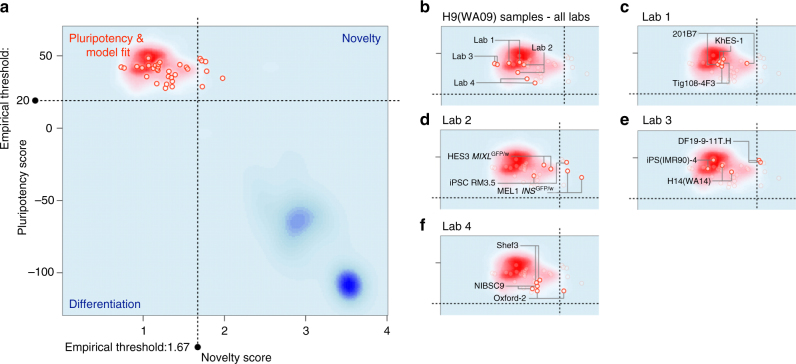
The International Stem Cell Initiative compared several commonly used approaches to assess human pluripotent stem cells (PSC). PluriTest predicts pluripotency through bioinformatic analysis of the transcriptomes of undifferentiated cells, whereas, embryoid body (EB) formation in vitro and teratoma formation in vivo provide direct tests of differentiation. Here we report that EB assays, analyzed after differentiation under neutral conditions and under conditions promoting differentiation to ectoderm, mesoderm, or endoderm lineages, are sufficient to assess the differentiation potential of PSCs. However, teratoma analysis by histologic examination and by TeratoScore, which estimates differential gene expression in each tumor, not only measures differentiation but also allows insight into a PSC's malignant potential. Each of the assays can be used to predict pluripotent differentiation potential but, at this stage of assay development, only the teratoma assay provides an assessment of pluripotency and malignant potential, which are both relevant to the pre-clinical safety assessment of PSCs.
国际干细胞倡议组织比较了几种常用于评估人类多能干细胞(PSC)的方法。PluriTest 通过对未分化细胞转录组的生物信息学分析来预测多能性,而体外胚状体(EB)形成和体内畸胎瘤形成则提供了分化的直接测试。在这里,我们报告说,在中性条件和促进向外胚层、中胚层或内胚层谱系分化的条件下进行分化后分析的 EB 测定足以评估 PSCs 的分化潜能。然而,通过组织学检查和 TeratoScore 分析畸胎瘤,后者估计每个肿瘤中的差异基因表达,不仅可以测量分化,还可以深入了解 PSC 的恶性潜能。每种测定方法都可用于预测多能性分化潜能,但在测定开发的现阶段,只有畸胎瘤测定法可用于评估多能性和恶性潜能,这两者都与 PSCs 的临床前安全性评估相关。