Department of Cell and Molecular Biology, Uppsala University, Uppsala, Sweden.
Nat Chem Biol. 2018 Jun;14(6):618-626. doi: 10.1038/s41589-018-0063-y. Epub 2018 May 16.
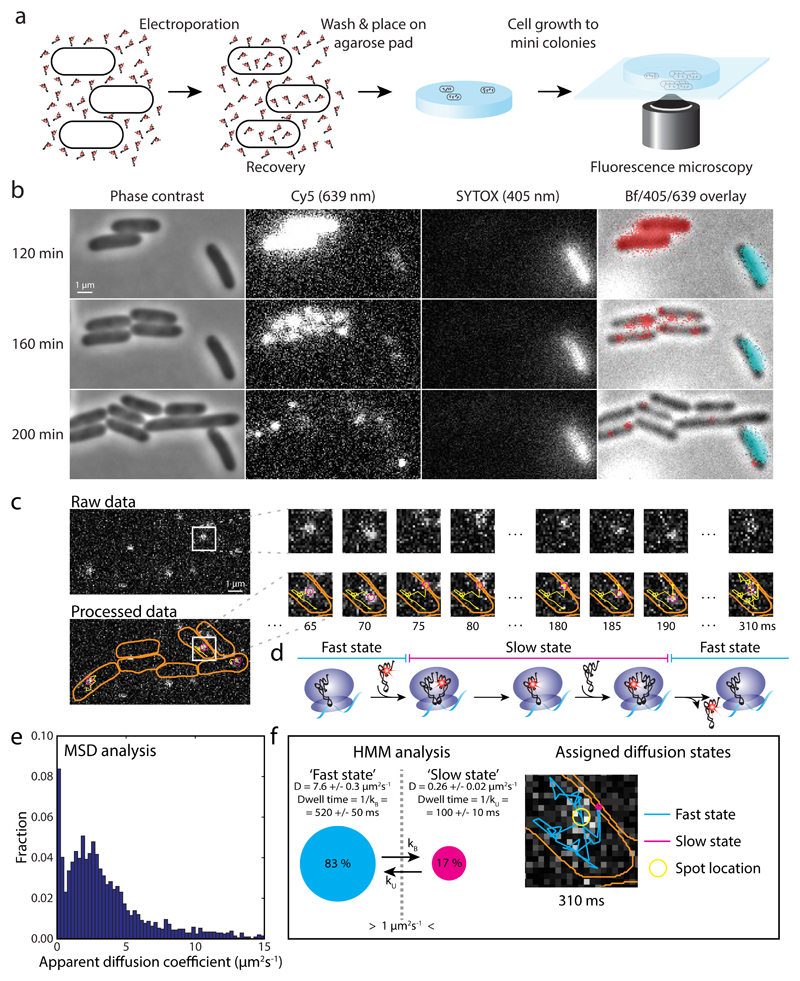
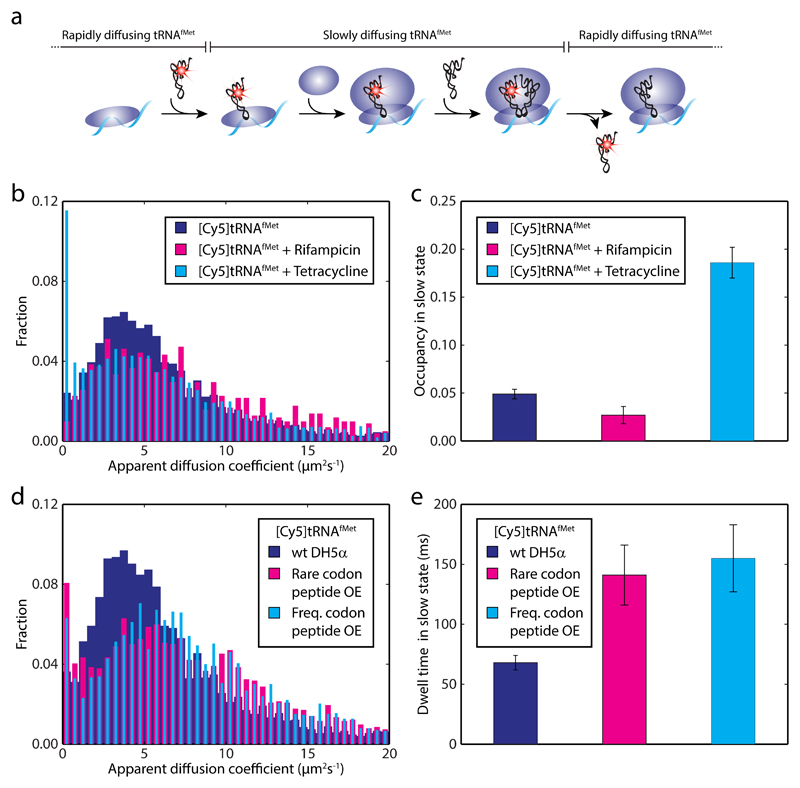
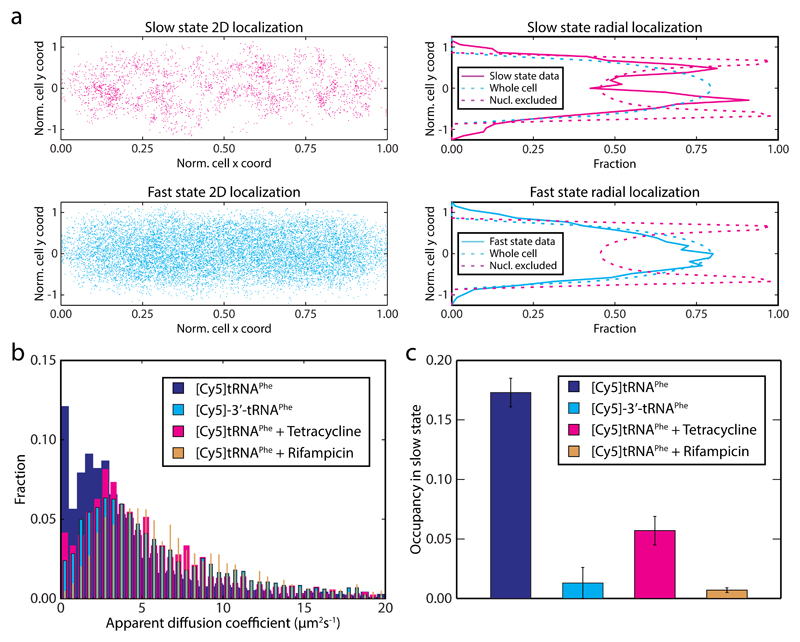
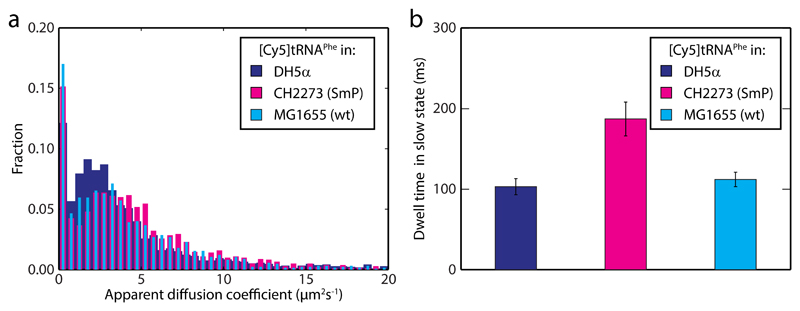
Our ability to directly relate results from test-tube biochemical experiments to the kinetics in living cells is very limited. Here we present experimental and analytical tools to directly study the kinetics of fast biochemical reactions in live cells. Dye-labeled molecules are electroporated into bacterial cells and tracked using super-resolved single-molecule microscopy. Trajectories are analyzed by machine-learning algorithms to directly monitor transitions between bound and free states. In particular, we measure the dwell time of tRNAs on ribosomes, and hence achieve direct measurements of translation rates inside living cells at codon resolution. We find elongation rates with tRNA that are in perfect agreement with previous indirect estimates, and once fMet-tRNA has bound to the 30S ribosomal subunit, initiation of translation is surprisingly fast and does not limit the overall rate of protein synthesis. The experimental and analytical tools for direct kinetics measurements in live cells have applications far beyond bacterial protein synthesis.
我们将试管生化实验的结果与活细胞中的动力学直接关联的能力非常有限。在这里,我们提出了实验和分析工具,以直接研究活细胞中快速生化反应的动力学。用荧光染料标记的分子通过电穿孔导入细菌细胞,并使用超分辨单分子显微镜进行跟踪。通过机器学习算法对轨迹进行分析,以直接监测结合态和游离态之间的转变。特别是,我们测量了 tRNA 在核糖体上的停留时间,从而可以直接在密码子分辨率下测量活细胞内的翻译速率。我们发现,tRNA 的延伸速率与之前的间接估计值完全一致,并且一旦 fMet-tRNA 结合到 30S 核糖体亚基上,翻译的起始速度非常快,不会限制蛋白质合成的整体速率。这些用于活细胞中直接动力学测量的实验和分析工具的应用远远超出了细菌蛋白质合成。