Schmitz M Lienhard, Shaban M Samer, Albert B Vincent, Gökçen Anke, Kracht Michael
Institute of Biochemistry, Justus Liebig University Giessen, D-35392 Giessen, Germany.
Rudolf-Buchheim-Institute of Pharmacology, Justus Liebig University Giessen, D-35392 Giessen, Germany.
Biomedicines. 2018 May 16;6(2):58. doi: 10.3390/biomedicines6020058.
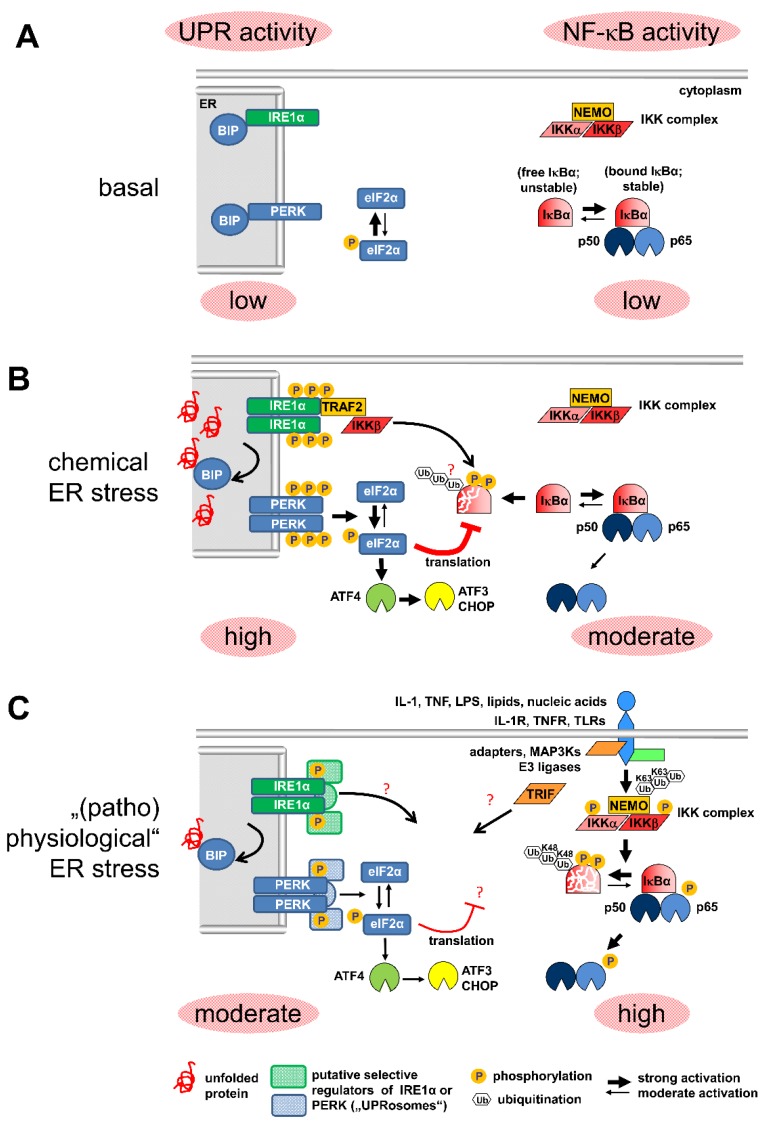
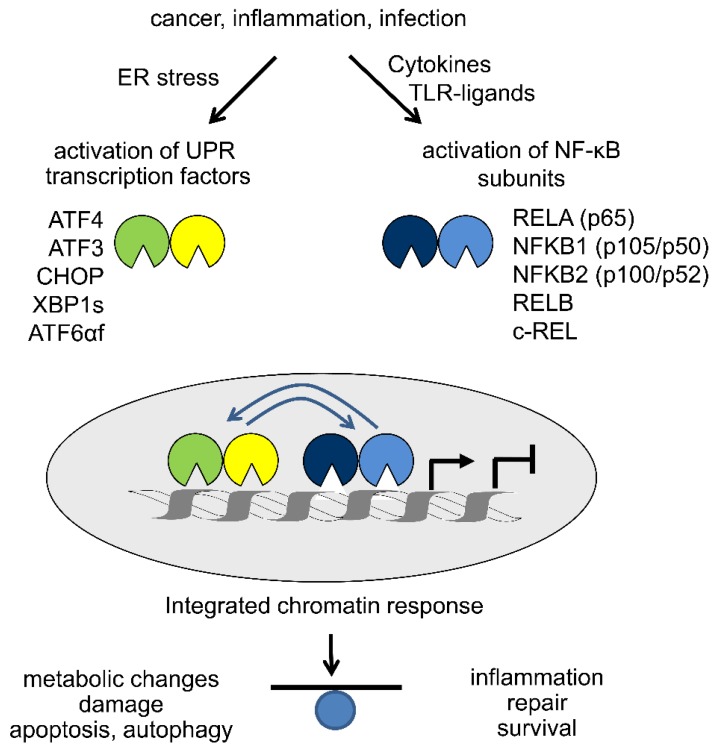
Stressful conditions occuring during cancer, inflammation or infection activate adaptive responses that are controlled by the unfolded protein response (UPR) and the nuclear factor of kappa light polypeptide gene enhancer in B-cells (NF-κB) signaling pathway. These systems can be triggered by chemical compounds but also by cytokines, toll-like receptor ligands, nucleic acids, lipids, bacteria and viruses. Despite representing unique signaling cascades, new data indicate that the UPR and NF-κB pathways converge within the nucleus through ten major transcription factors (TFs), namely activating transcription factor (ATF)4, ATF3, CCAAT/enhancer-binding protein (CEBP) homologous protein (CHOP), X-box-binding protein (XBP)1, ATF6α and the five NF-κB subunits. The combinatorial occupancy of numerous genomic regions (enhancers and promoters) coordinates the transcriptional activation or repression of hundreds of genes that collectively determine the balance between metabolic and inflammatory phenotypes and the extent of apoptosis and autophagy or repair of cell damage and survival. Here, we also discuss results from genetic experiments and chemical activators of endoplasmic reticulum (ER) stress that suggest a link to the cytosolic inhibitor of NF-κB (IκB)α degradation pathway. These data show that the UPR affects this major control point of NF-κB activation through several mechanisms. Taken together, available evidence indicates that the UPR and NF-κB interact at multiple levels. This crosstalk provides ample opportunities to fine-tune cellular stress responses and could also be exploited therapeutically in the future.
癌症、炎症或感染期间出现的应激条件会激活由未折叠蛋白反应(UPR)和B细胞中κ轻链多肽基因增强子的核因子(NF-κB)信号通路控制的适应性反应。这些系统不仅可以由化合物触发,也可以由细胞因子、Toll样受体配体、核酸、脂质、细菌和病毒触发。尽管代表着独特的信号级联反应,但新数据表明,UPR和NF-κB通路通过十种主要转录因子(TFs)在细胞核内汇聚,即激活转录因子(ATF)4、ATF3、CCAAT/增强子结合蛋白(CEBP)同源蛋白(CHOP)、X盒结合蛋白(XBP)1、ATF6α和五个NF-κB亚基。众多基因组区域(增强子和启动子)的组合占据协调了数百个基因的转录激活或抑制,这些基因共同决定了代谢和炎症表型之间的平衡以及细胞凋亡和自噬的程度,或细胞损伤修复和存活的程度。在这里,我们还讨论了来自遗传实验和内质网(ER)应激化学激活剂的结果,这些结果表明与NF-κB胞质抑制剂(IκB)α降解途径存在联系。这些数据表明,UPR通过多种机制影响NF-κB激活的这一主要控制点。综上所述,现有证据表明UPR和NF-κB在多个层面相互作用。这种相互作用为微调细胞应激反应提供了充足的机会,并且在未来也可用于治疗。