Cho Jungnam
The Sainsbury Laboratory, University of Cambridge, Cambridge, United Kingdom.
Front Plant Sci. 2018 May 3;9:600. doi: 10.3389/fpls.2018.00600. eCollection 2018.
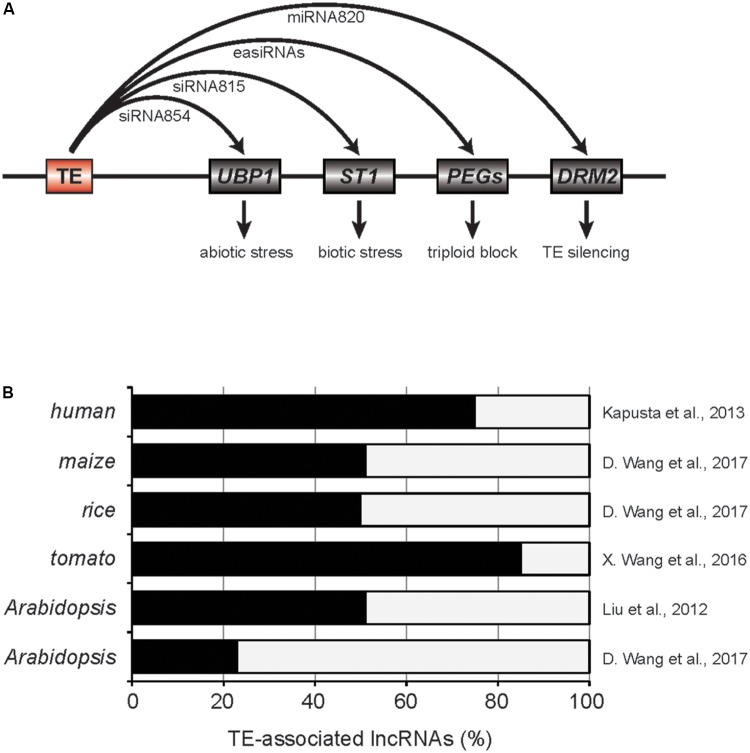
Transposable elements (TEs) are often regarded as harmful genomic factors and indeed they are strongly suppressed by the epigenetic silencing mechanisms. On the other hand, the mobilization of TEs brings about variability of genome and transcriptome which are essential in the survival and evolution of the host species. The vast majority of such controlling TEs influence the neighboring genes in by either promoting or repressing the transcriptional activities. Although TEs are highly repetitive in the genomes and transcribed in specific stress conditions or developmental stages, the -acting regulatory roles of TE-derived RNAs have been rarely studied. It was only recently that TEs were investigated for their regulatory roles as a form of RNA. Particularly in plants, TEs are ample source of small RNAs such as small interfering (si) RNAs and micro (mi) RNAs. Those TE-derived small RNAs have potentials to affect non-TE transcripts by sequence complementarity, thereby generating novel gene regulatory networks including stress resistance and hybridization barrier. Apart from the small RNAs, a number of long non-coding RNAs (lncRNAs) are originated from TEs in plants. For example, a retrotransposon-derived lncRNA expressed in rice root acts as a decoy RNA or miRNA target mimic which negatively controls miRNA171. The post-transcriptional suppression of miRNA171 in roots ensures the stabilization of the target transcripts encoding SCARECROW-LIKE transcription factors, the key regulators of root development. In this review article, the recent discoveries of the regulatory roles of TE-derived RNAs in plants will be highlighted.
转座元件(TEs)通常被视为有害的基因组因子,事实上它们受到表观遗传沉默机制的强烈抑制。另一方面,TEs的移动会导致基因组和转录组的变异,这对宿主物种的生存和进化至关重要。绝大多数这类调控TEs通过促进或抑制转录活性来影响邻近基因。尽管TEs在基因组中高度重复,并在特定的胁迫条件或发育阶段转录,但源自TE的RNA的顺式作用调控作用却很少被研究。直到最近,人们才开始研究TEs作为一种RNA形式的调控作用。特别是在植物中,TEs是小干扰RNA(siRNAs)和微小RNA(miRNAs)等小RNA的丰富来源。那些源自TE的小RNA有可能通过序列互补影响非TE转录本,从而产生包括抗逆性和杂交障碍在内的新型基因调控网络。除了小RNA外,植物中还有许多长链非编码RNA(lncRNAs)源自TEs。例如,水稻根中表达的一种逆转座子衍生的lncRNA作为诱饵RNA或miRNA靶标模拟物,对miRNA171起负调控作用。根中miRNA171的转录后抑制确保了编码SCARECROW-LIKE转录因子(根发育的关键调节因子)的靶转录本的稳定性。在这篇综述文章中,将重点介绍植物中源自TE的RNA调控作用的最新发现。