• 文献检索
  • 文档翻译
  • 深度研究
  • 学术资讯
  • Suppr Zotero 插件Zotero 插件
  • 邀请有礼
  • 套餐&价格
  • 历史记录
应用&插件
Suppr Zotero 插件Zotero 插件浏览器插件Mac 客户端Windows 客户端微信小程序
定价
高级版会员购买积分包购买API积分包
服务
文献检索文档翻译深度研究API 文档MCP 服务
关于我们
关于 Suppr公司介绍联系我们用户协议隐私条款
关注我们

Suppr 超能文献

核心技术专利:CN118964589B侵权必究
粤ICP备2023148730 号-1Suppr @ 2026

文献检索

告别复杂PubMed语法,用中文像聊天一样搜索,搜遍4000万医学文献。AI智能推荐,让科研检索更轻松。

立即免费搜索

文件翻译

保留排版,准确专业,支持PDF/Word/PPT等文件格式,支持 12+语言互译。

免费翻译文档

深度研究

AI帮你快速写综述,25分钟生成高质量综述,智能提取关键信息,辅助科研写作。

立即免费体验

基于科学的方法对人工林中的减排进行可靠核算。

Science-based approach for credible accounting of mitigation in managed forests.

作者信息

Grassi Giacomo, Pilli Roberto, House Jo, Federici Sandro, Kurz Werner A

机构信息

Giacomo Grassi, European Commission, Joint Research Centre, 21027, Ispra, VA, Italy.

Roberto Pilli, European Commission, Joint Research Centre, 21027, Ispra, VA, Italy.

出版信息

Carbon Balance Manag. 2018 May 17;13(1):8. doi: 10.1186/s13021-018-0096-2.

DOI:10.1186/s13021-018-0096-2
PMID:29774443
原文链接:https://pmc.ncbi.nlm.nih.gov/articles/PMC5957018/
Abstract

BACKGROUND

The credibility and effectiveness of country climate targets under the Paris Agreement requires that, in all greenhouse gas (GHG) sectors, the accounted mitigation outcomes reflect genuine deviations from the type and magnitude of activities generating emissions in the base year or baseline. This is challenging for the forestry sector, as the future net emissions can change irrespective of actual management activities, because of age-related stand dynamics resulting from past management and natural disturbances. The solution implemented under the Kyoto Protocol (2013-2020) was accounting mitigation as deviation from a projected (forward-looking) "forest reference level", which considered the age-related dynamics but also allowed including the assumed future implementation of approved policies. This caused controversies, as unverifiable counterfactual scenarios with inflated future harvest could lead to credits where no change in management has actually occurred, or conversely, failing to reflect in the accounts a policy-driven increase in net emissions. Instead, here we describe an approach to set reference levels based on the projected continuation of documented historical forest management practice, i.e. reflecting age-related dynamics but not the future impact of policies. We illustrate a possible method to implement this approach at the level of the European Union (EU) using the Carbon Budget Model.

RESULTS

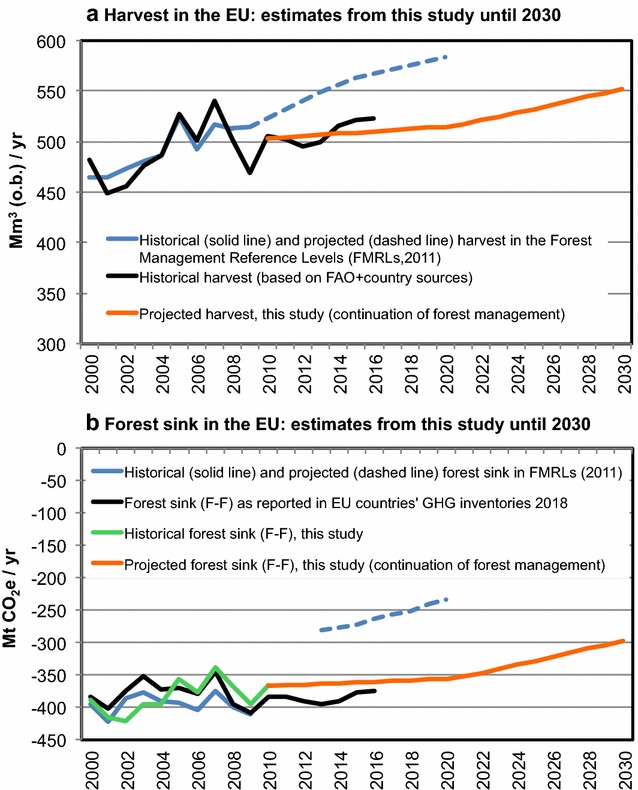
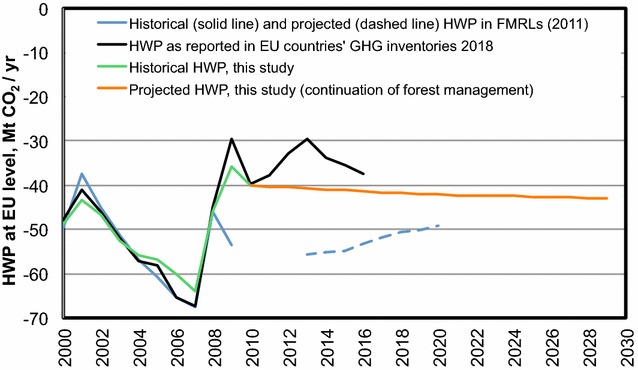
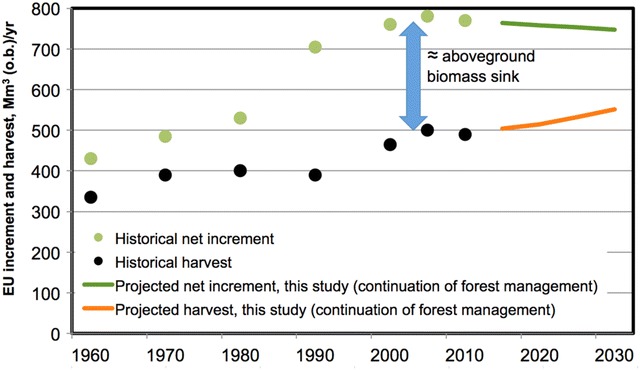
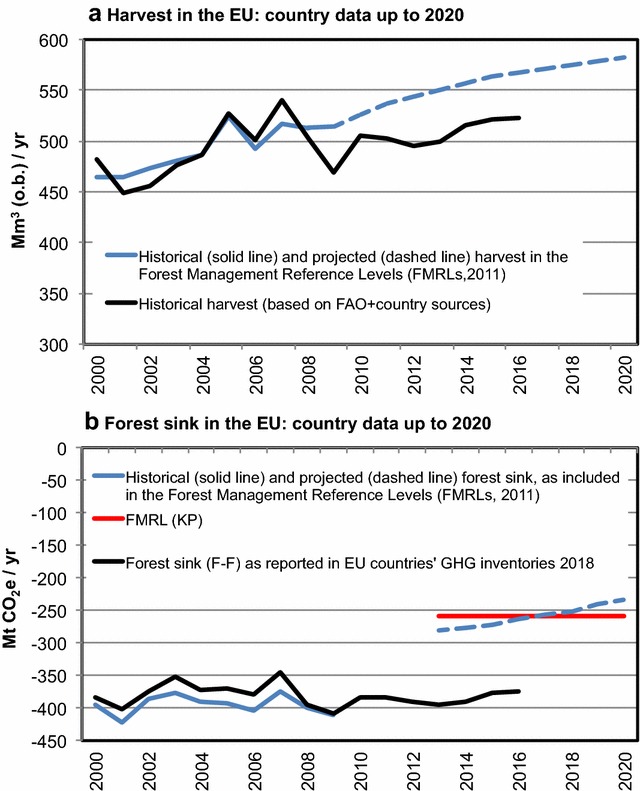
Using EU country data, we show that forest sinks between 2013 and 2016 were greater than that assumed in the 2013-2020 EU reference level under the Kyoto Protocol, which would lead to credits of 110-120 Mt CO/year (capped at 70-80 Mt CO/year, equivalent to 1.3% of 1990 EU total emissions). By modelling the continuation of management practice documented historically (2000-2009), we show that these credits are mostly due to the inclusion in the reference levels of policy-assumed harvest increases that never materialized. With our proposed approach, harvest is expected to increase (12% in 2030 at EU-level, relative to 2000-2009), but more slowly than in current forest reference levels, and only because of age-related dynamics, i.e. increased growing stocks in maturing forests.

CONCLUSIONS

Our science-based approach, compatible with the EU post-2020 climate legislation, helps to ensure that only genuine deviations from the continuation of historically documented forest management practices are accounted toward climate targets, therefore enhancing the consistency and comparability across GHG sectors. It provides flexibility for countries to increase harvest in future reference levels when justified by age-related dynamics. It offers a policy-neutral solution to the polarized debate on forest accounting (especially on bioenergy) and supports the credibility of forest sector mitigation under the Paris Agreement.
https://cdn.ncbi.nlm.nih.gov/pmc/blobs/3569/5957018/ec8176d8170a/13021_2018_96_Fig5_HTML.jpg
https://cdn.ncbi.nlm.nih.gov/pmc/blobs/3569/5957018/143280086e2d/13021_2018_96_Fig1_HTML.jpg
https://cdn.ncbi.nlm.nih.gov/pmc/blobs/3569/5957018/c2b8308ddbd9/13021_2018_96_Fig2_HTML.jpg
https://cdn.ncbi.nlm.nih.gov/pmc/blobs/3569/5957018/77c6fe11a928/13021_2018_96_Fig3_HTML.jpg
https://cdn.ncbi.nlm.nih.gov/pmc/blobs/3569/5957018/735a6eb1e0d2/13021_2018_96_Fig4_HTML.jpg
https://cdn.ncbi.nlm.nih.gov/pmc/blobs/3569/5957018/ec8176d8170a/13021_2018_96_Fig5_HTML.jpg
https://cdn.ncbi.nlm.nih.gov/pmc/blobs/3569/5957018/143280086e2d/13021_2018_96_Fig1_HTML.jpg
https://cdn.ncbi.nlm.nih.gov/pmc/blobs/3569/5957018/c2b8308ddbd9/13021_2018_96_Fig2_HTML.jpg
https://cdn.ncbi.nlm.nih.gov/pmc/blobs/3569/5957018/77c6fe11a928/13021_2018_96_Fig3_HTML.jpg
https://cdn.ncbi.nlm.nih.gov/pmc/blobs/3569/5957018/735a6eb1e0d2/13021_2018_96_Fig4_HTML.jpg
https://cdn.ncbi.nlm.nih.gov/pmc/blobs/3569/5957018/ec8176d8170a/13021_2018_96_Fig5_HTML.jpg
摘要

背景

《巴黎协定》下各国气候目标的可信度和有效性要求,在所有温室气体(GHG)部门,核算的减排成果应反映出与基准年或基线中产生排放的活动类型和规模的真实偏差。这对林业部门来说具有挑战性,因为由于过去的管理和自然干扰导致的与年龄相关的林分动态变化,未来的净排放量可能会发生变化,而与实际管理活动无关。《京都议定书》(2013 - 2020年)实施的解决方案是将减排核算为与预测的(前瞻性的)“森林参考水平”的偏差,该参考水平考虑了与年龄相关的动态变化,但也允许纳入已批准政策的假定未来实施情况。这引发了争议,因为具有夸大未来采伐量的不可核实的反事实情景可能导致在实际管理没有变化的情况下产生减排量,或者相反,在核算中未能反映政策驱动的净排放量增加。相反,在这里我们描述了一种基于记录的历史森林管理实践的预测延续来设定参考水平的方法,即反映与年龄相关的动态变化,但不考虑政策的未来影响。我们使用碳预算模型说明了在欧盟层面实施这种方法的一种可能方式。

结果

利用欧盟国家数据,我们表明2013年至2016年期间的森林碳汇大于《京都议定书》下2013 - 2020年欧盟参考水平中假定的碳汇,这将导致每年110 - 120百万吨二氧化碳的减排量(上限为每年70 - 80百万吨二氧化碳,相当于1990年欧盟总排放量的1.3%)。通过对历史记录的管理实践(2000 - 2009年)的延续进行建模,我们表明这些减排量主要是由于参考水平中纳入了从未实现的政策假定的采伐量增加。采用我们提出的方法,预计采伐量将会增加(在欧盟层面,相对于2000 - 2009年,2030年增加12%),但增长速度比当前森林参考水平慢,且仅是由于与年龄相关的动态变化所致,即成熟森林中生长量的增加。

结论

我们基于科学的方法与欧盟2020年后气候立法兼容,有助于确保只有与历史记录的森林管理实践延续的真实偏差才被计入气候目标,从而提高了温室气体各部门之间的一致性和可比性。当因与年龄相关的动态变化而合理时,它为各国在未来参考水平中增加采伐量提供了灵活性。它为关于森林核算(特别是生物能源方面)的两极分化辩论提供了一个政策中立的解决方案,并支持了《巴黎协定》下林业部门减排的可信度。

相似文献

1
Science-based approach for credible accounting of mitigation in managed forests.基于科学的方法对人工林中的减排进行可靠核算。
Carbon Balance Manag. 2018 May 17;13(1):8. doi: 10.1186/s13021-018-0096-2.
2
Modelling forest carbon stock changes as affected by harvest and natural disturbances. II. EU-level analysis.模拟受采伐和自然干扰影响的森林碳储量变化。二、欧盟层面的分析。
Carbon Balance Manag. 2016 Aug 26;11(1):20. doi: 10.1186/s13021-016-0059-4. eCollection 2016 Dec.
3
Understanding the implications of the EU-LULUCF regulation for the wood supply from EU forests to the EU.了解欧盟土地利用、土地利用变化和林业法规对从欧盟森林向欧盟供应木材的影响。
Carbon Balance Manag. 2018 Oct 16;13(1):18. doi: 10.1186/s13021-018-0107-3.
4
Setting the forest reference levels in the European Union: overview and challenges.设定欧盟的森林参考水平:概述与挑战
Carbon Balance Manag. 2021 Jul 31;16(1):23. doi: 10.1186/s13021-021-00185-4.
5
The role of forests in the EU climate policy: are we on the right track?森林在欧盟气候政策中的作用:我们是否走在正确的道路上?
Carbon Balance Manag. 2023 Jul 30;18(1):15. doi: 10.1186/s13021-023-00234-0.
6
Impact of modelling choices on setting the reference levels for the EU forest carbon sinks: how do different assumptions affect the country-specific forest reference levels?建模选择对设定欧盟森林碳汇参考水平的影响:不同假设如何影响特定国家的森林参考水平?
Carbon Balance Manag. 2019 Sep 3;14(1):10. doi: 10.1186/s13021-019-0125-9.
7
Accounting of GHG emissions and removals from forest management: a long road from Kyoto to Paris.森林管理温室气体排放与清除核算:从京都到巴黎的漫长之路。
Carbon Balance Manag. 2018 Jan 3;13(1):1. doi: 10.1186/s13021-017-0089-6.
8
Climate change mitigation in British Columbia's forest sector: GHG reductions, costs, and environmental impacts.不列颠哥伦比亚省林业部门的气候变化减缓:温室气体减排、成本及环境影响。
Carbon Balance Manag. 2020 Oct 1;15(1):21. doi: 10.1186/s13021-020-00155-2.
9
Modelling forest carbon stock changes as affected by harvest and natural disturbances. I. Comparison with countries' estimates for forest management.模拟受采伐和自然干扰影响的森林碳储量变化。一、与各国森林管理估算值的比较
Carbon Balance Manag. 2016 May 23;11(1):5. doi: 10.1186/s13021-016-0047-8. eCollection 2016 Dec.
10
A systems approach to assess climate change mitigation options in landscapes of the United States forest sector.一种用于评估美国林业部门景观中气候变化缓解方案的系统方法。
Carbon Balance Manag. 2018 Sep 4;13(1):13. doi: 10.1186/s13021-018-0100-x.

引用本文的文献

1
Evaluation of climate change mitigation strategies for Irish forests using the CBM-CFS3 model.使用CBM-CFS3模型评估爱尔兰森林的气候变化缓解策略。
Carbon Balance Manag. 2025 May 21;20(1):10. doi: 10.1186/s13021-025-00302-7.
2
Advancing forest carbon projections requires improved convergence between ecological and economic models.推进森林碳预测需要改善生态模型和经济模型之间的趋同性。
Carbon Balance Manag. 2025 Jan 10;20(1):2. doi: 10.1186/s13021-024-00290-0.
3
The role of forests in the EU climate policy: are we on the right track?

本文引用的文献

1
Climate change mitigation strategies in the forest sector: biophysical impacts and economic implications in British Columbia, Canada.森林部门的气候变化缓解策略:加拿大不列颠哥伦比亚省的生物物理影响和经济影响
Mitig Adapt Strateg Glob Chang. 2018;23(2):257-290. doi: 10.1007/s11027-016-9735-7. Epub 2017 Feb 17.
2
Accounting of GHG emissions and removals from forest management: a long road from Kyoto to Paris.森林管理温室气体排放与清除核算:从京都到巴黎的漫长之路。
Carbon Balance Manag. 2018 Jan 3;13(1):1. doi: 10.1186/s13021-017-0089-6.
3
Natural climate solutions.
森林在欧盟气候政策中的作用:我们是否走在正确的道路上?
Carbon Balance Manag. 2023 Jul 30;18(1):15. doi: 10.1186/s13021-023-00234-0.
4
Two large-scale forest scenario modelling approaches for reporting CO removal: a comparison for the Romanian forests.用于报告二氧化碳清除量的两种大规模森林情景建模方法:罗马尼亚森林的比较
Carbon Balance Manag. 2021 Aug 21;16(1):25. doi: 10.1186/s13021-021-00188-1.
5
Setting the forest reference levels in the European Union: overview and challenges.设定欧盟的森林参考水平:概述与挑战
Carbon Balance Manag. 2021 Jul 31;16(1):23. doi: 10.1186/s13021-021-00185-4.
6
Initial forest age distribution may generate computational sinks or sources of carbon: A generic approach to test assumptions underlying the EU LULUCF forest reference levels.初始森林年龄分布可能会产生碳的计算汇或源:一种检验欧盟土地利用、土地利用变化和林业(LULUCF)森林参考水平所依据假设的通用方法。
Carbon Balance Manag. 2021 May 4;16(1):13. doi: 10.1186/s13021-021-00177-4.
7
Which practices co-deliver food security, climate change mitigation and adaptation, and combat land degradation and desertification?哪些做法能同时实现粮食安全、减缓气候变化、适应气候变化以及防治土地退化和荒漠化?
Glob Chang Biol. 2020 Mar;26(3):1532-1575. doi: 10.1111/gcb.14878. Epub 2019 Dec 14.
8
Impact of modelling choices on setting the reference levels for the EU forest carbon sinks: how do different assumptions affect the country-specific forest reference levels?建模选择对设定欧盟森林碳汇参考水平的影响:不同假设如何影响特定国家的森林参考水平?
Carbon Balance Manag. 2019 Sep 3;14(1):10. doi: 10.1186/s13021-019-0125-9.
9
On the realistic contribution of European forests to reach climate objectives.论欧洲森林对实现气候目标的实际贡献。
Carbon Balance Manag. 2019 Jun 14;14(1):8. doi: 10.1186/s13021-019-0123-y.
10
Understanding the implications of the EU-LULUCF regulation for the wood supply from EU forests to the EU.了解欧盟土地利用、土地利用变化和林业法规对从欧盟森林向欧盟供应木材的影响。
Carbon Balance Manag. 2018 Oct 16;13(1):18. doi: 10.1186/s13021-018-0107-3.
自然气候解决方案。
Proc Natl Acad Sci U S A. 2017 Oct 31;114(44):11645-11650. doi: 10.1073/pnas.1710465114. Epub 2017 Oct 16.
4
A roadmap for rapid decarbonization.快速脱碳路线图。
Science. 2017 Mar 24;355(6331):1269-1271. doi: 10.1126/science.aah3443.
5
Modelling forest carbon stock changes as affected by harvest and natural disturbances. II. EU-level analysis.模拟受采伐和自然干扰影响的森林碳储量变化。二、欧盟层面的分析。
Carbon Balance Manag. 2016 Aug 26;11(1):20. doi: 10.1186/s13021-016-0059-4. eCollection 2016 Dec.
6
Modelling forest carbon stock changes as affected by harvest and natural disturbances. I. Comparison with countries' estimates for forest management.模拟受采伐和自然干扰影响的森林碳储量变化。一、与各国森林管理估算值的比较
Carbon Balance Manag. 2016 May 23;11(1):5. doi: 10.1186/s13021-016-0047-8. eCollection 2016 Dec.
7
EU mitigation potential of harvested wood products.欧盟收获的木质产品的减排潜力。
Carbon Balance Manag. 2015 Feb 25;10(1):6. doi: 10.1186/s13021-015-0016-7. eCollection 2015 Dec.
8
Increasing forest disturbances in Europe and their impact on carbon storage.欧洲森林干扰的增加及其对碳储存的影响。
Nat Clim Chang. 2014 Sep 1;4(9):806-810. doi: 10.1038/nclimate2318.
9
LCA-based optimization of wood utilization under special consideration of a cascading use of wood.基于生命周期分析的木材优化利用,特别考虑木材的梯级利用。
J Environ Manage. 2015 Apr 1;152:158-70. doi: 10.1016/j.jenvman.2015.01.018. Epub 2015 Feb 5.