Department of Epidemiology and Health Statistics, West China School of Public Health, Sichuan University, Chengdu, Sichuan, People's Republic of China.
Department of Health and Social Behavior, West China School of Public Health, Sichuan University, Chengdu, Sichuan, People's Republic of China.
BMC Psychiatry. 2018 May 18;18(1):134. doi: 10.1186/s12888-018-1709-8.
The management of severe mental disorder (SMD) patients in communities is an important initiative of healthcare reform in China. Yet the effects in terms of risk behavior of patients are unclear, particularly in rural areas. This study aims to examine high risk behaviors, changing trends, and possible associated factors among SMD patients in the rural areas of western China.
This analysis examined incidence rate (IR) of high risk behavior of 121,830 managed SMD patients in rural area of Sichuan province, based on data from the national system from 2006 to 2013. Register rate, high risk behavior IR, and time distribution and area distribution of high risk behavior were described. Two-level Poisson regression model was used to analyze associates of high risk behavior of patients, which include demographic characteristics at individual level, socio-economic condition and health system indicators at region level.
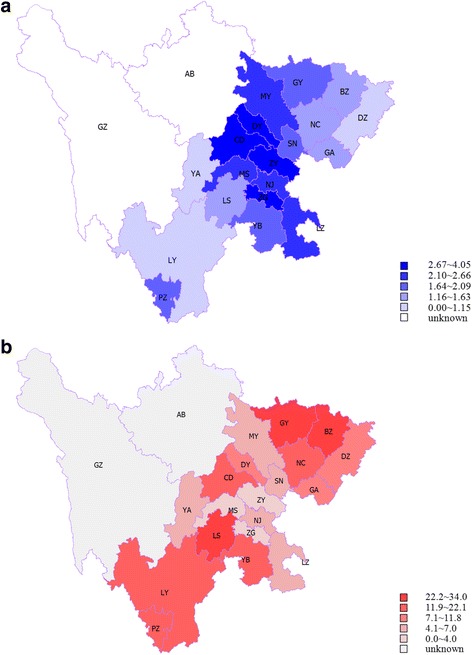
It was revealed that 6804 (5.58%) of managed patients were involved in 17,220 high risk behavior events, which gave an overall IR of 0.0998 (per person year) on the basis of 172,564 person years of follow-up. The IR varied widely across municipalities, in the range of 0.0305-0.3397. The IR of high risk behavior in the cohort had increased since 2006, and peaked by 2011, at 0.2392. At the individual level, males aged 25 to 44, who were unmarried and in poverty, illiterate or semiliterate, had a family history of mental disorders and antipsychotic treatments, longer duration illnesses, were associated with an increased IR risk. At the regional level, higher psychiatric practitioner visits and the lower annual net income of rural residents per capita, were associated with an increased IR risk.
This is the first large prospective study that revealed the current situation of the register rate, high risk behavior incidence rate in SMD patients in rural area of western China, and examined associates and the differences of high risk behavior of patients among municipalities. The findings may provide evidences that lead to guide prevention and control for risk behavior in SMD patients in rural areas of China, as well as to improve mental health services for this population. It could provide some reference for other developing countries too.
严重精神障碍(SMD)患者的社区管理是中国医疗改革的重要举措。然而,就患者的风险行为而言,其效果尚不清楚,尤其是在农村地区。本研究旨在探讨中国西部农村地区 SMD 患者的高风险行为、变化趋势及可能的相关因素。
本分析基于 2006 年至 2013 年全国系统数据,对四川省农村地区 121830 例管理 SMD 患者的高风险行为发生率(IR)进行了分析。描述了登记率、高风险行为 IR 以及高风险行为的时间分布和地区分布。采用两水平泊松回归模型分析患者高风险行为的相关因素,包括个体水平的人口统计学特征、区域水平的社会经济状况和卫生系统指标。
结果显示,在随访的 172564 人年中,共有 6804 例(5.58%)管理患者发生 17220 次高风险行为事件,总发生率为 0.0998(人年)。各市之间的发生率差异很大,范围为 0.0305-0.3397。自 2006 年以来,队列中的高风险行为发生率呈上升趋势,并在 2011 年达到峰值,为 0.2392。在个体水平上,25 至 44 岁、未婚、贫困、文盲或半文盲、有精神障碍家族史和抗精神病药物治疗史、病程较长的男性,高风险行为发生率较高。在区域水平上,精神科医生就诊次数较高,农村居民人均年纯收入较低,与高风险行为发生率增加有关。
这是首次对中国西部农村地区 SMD 患者的登记率和高风险行为发生率进行的大型前瞻性研究,并对各市患者的高风险行为及其差异进行了相关因素分析。研究结果为指导中国农村地区 SMD 患者的风险行为预防和控制提供了依据,并改善了这一人群的精神卫生服务。也可为其他发展中国家提供参考。