Global Health and Tropical Medicine, GHTM, Instituto de Higiene e Medicina Tropical, IHMT, Universidade Nova de Lisboa, UNL, Rua da Junqueira 100, 1349-008, Lisbon, Portugal.
Faculdade de Psicologia e de Ciências da Educação, CINEICC, Universidade de Coimbra, Coimbra, Portugal.
Malar J. 2018 May 18;17(1):203. doi: 10.1186/s12936-018-2354-x.
After the introduction of an artemisinin-based combination therapy, the reduction of prevalence of malaria infections has shown a remarkable progress during the last decade. However due to the lack of a consistent malaria control programme and socioeconomic inequalities, Plasmodium infection is still one of the major cause of disease in Equatorial Guinea, namely in the rural communities. This study explored the associated risk factors of malaria transmission at the microeconomic level (households) in two rural villages of mainland Equatorial Guinea.
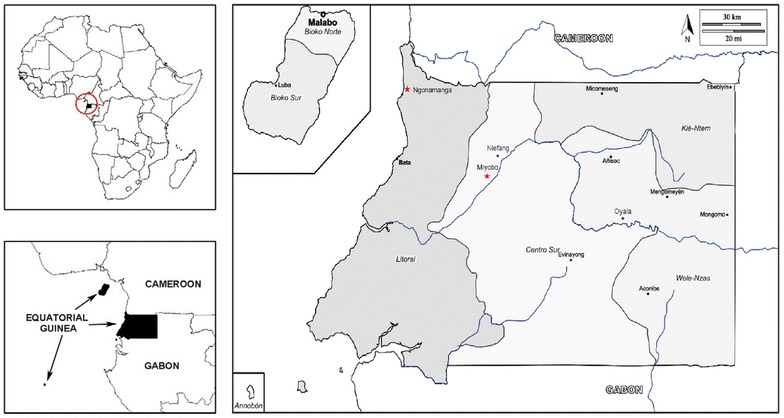
This survey involved 232 individuals living in 69 households located in two rural villages, Ngonamanga and Miyobo, of coastal and interior of Equatorial Guinea, respectively. Malaria prevalence was measured by PCR and parasitaemia level by optical microscopy; household socioeconomic status (SES) was measured based on house characteristics using a 2-step cluster analysis. Logistic regression analysis was performed to investigate the relationship of a diverse set of independent variables on being diagnosed with malaria and on showing high levels of parasitaemia.
The prevalence of Plasmodium spp. infection was 69%, with 80% of households having at least one parasitaemic member. The majority of houses have eaves (80%), walls of clay/wood (90%) and zinc roof (99%) and only 10% of them have basic sanitation facilities. The studied areas showed reduced rates of indoor residual spraying coverage (9%), and long-lasting insecticide-treated net ownership (35%), with none of these preventive tools showing any significant effects on malaria risk in these areas. Neither the risk of malaria infection (PCR positive result) or the development of high parasitaemia did show association with SES.
This study has contributed to reinforce the importance of living conditions associated to a high risk of malaria infection and vulnerability to develop high parasitaemia. This study also contributes to future malaria control interventions to be implemented in mainland Equatorial Guinea or in other countries with similar environmental conditions.
在引入青蒿素为基础的联合疗法后,过去十年疟疾感染率的降低取得了显著进展。然而,由于缺乏一致的疟疾控制规划和社会经济不平等,疟疾仍然是赤道几内亚,特别是农村社区的主要疾病原因之一。本研究在赤道几内亚大陆的两个农村村庄(恩冈曼加和米约博),从微观经济层面(家庭)探讨了疟疾传播的相关危险因素。
本调查涉及 232 名生活在赤道几内亚沿海和内陆的两个农村村庄(恩冈曼加和米约博)的 69 户家庭中的个体。通过 PCR 测量疟疾患病率,通过光学显微镜测量寄生虫血症水平;根据房屋特征,使用两步聚类分析来衡量家庭社会经济状况(SES)。进行逻辑回归分析,以调查一组不同的自变量与诊断为疟疾和寄生虫血症水平较高之间的关系。
疟原虫属感染的患病率为 69%,有 80%的家庭至少有一名寄生虫血症成员。大多数房屋都有屋檐(80%)、粘土/木材墙(90%)和锌屋顶(99%),只有 10%的房屋有基本卫生设施。研究区域的室内滞留喷洒覆盖率(9%)和长效驱虫蚊帐拥有率(35%)较低,这些预防工具在这些地区对疟疾风险均没有显示出显著影响。疟疾感染风险(PCR 阳性结果)或高寄生虫血症的发展均与 SES 无关。
本研究有助于加强与高疟疾感染风险和高寄生虫血症易感性相关的生活条件的重要性。本研究也有助于在赤道几内亚大陆或其他环境条件相似的国家实施未来的疟疾控制干预措施。