Romay-Barja Maria, Ncogo Policarpo, Nseng Gloria, Santana-Morales Maria A, Herrador Zaida, Berzosa Pedro, Valladares Basilio, Riloha Matilde, Benito Agustin
Centro Nacional de Medicina Tropical, Instituto de Salud Carlos III, Madrid, Spain.
Red de Investigación Colaborativa en Enfermedades Tropicales, RICET, Madrid, Spain.
PLoS One. 2016 Dec 30;11(12):e0168668. doi: 10.1371/journal.pone.0168668. eCollection 2016.
Adequate community knowledge about malaria is crucial in order to improve prevention by reducing exposure to the disease. Malaria is a major cause of morbidity and mortality among children of less than five years of age in Equatorial Guinea. However, information concerning the accuracy of community knowledge is insufficient. This study aimed at assessing the depth of caregivers' knowledge of malaria, their beliefs and attitudes about this disease, and their socioeconomic determinants in the Bata district of Equatorial Guinea.
A cross-sectional study was conducted in the district of Bata, involving 440 houses selected from 18 rural villages and 26 urban neighbourhoods. A combined "Malaria Knowledge Score" was generated based on caregivers' knowledge about transmission, symptoms, prevention, the treatment of children, and best place to seek treatment. Multivariate logistic regressions analyses were performed to assess those factors that are associated with knowledge about malaria.
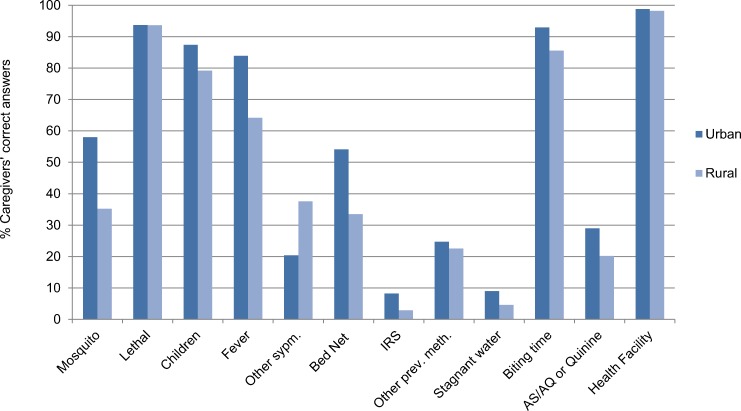
A total of 428 caregivers were interviewed; 255 (59.6%) and 173 (40.4%) lived in urban and rural areas respectively. Significant differences between rural and urban households were observed in caregivers' malaria knowledges and beliefs. Almost 42% of urban and 65% of rural caregivers were unaware as to how malaria is transmitted (OR = 2.69; 95% CI: 1.78-4.05). Together with rurality, the factors most significantly associated with the Malaria Knowledge were the level of education of the caregiver and the socioeconomic status of the household.
Improvements in educational programs are needed to empower the most vulnerable households such that they can pro-actively implement malaria control measures. This could be achieved by a comprehensive communication strategy aimed at changing individual and community behaviours, and delivered by suitably trained community health workers and indoor residual spraying personnel.
为了通过减少接触疟疾来加强预防,社区对疟疾有充分的了解至关重要。疟疾是赤道几内亚5岁以下儿童发病和死亡的主要原因。然而,关于社区知识准确性的信息并不充分。本研究旨在评估赤道几内亚巴塔区护理人员对疟疾的了解程度、他们对这种疾病的看法和态度,以及他们的社会经济决定因素。
在巴塔区进行了一项横断面研究,涉及从18个乡村和26个城市社区中选取的440户家庭。根据护理人员对传播、症状、预防、儿童治疗以及最佳治疗地点的了解,生成了一个综合的“疟疾知识得分”。进行多变量逻辑回归分析以评估与疟疾知识相关的因素。
共采访了428名护理人员;其中255人(59.6%)居住在城市地区,173人(40.4%)居住在农村地区。农村和城市家庭的护理人员在疟疾知识和看法方面存在显著差异。近42%的城市护理人员和65%的农村护理人员不知道疟疾是如何传播的(比值比=2.69;95%置信区间:1.78-4.05)。与农村地区一样,与疟疾知识最显著相关的因素是护理人员的教育水平和家庭的社会经济地位。
需要改进教育项目,以使最脆弱的家庭有能力积极实施疟疾控制措施。这可以通过一项旨在改变个人和社区行为的综合传播战略来实现,该战略由经过适当培训的社区卫生工作者和室内滞留喷洒人员实施。