Department of Civil and Environmental Engineering, Hanyang University, Seoul 04763, Republic of Korea.
Department of Farm, Power & Machinery, Bangladesh Agricultural University, Mymensingh, Bangladesh.
J Environ Sci (China). 2018 May;67:23-35. doi: 10.1016/j.jes.2017.08.027. Epub 2017 Sep 20.
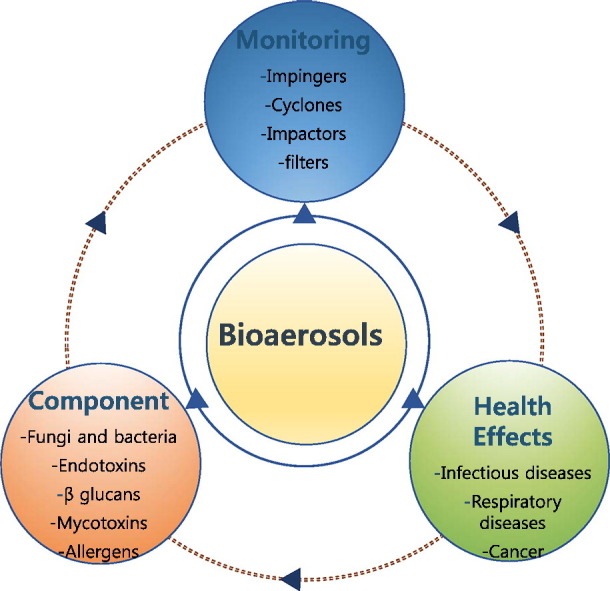
Bioaerosols consist of aerosols originated biologically such as metabolites, toxins, or fragments of microorganisms that are present ubiquitously in the environment. International interests in bioaerosols have increased rapidly to broaden the pool of knowledge on their identification, quantification, distribution, and health impacts (e.g., infectious and respiratory diseases, allergies, and cancer). However, risk assessment of bioaerosols based on conventional culture methods has been hampered further by several factors such as: (1) the complexity of microorganisms or derivatives to be investigated; (2) the purpose, techniques, and locations of sampling; and (3) the lack of valid quantitative criteria (e.g., exposure standards and dose/effect relationships). Although exposure to some microbes is considered to be beneficial for health, more research is needed to properly assess their potential health hazards including inter-individual susceptibility, interactions with non-biological agents, and many proven/unproven health effects (e.g., atopy and atopic diseases).
生物气溶胶由生物来源的气溶胶组成,例如存在于环境中的微生物的代谢物、毒素或片段。国际上对生物气溶胶的兴趣迅速增加,以拓宽对其鉴定、定量、分布和健康影响(例如传染病和呼吸道疾病、过敏和癌症)的认识。然而,基于传统培养方法的生物气溶胶风险评估还受到以下几个因素的阻碍:(1)待研究的微生物或衍生物的复杂性;(2)采样的目的、技术和地点;(3)缺乏有效的定量标准(例如,暴露标准和剂量/效应关系)。尽管接触某些微生物被认为对健康有益,但需要更多的研究来正确评估它们的潜在健康危害,包括个体易感性、与非生物制剂的相互作用以及许多已证实/未证实的健康影响(例如,特应性和特应性疾病)。