Kumar Pradeep, Singh Rajeev
Department of Environmental Studies, Satyawati College, University of Delhi, New Delhi, India.
Department of Agricultural and Biosystems Engineering, South Dakota State University, Brookings, SD, United States.
Front Public Health. 2025 Jul 24;13:1626827. doi: 10.3389/fpubh.2025.1626827. eCollection 2025.
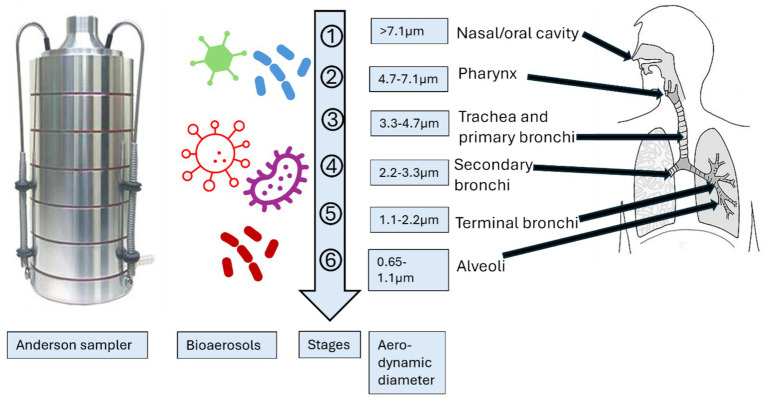
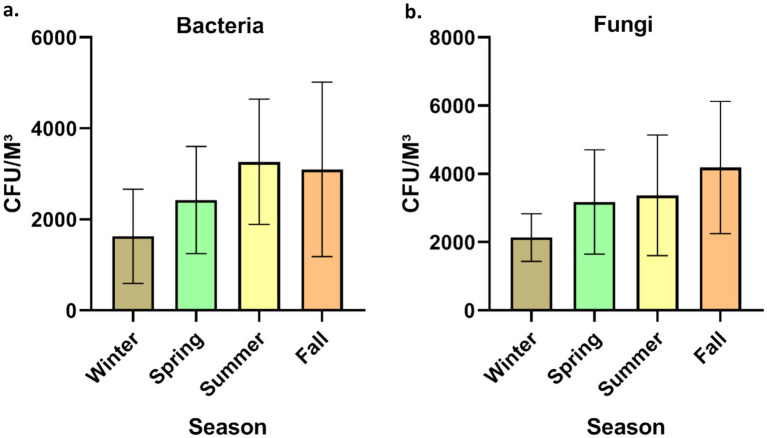
Indoor air quality plays a crucial role in the health and well-being of residents. Delhi, known as one of the most polluted cities globally, often receives insufficient attention in managing and mitigating related health impacts. This study isolated, characterized, and assessed microbial indoor air quality (bioaerosols) using multiproxy approaches and correlated findings with associated health effects. The spatial variation of bacterial aerosols showed irregular patterns, increasing from winter to summer and decreasing in fall; fungal aerosols consistently increased from winter to fall. Bacterial aerosol concentrations ranged from 730 to 5,300 CFU/m, while fungal concentrations were between 1,330 and 6,050 CFU/m, significantly exceeding the recommended limits. The size distribution of fungal aerosols varied across seasons, with higher concentrations in the 4th and 5th stages of the sampler. Several airborne bacterial and fungal genera, including , , , , , and , were identified in homes. Health effects were most pronounced in winter followed by fall, with symptoms such as headaches, eye irritation, allergic rhinitis, coughing, and sneezing being common. As per this study, there may be a correlation between indoor bioaerosol concentrations, seasonal variations, and health outcomes, though further in-depth , exposure assessment, and epidemiological studies are necessary to substantiate these findings.
室内空气质量对居民的健康和福祉起着至关重要的作用。德里作为全球污染最严重的城市之一,在管理和减轻相关健康影响方面往往未得到足够重视。本研究采用多代理方法对室内微生物空气质量(生物气溶胶)进行分离、表征和评估,并将研究结果与相关健康影响进行关联。细菌气溶胶的空间变化呈现不规则模式,从冬季到夏季增加,秋季减少;真菌气溶胶从冬季到秋季持续增加。细菌气溶胶浓度范围为730至5300 CFU/m,而真菌浓度在1330至6050 CFU/m之间,显著超过推荐限值。真菌气溶胶的粒径分布随季节变化,在采样器的第4和第5阶段浓度较高。在家庭中鉴定出了几种空气传播的细菌和真菌属,包括 、 、 、 、 和 。健康影响在冬季最为明显,其次是秋季,常见症状有头痛、眼睛刺激、过敏性鼻炎、咳嗽和打喷嚏。根据本研究,室内生物气溶胶浓度、季节变化和健康结果之间可能存在关联,不过需要进一步深入的暴露评估和流行病学研究来证实这些发现。