
局部立体定向消融增敏放疗用于治疗体积较大的非小细胞肺癌:一项回顾性研究。
Partial stereotactic ablative boost radiotherapy in bulky non-small cell lung cancer: a retrospective study.
作者信息
Bai Yun, Gao Xian-Shu, Qin Shang-Bin, Chen Jia-Yan, Su Meng-Meng, Liu Qing, Qin Xiu-Bo, Ma Ming-Wei, Zhao Bo, Gu Xiao-Bin, Xie Mu, Cui Ming, Qi Xin, Li Xiao-Ying
机构信息
Department of Radiation Oncology, Peking University First Hospital, Beijing, China.
Department of Medical Imaging, Peking University First Hospital, Beijing, China.
出版信息
Onco Targets Ther. 2018 May 8;11:2571-2579. doi: 10.2147/OTT.S159538. eCollection 2018.
PURPOSE
Bulky non-small cell lung cancer (NSCLC) is difficult to achieve effective local control by conventionally fractionated radiotherapy (CRT). The present work aims to evaluate the safety and efficacy of partial stereotactic ablative boost radiotherapy (P-SABR) in bulky NSCLC.
PATIENTS AND METHODS
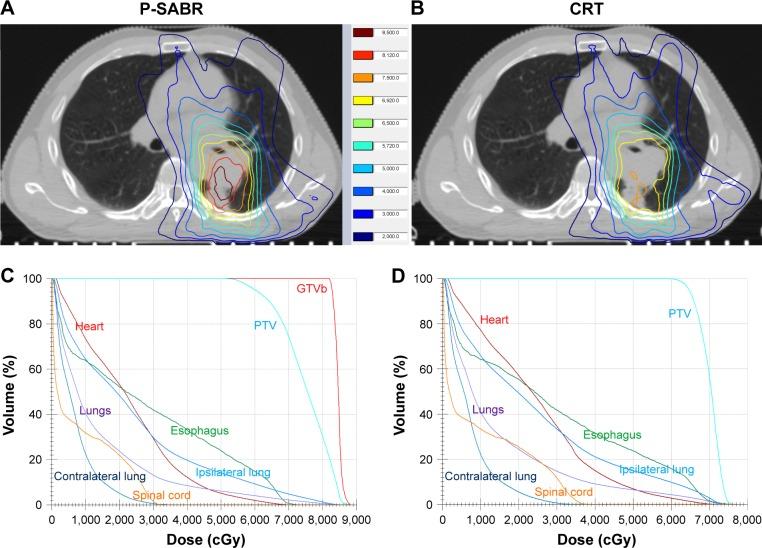
From December 2012 through August 2017, 30 patients with bulky NSCLC treated with P-SABR technique were analyzed. The P-SABR plan consisted of one partial SABR plan (5-9 Gy/f, 3-6 fractions) to gross tumor boost (GTVb), followed by one CRT plan to the planning target volume (PTV). GTVb was the max volume receiving SABR to guarantee the dose of organs-at-risks (OARs) falloff to about 3 Gy/f. The total dose of PTV margin was planned to above 60 Gy. The simply CRT plans were created using the same planning parameters as the original plan, with the goal to achieve comparable OARs doses and PTV margin dose to the P-SABR plan. Dosimetric variables were acquired in both P-SABR and compared CRT plans. Toxicity, local control, and survival were also evaluated.
RESULTS
Median follow-up in survivors was 10.3 months (range=2.3-39.4 months). Eleven patients (36.7%) had partial response (PR) and ten patients (33.3%) had stable disease (SD). Two-year overall survival was 55.6%. Two-year local control rate was 85.7%. No severe acute side effects >CTCAE Grade III were observed. Compared to the simply CRT plan, P-SABR plans achieved similar doses to the OARs and Dmin, but increased dose at the isocenter, Dmean, Dmax, and biological equivalent dose (BED) significantly (<0.05). BED in the tumor center could reach 107.3 Gy (93.2-132 Gy). Patients with B90≥65% achieved a higher local control rate than those with B90<65% (=0.010).
CONCLUSION
This retrospective study suggests that P-SABR is feasible and well tolerated in bulky NSCLC. Local control rate is encouraging, especially for the B90≥65% group, which may due to the ability of P-SABR to optimize BED with equivalent toxicity.
目的
体积较大的非小细胞肺癌(NSCLC)难以通过常规分割放疗(CRT)实现有效的局部控制。本研究旨在评估局部立体定向消融增敏放疗(P-SABR)在体积较大的NSCLC中的安全性和疗效。
患者与方法
分析2012年12月至2017年8月期间30例采用P-SABR技术治疗的体积较大的NSCLC患者。P-SABR计划包括一个针对大体肿瘤增敏(GTVb)的局部SABR计划(5-9 Gy/次,3-6次分割),随后是一个针对计划靶体积(PTV)的CRT计划。GTVb是接受SABR的最大体积,以确保危及器官(OARs)的剂量降至约3 Gy/次。PTV边缘的总剂量计划超过60 Gy。简单CRT计划使用与原计划相同的计划参数创建,目标是使OARs剂量和PTV边缘剂量与P-SABR计划相当。在P-SABR计划和对照CRT计划中均获取剂量学变量。还评估了毒性、局部控制和生存率。
结果
幸存者的中位随访时间为10.3个月(范围=2.3-39.4个月)。11例患者(36.7%)有部分缓解(PR),10例患者(33.3%)病情稳定(SD)。两年总生存率为55.6%。两年局部控制率为85.7%。未观察到>CTCAE III级的严重急性副作用。与简单CRT计划相比,P-SABR计划使OARs和Dmin的剂量相似,但等中心剂量、Dmean、Dmax和生物等效剂量(BED)显著增加(<0.05)。肿瘤中心的BED可达107.3 Gy(93.2-132 Gy)。B90≥65%的患者局部控制率高于B90<65%的患者(=0.010)。
结论
这项回顾性研究表明,P-SABR在体积较大的NSCLC中是可行的,且耐受性良好。局部控制率令人鼓舞,尤其是对于B90≥65%的组,这可能归因于P-SABR在同等毒性下优化BED的能力。


 Zotero 插件