
GoActive:一项针对13至14岁青少年的校内体育活动促进计划混合方法过程评估的方案。
GoActive: a protocol for the mixed methods process evaluation of a school-based physical activity promotion programme for 13-14year old adolescents.
作者信息
Jong Stephanie T, Brown Helen Elizabeth, Croxson Caroline H D, Wilkinson Paul, Corder Kirsten L, van Sluijs Esther M F
机构信息
MRC Epidemiology Unit and UKCRC Centre for Diet and Activity Research (CEDAR), University of Cambridge School of Clinical Medicine, Box 285, Institute of Metabolic Science, Cambridge Biomedical Campus, Cambridge, CB2 0QQ, UK.
Nuffield Department of Primary Care Health Sciences, University of Oxford, Radcliffe Primary Care Building, Radcliffe Observatory Quarter, Woodstock Rd, Oxford, OX2 6GG, UK.
出版信息
Trials. 2018 May 21;19(1):282. doi: 10.1186/s13063-018-2661-0.
BACKGROUND
Process evaluations are critical for interpreting and understanding outcome trial results. By understanding how interventions function across different settings, process evaluations have the capacity to inform future dissemination of interventions. The complexity of Get others Active (GoActive), a 12-week, school-based physical activity intervention implemented in eight schools, highlights the need to investigate how implementation is achieved across a variety of school settings. This paper describes the mixed methods GoActive process evaluation protocol that is embedded within the outcome evaluation. In this detailed process evaluation protocol, we describe the flexible and pragmatic methods that will be used for capturing the process evaluation data.
METHODS
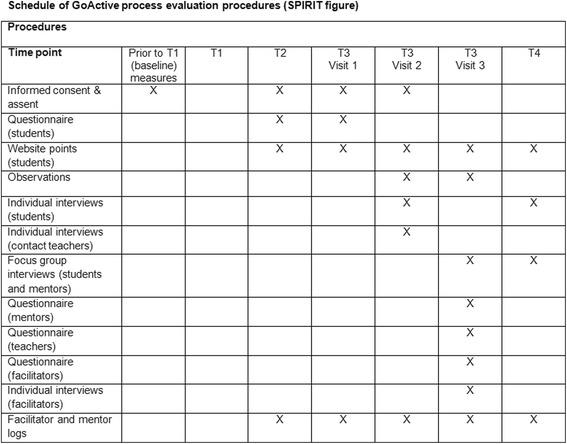
A mixed methods design will be used for the process evaluation, including quantitative data collected in both the control and intervention arms of the GoActive trial, and qualitative data collected in the intervention arm. Data collection methods will include purposively sampled, semi-structured interviews and focus group interviews, direct observation, and participant questionnaires (completed by students, teachers, older adolescent mentors, and local authority-funded facilitators). Data will be analysed thematically within and across datasets. Overall synthesis of findings will address the process of GoActive implementation, and through which this process affects outcomes, with careful attention to the context of the school environment.
DISCUSSION
This process evaluation will explore the experience of participating in GoActive from the perspectives of key groups, providing a greater understanding of the acceptability and process of implementation of the intervention across the eight intervention schools. This will allow for appraisal of the intervention's conceptual base, inform potential dissemination, and help optimise post-trial sustainability. The process evaluation will also assist in contextualising the trial effectiveness results with respect to how the intervention may or may not have worked and, if it was found to be effective, what might be required for it to be sustained in the 'real world'. Furthermore, it will offer suggestions for the development and implementation of future initiatives to promote physical activity within schools.
TRIAL REGISTRATION
ISRCTN, ISRCTN31583496 . Registered on 18 February 2014.
背景
过程评估对于解释和理解结果试验结果至关重要。通过了解干预措施在不同环境中的作用方式,过程评估能够为未来干预措施的推广提供信息。“让他人动起来”(GoActive)是一项在八所学校实施的为期12周的校内体育活动干预项目,其复杂性凸显了调查在各种学校环境中如何实现实施的必要性。本文描述了嵌入在结果评估中的混合方法GoActive过程评估方案。在这个详细的过程评估方案中,我们描述了将用于收集过程评估数据的灵活务实的方法。
方法
过程评估将采用混合方法设计,包括在GoActive试验的对照组和干预组中收集的定量数据,以及在干预组中收集的定性数据。数据收集方法将包括有目的抽样、半结构化访谈和焦点小组访谈、直接观察以及参与者问卷(由学生、教师、青少年导师和地方当局资助的促进者填写)。数据将在数据集内部和之间进行主题分析。研究结果的总体综合将涉及GoActive实施的过程,以及该过程如何影响结果,并仔细关注学校环境背景。
讨论
该过程评估将从关键群体的角度探索参与GoActive的体验,从而更深入地了解该干预措施在八所干预学校中的可接受性和实施过程。这将有助于评估干预措施的概念基础,为潜在的推广提供信息,并有助于优化试验后的可持续性。过程评估还将有助于结合试验有效性结果,说明干预措施可能起作用或不起作用的方式,如果发现其有效,在“现实世界”中维持该措施可能需要什么。此外,它将为未来在学校推广体育活动的倡议的制定和实施提供建议。
试验注册
国际标准随机对照试验编号,ISRCTN31583496。于2014年2月18日注册。


 Zotero 插件