Morelli Nayara Rampazzo, Scavuzzi Bruna Miglioranza, Miglioranza Lucia Helena da Silva, Lozovoy Marcell Alysson Batisti, Simão Andréa Name Colado, Dichi Isaias
Departamento de Pós-Graduação em Ciências da Saúde, Universidade Estadual de Londrina (UEL), Londrina, PR, Brasil.
Departamento de Ciência e Tecnologia de Alimentos, Universidade Estadual de Londrina (UEL), Londrina, PR, Brasil.
Arch Endocrinol Metab. 2018 Jun;62(3):309-318. doi: 10.20945/2359-3997000000036. Epub 2018 May 17.
The aim of this study is to evaluate the influence of the body mass index (BMI) and the metabolic syndrome (MetS) parameters on oxidative and nitrosative stress in overweight and obese subjects.
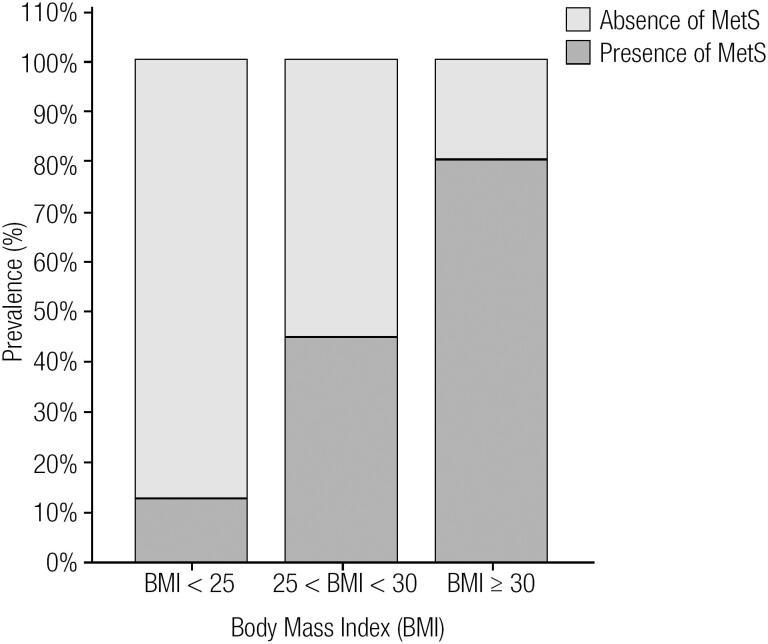
Individuals were divided into three groups: the control group (G1, n = 131) with a BMI between 20 and 24.9 kg/m2, the overweight group (G2, n = 120) with a BMI between 25 and 29.9 kg/m2 and the obese group (G3, n = 79) with a BMI ≥ 30 kg/m2.
G3 presented higher advanced oxidation protein products (AOPPs) in relation to G1 and G2 (p = 0.001 and p = 0.011, respectively) whereas G2 and G3 had lower levels of nitric oxide (NO) (p = 0.009 and p = 0.048, respectively) compared to G1. Adjusted for the presence of MetS to evaluate its influence, the levels of AOPPs did not differ between the groups, whereas NO remained significantly lower. Data adjusted by the BMI showed that subjects with higher triacylglycerol levels had higher AOPPs (p = 0.001) and decreased total radical-trapping antioxidant parameter/uric Acid (p = 0.036). Subjects with lower high-density lipoprotein (HDL) levels and patients with higher blood pressure showed increased AOPPs (p = 0.001 and p = 0.034, respectively) and lower NO levels (p = 0.017 and p = 0.043, respectively). Subjects who presented insulin resistance had higher AOPPs (p = 0.024).
Nitrosative stress was related to BMI, and protein oxidation and nitrosative stress were related to metabolic changes and hypertension. MetS components were essential participants in oxidative and nitrosative stress in overweight and obese subjects.
本研究旨在评估体重指数(BMI)和代谢综合征(MetS)参数对超重和肥胖受试者氧化应激及亚硝化应激的影响。
个体被分为三组:对照组(G1,n = 131),BMI在20至24.9 kg/m²之间;超重组(G2,n = 120),BMI在25至29.9 kg/m²之间;肥胖组(G3,n = 79),BMI≥30 kg/m²。
与G1和G2相比,G3组的晚期氧化蛋白产物(AOPPs)更高(分别为p = 0.001和p = 0.011),而与G1相比,G2和G3组的一氧化氮(NO)水平较低(分别为p = 0.009和p = 0.048)。为评估MetS的影响而对其存在情况进行校正后,各组间AOPPs水平无差异,但NO水平仍显著较低。经BMI校正的数据显示,三酰甘油水平较高的受试者AOPPs更高(p = 0.001),总自由基捕获抗氧化参数/尿酸降低(p = 0.036)。高密度脂蛋白(HDL)水平较低的受试者和血压较高的患者AOPPs增加(分别为p = 0.001和p = 0.034),NO水平降低(分别为p = 0.017和p = 0.043)。存在胰岛素抵抗的受试者AOPPs更高(p = 0.024)。
亚硝化应激与BMI相关,蛋白质氧化和亚硝化应激与代谢变化及高血压相关。MetS各组分是超重和肥胖受试者氧化应激及亚硝化应激的重要参与者。