Barroso Lygia N, Farias Dayana R, Soares-Mota Marcia, Bettiol Heloisa, Barbieri Marco Antônio, Foss Milton Cesar, Silva Antônio Augusto M da, Kac Gilberto
Observatório de Epidemiologia Nutricional, Departamento de Nutrição Social e Aplicada, Instituto de Nutrição Josué de Castro, Universidade Federal do Rio de Janeiro (UFRJ), Cidade Universitária, Ilha do Fundão, Rio de Janeiro, RJ, Brasil.
Instituto de Nutrição Josué de Castro, Universidade Federal do Rio de Janeiro (UFRJ), Cidade Universitária, Ilha do Fundão, Rio de Janeiro, RJ, Brasil.
Arch Endocrinol Metab. 2018 Jun;62(3):285-295. doi: 10.20945/2359-3997000000040. Epub 2018 May 17.
The role of bone markers on insulin resistance (IR) remains controversial. The objective of this study is to evaluate the association between bone mineral density (BMD) and glucose metabolism and investigate if visceral hyperadiposity, evaluated by waist circumference (WC), is an effect modifier of this association.
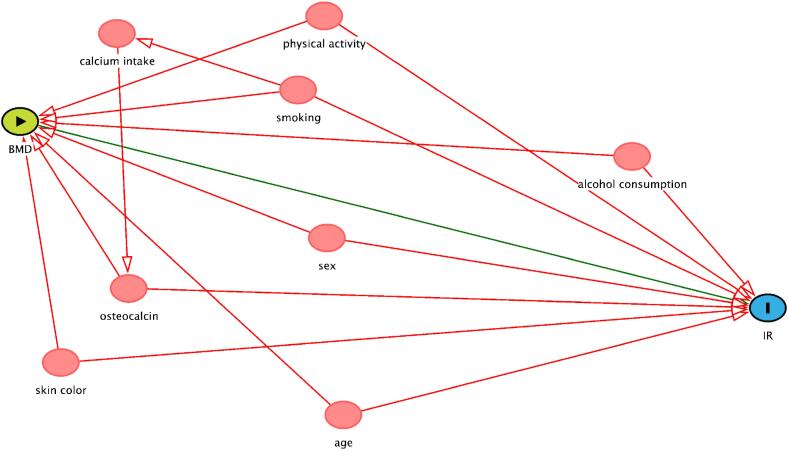
Cross-sectional analysis with 468 young adults from the fourth follow-up of the 1978/79 Ribeirão Preto prospective birth cohort, Brazil. BMD, total osteocalcin (OC), fasting plasma glucose and insulin concentrations were assessed. IR, sensitivity (S) and secretion (β) were estimated by homeostasis model assessment (HOMA) indexes. Multiple linear regression models were constructed to estimate the association between BMD and glucose metabolism. Beta coefficient, R2 and p-values were provided. WC was tested as an effect modifier and OC as a confounder. The covariates were selected based on Direct Acyclic Graph.
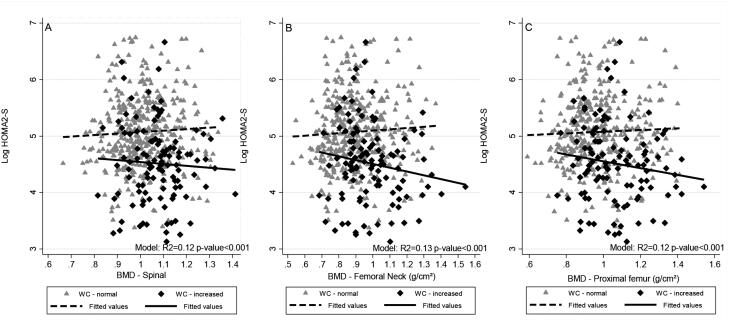
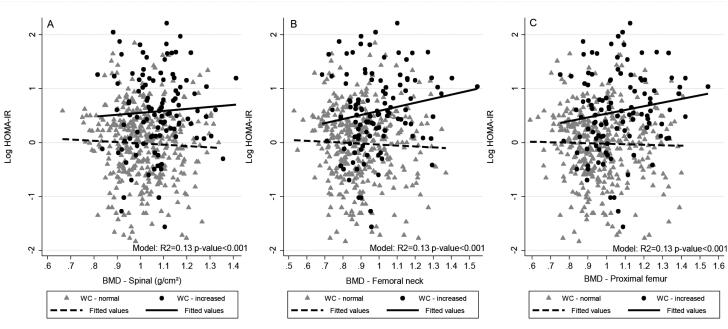
Significant interaction between BMD (femoral neck and proximal femur areas) and WC on glucose metabolism was observed in the adjusted models. Subjects with increased WC presented a positive association between BMD and log HOMA1-IR while an inverse association was found in those with normal WC (femoral neck R2 = 0.17, p = 0.036; proximal femur R2 = 0.16, p = 0.086). BMD was negatively associated with log HOMA2-S in individuals with increased WC and positively in those with normal WC (femoral neck R2 = 0.16, p = 0.042; proximal femur R2 = 0.15, p = 0.097). No significant associations between BMD, log HOMA2-β and OC and glucose metabolism markers were observed.
BMD was associated with glucose metabolism, independently of OC, and WC modifies this association.
骨标志物在胰岛素抵抗(IR)中的作用仍存在争议。本研究的目的是评估骨密度(BMD)与糖代谢之间的关联,并调查通过腰围(WC)评估的内脏型肥胖是否是这种关联的效应修饰因素。
对巴西里贝朗普雷图1978/79年前瞻性出生队列第四次随访中的468名年轻成年人进行横断面分析。评估了骨密度、总骨钙素(OC)、空腹血糖和胰岛素浓度。通过稳态模型评估(HOMA)指数估计胰岛素抵抗、敏感性(S)和分泌(β)。构建多元线性回归模型以估计骨密度与糖代谢之间的关联。提供了β系数、R²和p值。将腰围作为效应修饰因素进行检验,将骨钙素作为混杂因素。根据直接无环图选择协变量。
在调整模型中观察到骨密度(股骨颈和股骨近端区域)与腰围在糖代谢方面存在显著交互作用。腰围增加的受试者中,骨密度与对数HOMA1-IR呈正相关,而腰围正常的受试者中则呈负相关(股骨颈R² = 0.17,p = 0.036;股骨近端R² = 0.16,p = 0.086)。腰围增加的个体中,骨密度与对数HOMA2-S呈负相关,腰围正常的个体中则呈正相关(股骨颈R² = 0.16,p = 0.042;股骨近端R² = 0.15,p = 0.097)。未观察到骨密度、对数HOMA2-β和骨钙素与糖代谢标志物之间存在显著关联。
骨密度与糖代谢相关,独立于骨钙素,且腰围可改变这种关联。