• 文献检索
  • 文档翻译
  • 深度研究
  • 学术资讯
  • Suppr Zotero 插件Zotero 插件
  • 邀请有礼
  • 套餐&价格
  • 历史记录
应用&插件
Suppr Zotero 插件Zotero 插件浏览器插件Mac 客户端Windows 客户端微信小程序
定价
高级版会员购买积分包购买API积分包
服务
文献检索文档翻译深度研究API 文档MCP 服务
关于我们
关于 Suppr公司介绍联系我们用户协议隐私条款
关注我们

Suppr 超能文献

核心技术专利:CN118964589B侵权必究
粤ICP备2023148730 号-1Suppr @ 2026

文献检索

告别复杂PubMed语法,用中文像聊天一样搜索,搜遍4000万医学文献。AI智能推荐,让科研检索更轻松。

立即免费搜索

文件翻译

保留排版,准确专业,支持PDF/Word/PPT等文件格式,支持 12+语言互译。

免费翻译文档

深度研究

AI帮你快速写综述,25分钟生成高质量综述,智能提取关键信息,辅助科研写作。

立即免费体验

早产儿的肠道微生物组在生命的头 6 周内会根据出生时的胎龄而有所不同。

The premature infant gut microbiome during the first 6 weeks of life differs based on gestational maturity at birth.

机构信息

Department of Genetics, Geisel School of Medicine at Dartmouth, Hanover, NH, USA.

Division of Neonatology, Department of Pediatrics, Dartmouth-Hitchcock Medical Center, Lebanon, NH, USA.

出版信息

Pediatr Res. 2018 Jul;84(1):71-79. doi: 10.1038/s41390-018-0022-z. Epub 2018 May 23.

DOI:10.1038/s41390-018-0022-z
PMID:29795209
原文链接:https://pmc.ncbi.nlm.nih.gov/articles/PMC6082716/
Abstract

BACKGROUND

The impact of degree of prematurity at birth on premature infant gut microbiota has not been extensively studied in comparison to term infants in large cohorts.

METHODS

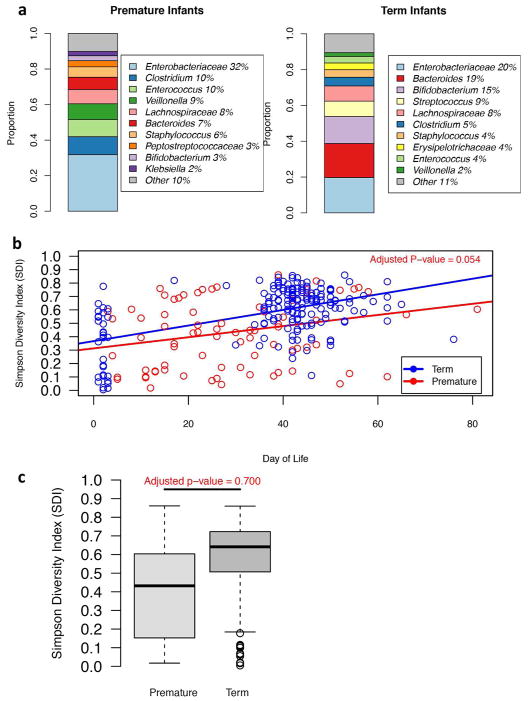
To determine the effect of gestational age at birth and postnatal exposures on gut bacterial colonization in infants, we analyzed 65 stool samples from 17 premature infants in the neonatal intensive care unit, as well as 13 samples from 13 mostly moderate-to-late premature infants and 189 samples from 176 term infants in the New Hampshire Birth Cohort Study. Gut colonization patterns were determined with 16S rDNA microbiome profiling.

RESULTS

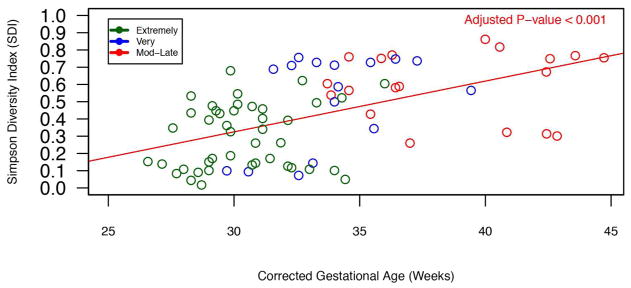
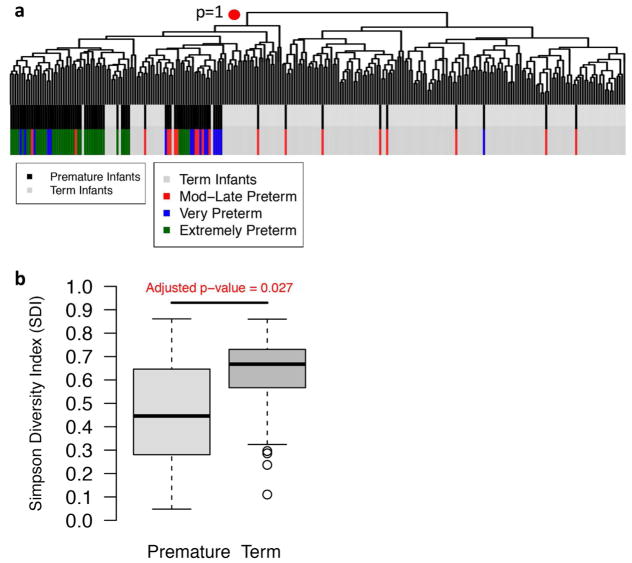
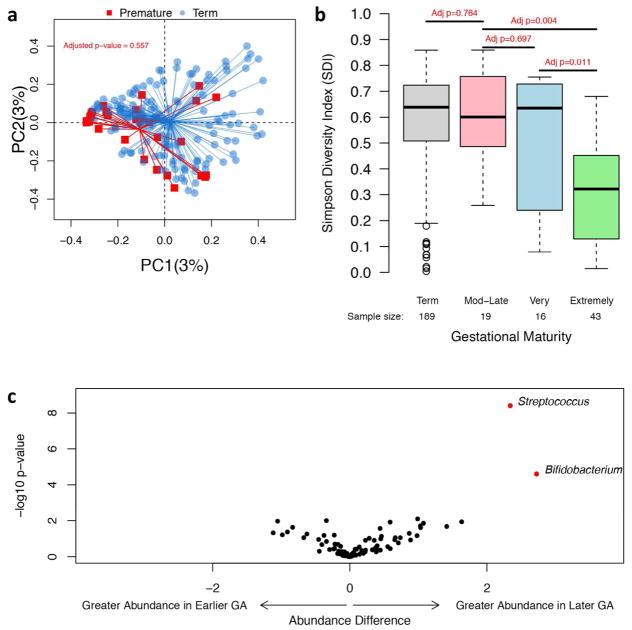
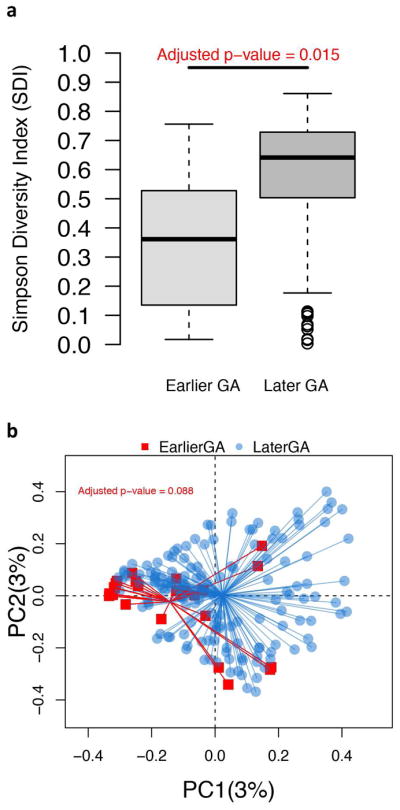
Gut bacterial alpha-diversity differed between premature and term infants at 6 weeks of age, after adjusting for exposures (p = 0.027). Alpha-diversity varied between extremely premature (<28 weeks gestation) and very premature infants (≥28 but <32 weeks, p = 0.011), as well as between extremely and moderate-to-late premature infants (≥32 and <37 weeks, p = 0.004). Newborn antibiotic use among premature infants was associated with lower Bifidobacterium and Bacteroides abundance (p = 0.015 and p = 0.041).

CONCLUSION

Gestational age at birth and early antibiotic exposure have significant effects on the premature infant gut microbiota.

摘要

背景

与足月婴儿相比,大规模队列中对出生时早产儿的成熟度对早产儿肠道微生物群的影响尚未得到广泛研究。

方法

为了确定出生时的胎龄和产后暴露对婴儿肠道细菌定植的影响,我们分析了新生儿重症监护病房 17 名早产儿的 65 份粪便样本,以及 13 名中度至晚期早产儿的 13 份样本和新罕布什尔州出生队列研究的 176 名足月婴儿的 189 份样本。使用 16S rDNA 微生物组谱分析来确定肠道定植模式。

结果

在调整了暴露因素后,6 周龄时早产儿和足月儿的肠道细菌α多样性存在差异(p=0.027)。α多样性在极早产儿(<28 周胎龄)和非常早产儿(≥28 但<32 周,p=0.011)之间以及极早产儿和中晚期早产儿(≥32 但<37 周,p=0.004)之间存在差异。早产儿中新生儿使用抗生素与双歧杆菌和拟杆菌丰度降低有关(p=0.015 和 p=0.041)。

结论

出生时的胎龄和早期抗生素暴露对早产儿的肠道微生物群有显著影响。

https://cdn.ncbi.nlm.nih.gov/pmc/blobs/6a29/6082716/a1372affaef1/nihms964261f5.jpg
https://cdn.ncbi.nlm.nih.gov/pmc/blobs/6a29/6082716/4b605ea42c46/nihms964261f1.jpg
https://cdn.ncbi.nlm.nih.gov/pmc/blobs/6a29/6082716/90ba533bf3b4/nihms964261f2.jpg
https://cdn.ncbi.nlm.nih.gov/pmc/blobs/6a29/6082716/cb6ae0a8f96b/nihms964261f3.jpg
https://cdn.ncbi.nlm.nih.gov/pmc/blobs/6a29/6082716/b876917b84c2/nihms964261f4.jpg
https://cdn.ncbi.nlm.nih.gov/pmc/blobs/6a29/6082716/a1372affaef1/nihms964261f5.jpg
https://cdn.ncbi.nlm.nih.gov/pmc/blobs/6a29/6082716/4b605ea42c46/nihms964261f1.jpg
https://cdn.ncbi.nlm.nih.gov/pmc/blobs/6a29/6082716/90ba533bf3b4/nihms964261f2.jpg
https://cdn.ncbi.nlm.nih.gov/pmc/blobs/6a29/6082716/cb6ae0a8f96b/nihms964261f3.jpg
https://cdn.ncbi.nlm.nih.gov/pmc/blobs/6a29/6082716/b876917b84c2/nihms964261f4.jpg
https://cdn.ncbi.nlm.nih.gov/pmc/blobs/6a29/6082716/a1372affaef1/nihms964261f5.jpg

相似文献

1
The premature infant gut microbiome during the first 6 weeks of life differs based on gestational maturity at birth.早产儿的肠道微生物组在生命的头 6 周内会根据出生时的胎龄而有所不同。
Pediatr Res. 2018 Jul;84(1):71-79. doi: 10.1038/s41390-018-0022-z. Epub 2018 May 23.
2
The Microbiome and Metabolome of Preterm Infant Stool Are Personalized and Not Driven by Health Outcomes, Including Necrotizing Enterocolitis and Late-Onset Sepsis.早产儿粪便的微生物组和代谢组具有个体特异性,不受健康结果(包括坏死性小肠结肠炎和晚发性败血症)驱动。
mSphere. 2018 Jun 6;3(3). doi: 10.1128/mSphere.00104-18. Print 2018 Jun 27.
3
Temporal dynamics of the very premature infant gut dominant microbiota.极早产儿肠道优势微生物群的时间动态变化。
BMC Microbiol. 2014 Dec 31;14:325. doi: 10.1186/s12866-014-0325-0.
4
Prenatal and postnatal antibiotic exposure influences the gut microbiota of preterm infants in neonatal intensive care units.产前和产后抗生素暴露会影响新生儿重症监护病房早产儿的肠道微生物群。
Ann Clin Microbiol Antimicrob. 2018 Mar 19;17(1):9. doi: 10.1186/s12941-018-0264-y.
5
Influence of maternal breast milk ingestion on acquisition of the intestinal microbiome in preterm infants.母乳摄入对早产儿肠道微生物组获得的影响。
Microbiome. 2016 Dec 30;4(1):68. doi: 10.1186/s40168-016-0214-x.
6
The development of gut microbiota in critically ill extremely low birth weight infants assessed with 16S rRNA gene based sequencing.基于16S rRNA基因测序评估危重新生极低出生体重儿肠道微生物群的发育情况。
Gut Microbes. 2014 May-Jun;5(3):304-12. doi: 10.4161/gmic.28849.
7
Feeding practice influences gut microbiome composition in very low birth weight preterm infants and the association with oxidative stress: A prospective cohort study.喂养方式影响极低出生体重早产儿的肠道微生物群组成及其与氧化应激的关系:一项前瞻性队列研究。
Free Radic Biol Med. 2019 Oct;142:146-154. doi: 10.1016/j.freeradbiomed.2019.02.032. Epub 2019 Mar 6.
8
Evolution of gut microbiota composition from birth to 24 weeks in the INFANTMET Cohort.婴儿肠道微生物组成的演变:来自 IN-FANTMET 队列的从出生到 24 周的研究。
Microbiome. 2017 Jan 17;5(1):4. doi: 10.1186/s40168-016-0213-y.
9
Longitudinal Survey of Microbiota in Hospitalized Preterm Very-Low-Birth-Weight Infants.住院早产极低出生体重儿微生物群的纵向调查。
J Pediatr Gastroenterol Nutr. 2016 Feb;62(2):292-303. doi: 10.1097/MPG.0000000000000913.
10
Maternal diet during pregnancy is related with the infant stool microbiome in a delivery mode-dependent manner.母亲孕期饮食与分娩方式依赖的婴儿粪便微生物组有关。
Microbiome. 2018 Jul 5;6(1):109. doi: 10.1186/s40168-018-0490-8.

引用本文的文献

1
Longitudinal analysis of oral microbiome changes during the neonatal period in full-term and preterm newborns.足月儿和早产儿新生儿期口腔微生物组变化的纵向分析。
J Oral Microbiol. 2025 Sep 6;17(1):2555575. doi: 10.1080/20002297.2025.2555575. eCollection 2025.
2
Review: microbial metabolites - a key to address gut inflammation and barrier dysfunction in the premature infant.综述:微生物代谢产物——解决早产儿肠道炎症和屏障功能障碍的关键
Gut Microbes. 2025 Dec;17(1):2551117. doi: 10.1080/19490976.2025.2551117. Epub 2025 Aug 31.
3
Early-life gut microbiome maturity regulates blood-brain barrier and cognitive development.
生命早期肠道微生物群成熟度调节血脑屏障和认知发育。
Gut Microbes. 2025 Dec;17(1):2551879. doi: 10.1080/19490976.2025.2551879. Epub 2025 Aug 31.
4
Changes in intestinal bacterial characteristics during hospitalization in the NICU in very low birth weight infants.极低出生体重儿在新生儿重症监护病房住院期间肠道细菌特征的变化。
Ital J Pediatr. 2025 Aug 26;51(1):263. doi: 10.1186/s13052-025-02095-4.
5
Fecal 16S rRNA sequencing and metabolomics reveal abnormal metabolism activity in preterm infants with different gestational ages.粪便16S rRNA测序和代谢组学揭示不同胎龄早产儿的代谢活动异常。
Front Cell Infect Microbiol. 2025 May 26;15:1530653. doi: 10.3389/fcimb.2025.1530653. eCollection 2025.
6
Citrobacter and Acinetobacter are respectively involved in feeding intolerance in preterm infants of different gestational ages: a prospective case-control study.柠檬酸杆菌和不动杆菌分别与不同胎龄早产儿的喂养不耐受有关:一项前瞻性病例对照研究。
Ital J Pediatr. 2025 Jun 9;51(1):184. doi: 10.1186/s13052-025-02034-3.
7
Dysbiotic Microbiota in Necrotizing Enterocolitis: Insights into Pathogenesis, Treatment, and Prevention.坏死性小肠结肠炎中的生态失调微生物群:对发病机制、治疗和预防的见解
Gastroenterol Clin North Am. 2025 Jun;54(2):415-427. doi: 10.1016/j.gtc.2024.11.001. Epub 2025 Jan 24.
8
Short-chain fatty acids-a key link between the gut microbiome and T-lymphocytes in neonates?短链脂肪酸——新生儿肠道微生物群与T淋巴细胞之间的关键纽带?
Pediatr Res. 2025 Apr 30. doi: 10.1038/s41390-025-04075-0.
9
Progression of gut microbiome in preterm infants during the first three months.早产儿出生后头三个月肠道微生物群的发展
Sci Rep. 2025 Apr 9;15(1):12104. doi: 10.1038/s41598-025-95198-1.
10
Gut Microbiota Alteration in Healthy Preterm Infants: An Observational Study from Tertiary Care Center in India.印度三级医疗中心对健康早产儿肠道微生物群变化的一项观察性研究。
Microorganisms. 2025 Mar 3;13(3):577. doi: 10.3390/microorganisms13030577.