Department of Psychology, Bournemouth University, Fern Barrow, Poole, Dorset, BH12 5BB UK.
Mol Autism. 2018 May 18;9:33. doi: 10.1186/s13229-018-0216-6. eCollection 2018.
Sex differences in autistic symptomatology are believed to contribute to the mis- and missed diagnosis of many girls and women with an autism spectrum condition (ASC). Whilst recent years have seen the emergence of clinical and empirical reports delineating the profile of young autistic girls, recognition of sex differences in symptomatology in adulthood is far more limited.
We chose here to focus on symptomatology as reported using a screening instrument, the Ritvo Autism Asperger Diagnostic Scale-Revised (RAADS-R). In a meta-analysis, we pooled and analysed RAADS-R data from a number of experimental groups. Analysis of variance (ANOVA) searched for the presence of main effects of Sex and Diagnosis and for interactions between these factors in our sample of autistic and non-autistic adults.
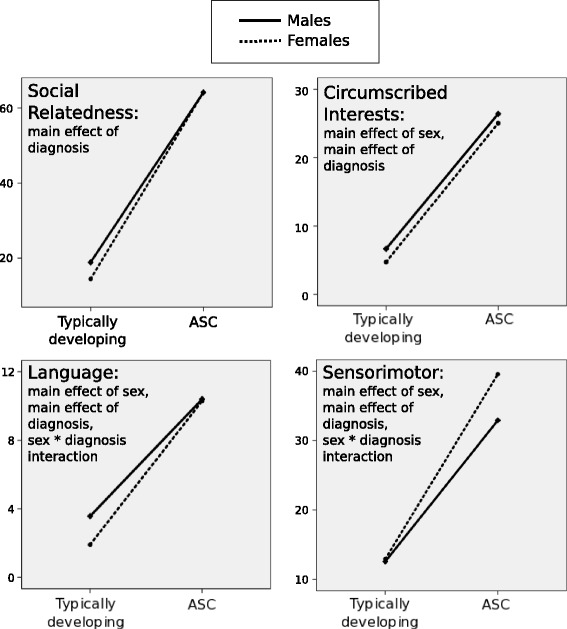
In social relatedness and circumscribed interests, main effects of Diagnosis revealed that as expected, autistic adults reported significantly greater lifetime prevalence of symptoms in these domains; an effect of Sex, in circumscribed interests, also suggested that males generally reported more prevalent symptoms than females. An interaction of Sex and Diagnosis in language symptomatology revealed that a normative sex difference in language difficulties was attenuated in autism. An interaction of Sex and Diagnosis in the sensorimotor domain revealed the opposite picture: a lack of sex differences between typically developing men and women and a greater prevalence of sensorimotor symptoms in autistic women than autistic men.
We discuss the literature on childhood sex differences in relation to those which emerged in our adult sample. Where childhood sex differences fail to persist in adulthood, several interpretations exist, and we discuss, for example, an inherent sampling bias that may mean that only autistic women most similar to the male presentation are diagnosed. The finding that sensorimotor symptomatology is more highly reported by autistic women is a finding requiring objective confirmation, given its potential importance in diagnosis.
据信,自闭症谱系障碍(ASD)患者的性别差异导致许多女孩和女性被误诊或漏诊。尽管近年来出现了描述年轻自闭症女孩特征的临床和实证报告,但对成年自闭症患者性别差异的认识还远远不够。
我们选择了使用筛查工具 Ritvo 自闭症和阿斯伯格诊断量表修订版(RAADS-R)来报告的症状作为研究重点。在一项荟萃分析中,我们汇总并分析了来自多个实验组的 RAADS-R 数据。方差分析(ANOVA)用于寻找我们的自闭症和非自闭症成年患者样本中性别和诊断的主要影响以及这些因素之间的相互作用。
在社交关联性和狭隘兴趣方面,诊断的主要影响表明,正如预期的那样,自闭症成年人报告了这些领域中症状的终生患病率明显更高;性别在狭隘兴趣方面的影响也表明,男性通常报告的症状更为普遍。语言症状的性别和诊断的相互作用表明,自闭症中语言困难的正常性别差异减弱。感觉运动领域的性别和诊断的相互作用则揭示了相反的情况:在典型发育的男性和女性之间没有性别差异,而自闭症女性比自闭症男性更普遍地出现感觉运动症状。
我们讨论了与成年样本中出现的性别差异相关的儿童时期的文献。在成年时期,一些性别差异不再存在,存在多种解释,例如,可能存在一种固有的抽样偏差,即只有最类似于男性表现的自闭症女性被诊断出来。自闭症女性报告的感觉运动症状更为普遍,这是一个需要客观确认的发现,因为它对诊断具有潜在的重要性。