Nabi Razieh, Shpitser Ilya
Computer Science Department, Johns Hopkins University.
Proc AAAI Conf Artif Intell. 2018 Feb;2018:1931-1940. Epub 2018 Apr 25.
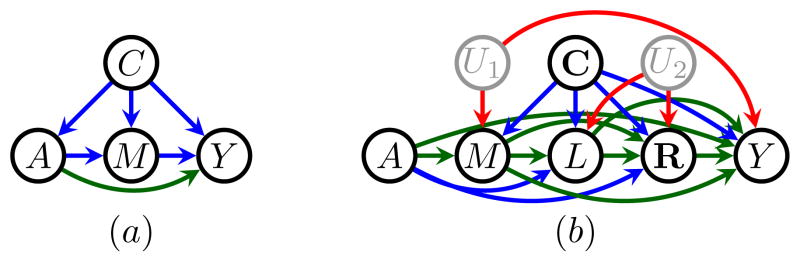
In this paper, we consider the problem of fair statistical inference involving outcome variables. Examples include classification and regression problems, and estimating treatment effects in randomized trials or observational data. The issue of fairness arises in such problems where some covariates or treatments are "sensitive," in the sense of having potential of creating discrimination. In this paper, we argue that the presence of discrimination can be formalized in a sensible way as the presence of an effect of a sensitive covariate on the outcome along certain causal pathways, a view which generalizes (Pearl 2009). A fair outcome model can then be learned by solving a constrained optimization problem. We discuss a number of complications that arise in classical statistical inference due to this view and provide workarounds based on recent work in causal and semi-parametric inference.
在本文中,我们考虑涉及结果变量的公平统计推断问题。示例包括分类和回归问题,以及在随机试验或观测数据中估计治疗效果。在这类问题中,如果某些协变量或治疗方法具有产生歧视的可能性,那么公平性问题就会出现。在本文中,我们认为,歧视的存在可以以一种合理的方式形式化为敏感协变量沿着某些因果路径对结果产生的影响,这一观点是对(Pearl,2009年)观点的推广。然后,可以通过解决一个约束优化问题来学习公平结果模型。我们讨论了由于这种观点在经典统计推断中出现的一些复杂情况,并根据因果和半参数推断方面的最新工作提供了解决方法。