Department of Biomedical Engineering, Johns Hopkins University, United States.
Department of Radiology, Memorial Sloan Kettering Cancer Center, United States.
Nucl Med Biol. 2018 Jul-Aug;62-63:1-8. doi: 10.1016/j.nucmedbio.2018.05.003. Epub 2018 May 8.
Radium-223 dichloride is the first alpha-particle emitting therapeutic agent approved by FDA and EMA for bone metastatic castration-resistant prostate cancer. We studied its age-dependent biodistribution in mice, and compared it with [Tc]Tc-MDP and [F]NaF aiming to identify a potential imaging surrogate to predict [Ra]RaCl whole-body localization.
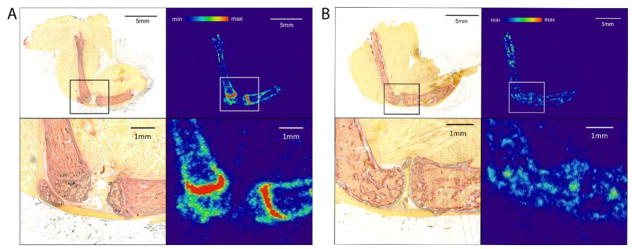
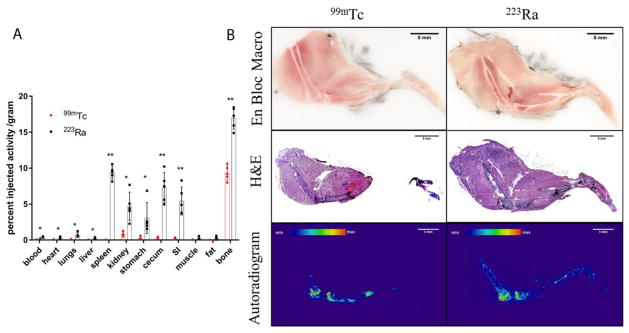
Male C57Bl/6 mice dosed with [Ra]RaCl were sacrificed at different time points to explore [Ra]RaCl whole-body distribution. In another experiment, mice at different ages were dosed with [Ra]RaCl to evaluate the aging impact. Finally, [Tc]Tc-MDP and [F]NaF were administered to mice, and we compared their biodistributions with [Ra]RaCl. Detailed micro-localization of each tracer was visualized using autoradiography and histochemical staining.
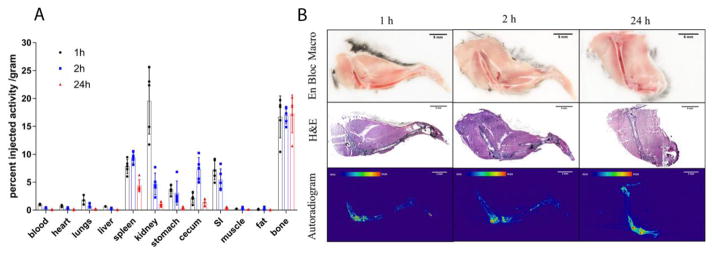
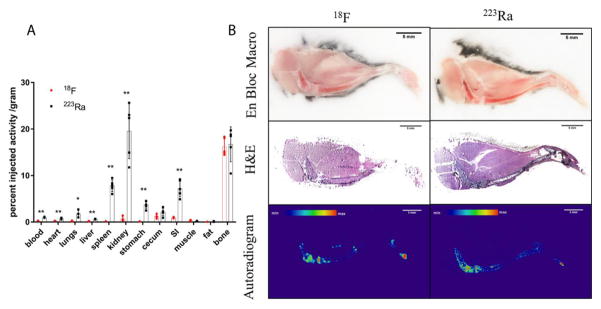
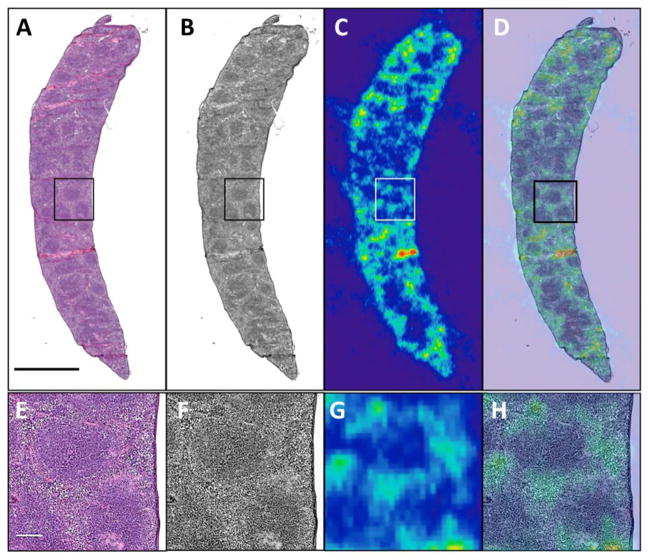
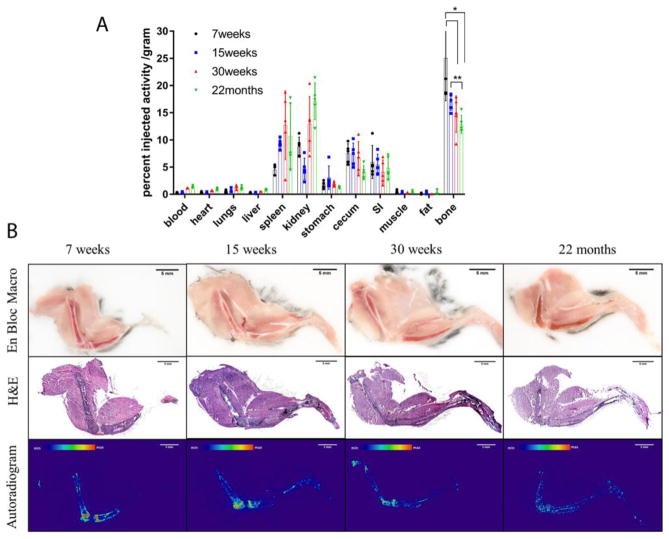
[Ra]RaCl uptake in bone was rapid and stable. We observed persistent localization at bone epiphyses, as well as the red pulp of the spleen, while its uptake in most soft tissues cleared within 24 h. [Ra]RaCl distribution in soft tissues is similar in all age groups tested, while bone activity significantly decreased with aging. Although the diagnostic tracers cleared much faster from soft tissues than the therapeutic radionuclide, [Tc]Tc-MDP and [F]NaF both co-localized with [Ra]RaCl in the skeletal compartment.
Radium-223 localization to the bone is dependent on age-varying factors, which implies that radium-223 dosimetry should take patient age into account. [Tc]Tc-MDP shows a different biodistribution from [Ra]RaCl, both in soft tissues and in bone. [F]NaF presents a high similarity with [Ra]RaCl in skeletal uptake, which validates the potential of [F]NaF as an imaging surrogate to predict radium-223 radiotherapeutic distribution in bone.
镭-223 二氯化物是 FDA 和 EMA 批准的首个用于治疗去势抵抗性前列腺癌骨转移的α粒子发射治疗药物。我们研究了其在小鼠中的年龄依赖性生物分布,并与[Tc]Tc-MDP 和[F]NaF 进行了比较,旨在寻找一种潜在的成像替代物来预测[Ra]RaCl 的全身定位。
雄性 C57Bl/6 小鼠给予[Ra]RaCl 后,在不同时间点处死,以探索[Ra]RaCl 的全身分布。在另一个实验中,不同年龄的小鼠给予[Ra]RaCl,以评估年龄的影响。最后,给予小鼠[Tc]Tc-MDP 和[F]NaF,并比较它们与[Ra]RaCl 的生物分布。使用放射自显影和组织化学染色详细观察每个示踪剂的微定位。
[Ra]RaCl 在骨骼中的摄取快速且稳定。我们观察到骨骺和脾脏红髓的持续定位,而大多数软组织中的摄取在 24 小时内清除。在测试的所有年龄组中,[Ra]RaCl 在软组织中的分布相似,而骨骼活性随年龄增长显著下降。尽管诊断示踪剂从软组织中清除的速度比治疗性放射性核素快得多,但[Tc]Tc-MDP 和[F]NaF 都与骨骼部位的[Ra]RaCl 共定位。
镭-223 对骨骼的定位取决于随年龄变化的因素,这意味着镭-223 剂量学应考虑患者年龄。[Tc]Tc-MDP 在软组织和骨骼中的分布与[Ra]RaCl 不同。[F]NaF 在骨骼摄取方面与[Ra]RaCl 高度相似,这验证了[F]NaF 作为预测镭-223 放射性治疗在骨骼中分布的成像替代物的潜力。