School of Public Health, The University of Hong Kong, Hong Kong Special Administrative Region; School of Public Health and Health Policy, City University of New York, New York, NY, USA.
School of Public Health, The University of Hong Kong, Hong Kong Special Administrative Region.
Int J Cardiol. 2018 Sep 15;267:171-176. doi: 10.1016/j.ijcard.2018.05.051. Epub 2018 May 18.
Testosterone supplementation has been linked to increased cardiovascular disease risk in some observational studies. The causal role of testosterone can be investigated using a Mendelian randomization approach.
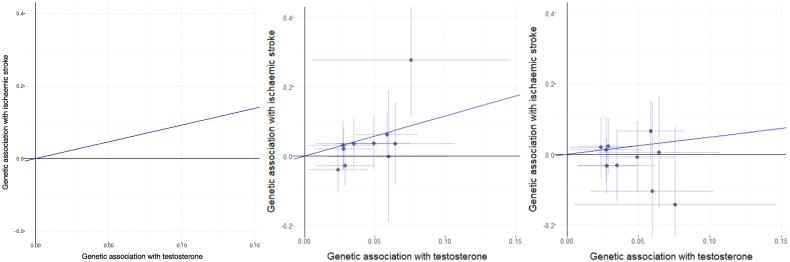
We assessed genetic associations of variants in two gene regions (SHBG and JMJD1C) with several cardiovascular risk factors (lipids, adiponectin, blood pressure, anthropometric traits) plus male pattern baldness, including control outcomes and potential mediators. We assessed genetic associations with coronary artery disease (CAD) risk in the CARDIoGRAMplusC4D consortium (171,191 individuals including 60,801 cases), and associations with CAD and ischaemic stroke risk in the UK Biobank (367,643 individuals including 25,352 CAD cases and 3650 ischaemic stroke cases). Genetic predictors of increased serum testosterone were associated with lipids, blood pressure, and height. There was some evidence of an association with risk of CAD (SHBG gene region: odds ratio (OR) 0.95 per 1 unit increase in log-transformed testosterone [95% confidence interval: 0.81-1.12, p = 0.55]; JMJD1C gene region: OR 1.24 [1.01-1.51, p = 0.04]) and ischaemic stroke both overall (SHBG: OR 1.05 [0.64, 1.73, p = 0.83]; JMJD1C: OR 2.52 [1.33, 4.77, p = 0.005]) and in men. However, associations with some control outcomes were in the opposite direction to that expected.
Sex hormone-related mechanisms appear to be relevant to cardiovascular risk factors and for stroke (particularly for men). However, the extent that these findings are specifically informative about endogenous testosterone or testosterone supplementation is unclear. These findings underline a fundamental limitation for the use of Mendelian randomization where biological knowledge about the function of genetic variants is uncertain.
一些观察性研究表明,睾酮补充与心血管疾病风险增加有关。使用孟德尔随机化方法可以研究睾酮的因果作用。
我们评估了两个基因区域(SHBG 和 JMJD1C)中的变体与多种心血管风险因素(脂质、脂联素、血压、人体测量特征)以及男性型秃发的遗传相关性,包括对照结果和潜在的中介物。我们评估了在 CARDIoGRAMplusC4D 联盟(包括 60801 例病例在内的 171191 人)中与冠状动脉疾病(CAD)风险相关的遗传相关性,以及在英国生物库(包括 367643 人在内的 25352 例 CAD 病例和 3650 例缺血性中风病例)中与 CAD 和缺血性中风风险相关的遗传相关性。增加血清睾酮的遗传预测因子与脂质、血压和身高有关。有一些证据表明与 CAD 风险相关(SHBG 基因区域:每增加一个单位的睾酮[95%置信区间:0.81-1.12,p=0.55])和缺血性中风(整体:SHBG:OR 1.05 [0.64,1.73,p=0.83];JMJD1C:OR 2.52 [1.33,4.77,p=0.005]),总体和男性均如此。然而,一些对照结果的相关性与预期相反。
性激素相关机制似乎与心血管风险因素和中风(特别是男性)有关。然而,这些发现是否特别有助于了解内源性睾酮或睾酮补充,目前尚不清楚。这些发现强调了在生物学上对遗传变异功能的认识不确定的情况下,孟德尔随机化的基本局限性。