Zoet Harmen A, Wagenmans Anouk, van Minnen Agnes, de Jongh Ad
Research Department, PSYTREC, Bilthoven, The Netherlands.
Behavioural Science Institute (BSI), Radboud University Nijmegen, Nijmegen, The Netherlands.
Eur J Psychotraumatol. 2018 May 18;9(1):1468707. doi: 10.1080/20008198.2018.1468707. eCollection 2018.
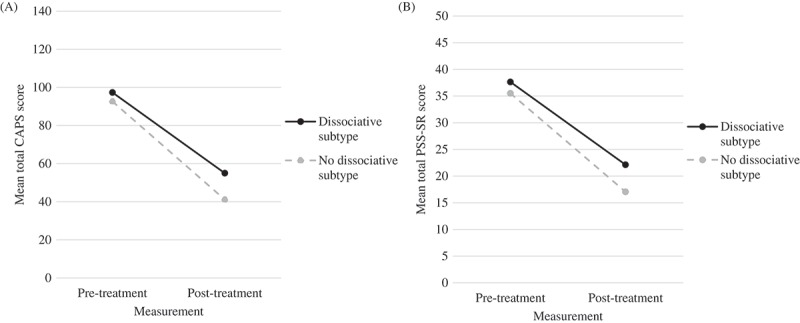
: There is a widely-held belief in the trauma field that the presence of dissociative symptoms is associated with poor treatment response. However, previous research on the effect of dissociation in treatment outcomes pertained to specific patients and trauma populations. : To test the hypothesis that the presence of the dissociative subtype of PTSD (DS) would have a detrimental effect on the outcome of an intensive trauma-focused treatment programme. : PTSD symptom scores (Clinician Administered PTSD Scale [CAPS] and PTSD Symptom Scale Self-Report [PSS-SR]) were analysed using the data of 168 consecutive patients (70.6% female) who had been exposed to a wide variety of multiple traumas, including childhood sexual abuse, and of whom 98.2% were diagnosed with severe PTSD (CAPS > 65). Most of them suffered from multiple comorbidities and 38 (22.6%) met the criteria for DS. They took part in an intensive trauma-focused treatment programme for PTSD. Pre- and post-treatment differences were compared between patients with and without DS. : Large effect sizes were achieved for PTSD symptom reduction on CAPS and the PSS-SR, both for patients with DS and those without. Although patients with DS showed a significantly greater PTSD symptom severity at the beginning, and throughout, treatment, both groups showed equal reductions in PTSD symptoms. Of those who met the criteria for DS, 26 (68.4%) no longer fulfilled the criteria for this classification after treatment. : The results provide no support for the notion that the presence of DS negatively impacts trauma-focused treatment outcomes. Accordingly, PTSD patients with DS should not be denied effective trauma-focused treatments.
在创伤领域,人们普遍认为解离症状的存在与治疗反应不佳有关。然而,先前关于解离对治疗结果影响的研究涉及特定患者和创伤人群。:为了检验创伤后应激障碍解离亚型(DS)的存在会对强化的以创伤为重点的治疗方案的结果产生不利影响这一假设。:使用168例连续患者(70.6%为女性)的数据,分析创伤后应激障碍症状评分(临床医生管理的创伤后应激障碍量表[CAPS]和创伤后应激障碍症状量表自我报告[PSS-SR]),这些患者遭受了各种各样的多重创伤,包括童年期性虐待,其中98.2%被诊断为重度创伤后应激障碍(CAPS>65)。他们中的大多数患有多种共病,38例(22.6%)符合DS标准。他们参加了一项针对创伤后应激障碍的强化以创伤为重点的治疗方案。比较了有DS和无DS患者治疗前后的差异。:对于有DS和无DS的患者,CAPS和PSS-SR上的创伤后应激障碍症状减轻均取得了较大的效应量。尽管有DS的患者在治疗开始时和整个治疗过程中创伤后应激障碍症状严重得多,但两组的创伤后应激障碍症状减轻程度相同。在符合DS标准的患者中,26例(68.4%)在治疗后不再符合该分类标准。:结果不支持DS的存在会对以创伤为重点的治疗结果产生负面影响这一观点。因此,不应拒绝为患有DS的创伤后应激障碍患者提供有效的以创伤为重点的治疗。