Division of Hematology-Oncology, Department of Medicine, Samsung Medical Center, Sungkyunkwan University School of Medicine, Seoul, Korea.
Samsung Genome Institute, Samsung Medical Center, Seoul, Korea.
Cancer Res Treat. 2019 Jan;51(1):408-412. doi: 10.4143/crt.2018.138. Epub 2018 May 23.
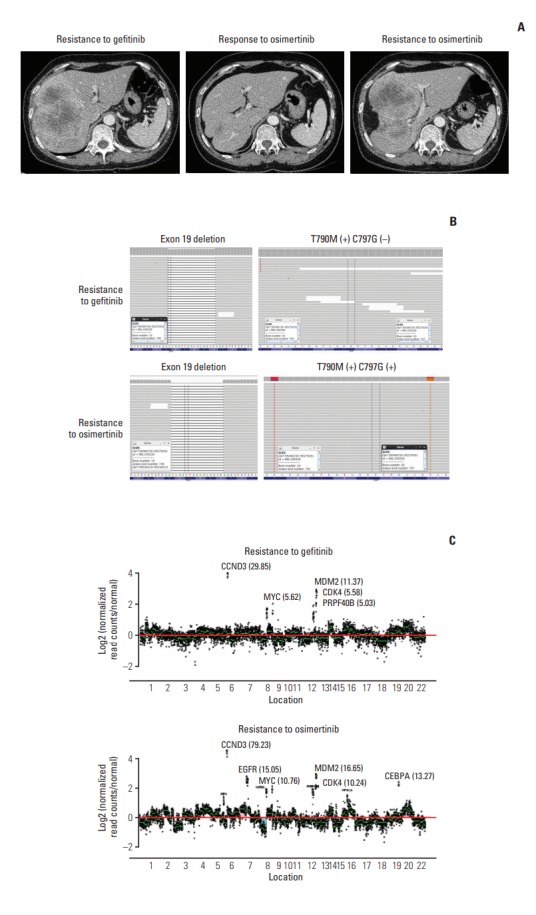
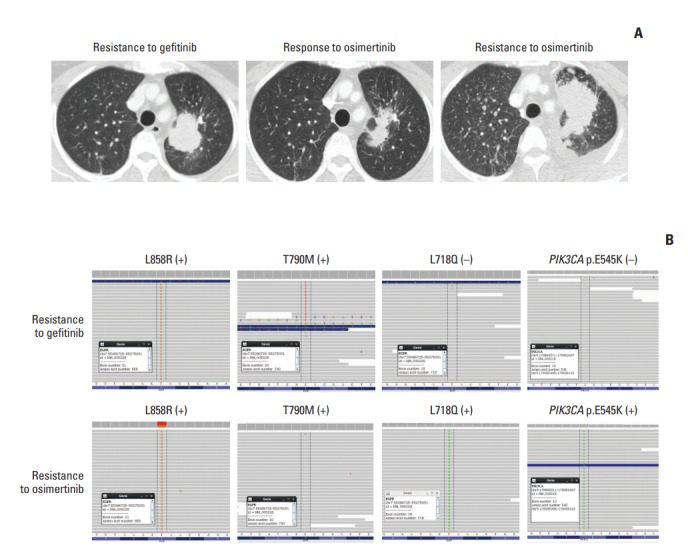
Epidermal growth factor receptor (EGFR)‒tyrosine kinase inhibitors (TKIs) are effective clinical therapeutics for EGFR-mutant non-small cell lung cancer (NSCLC). Osimertinib, a thirdgeneration EGFR TKI, has proven effective against T790M mutations. However, the vast majority of patients acquire resistance following successful treatment. A 59-year-old female patient with metastatic NSCLC developed resistance after 43 weeks of osimertinib. CancerSCAN of the metastatic liver lesion revealed a EGFR C797G mutation at an allele frequency of 72%, a preexisting T790M mutation (73%) in cis and an exon 19 deletion (87%). Another 53-year-old female patient developed systemic progression after 10 months of osimertinib. CancerSCAN of the lung biopsy identified an EGFR L718Q mutation at an allele frequency of 7%, concomitant PIK3CA E545K (12.90%) and preexisting EGFR L858R (38%), but loss of the T790M mutation. The heterogeneity of osimertinib resistance mechanisms warrants further investigation into novel or combination agents to overcome the rare acquired resistances.
表皮生长因子受体(EGFR)-酪氨酸激酶抑制剂(TKI)是治疗 EGFR 突变型非小细胞肺癌(NSCLC)的有效临床疗法。奥希替尼是一种第三代 EGFR TKI,对 T790M 突变有效。然而,绝大多数患者在成功治疗后会产生耐药性。一名 59 岁的女性转移性 NSCLC 患者在接受奥希替尼治疗 43 周后产生耐药性。转移性肝脏病变的 CancerSCAN 显示 EGFR C797G 突变等位基因频率为 72%,顺式存在的 T790M 突变(73%)和外显子 19 缺失(87%)。另一名 53 岁的女性患者在接受奥希替尼治疗 10 个月后出现全身进展。肺活检的 CancerSCAN 显示 EGFR L718Q 突变等位基因频率为 7%,同时存在 PIK3CA E545K(12.90%)和先前存在的 EGFR L858R(38%),但 T790M 突变丢失。奥希替尼耐药机制的异质性需要进一步研究新型或联合药物以克服罕见的获得性耐药。