CAS Key Laboratory of Separation Science for Analytical Chemistry, Dalian Institute of Chemical Physics , Chinese Academy of Sciences , Dalian , Liaoning , 116023 , China.
University of Chinese Academy of Sciences , Beijing 100049 , China.
Anal Chem. 2018 Jun 19;90(12):7608-7616. doi: 10.1021/acs.analchem.8b01331. Epub 2018 Jun 8.
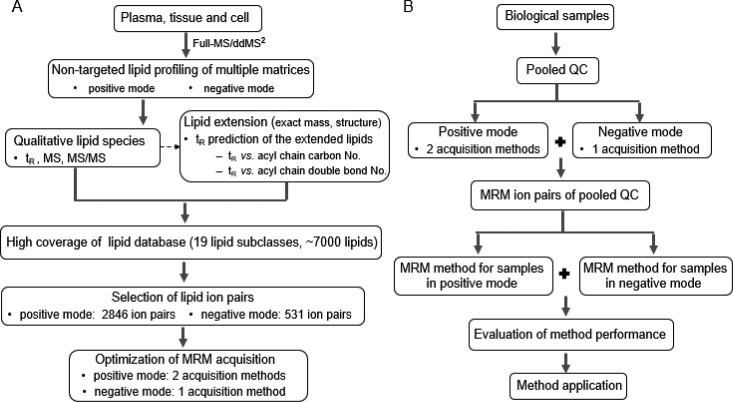
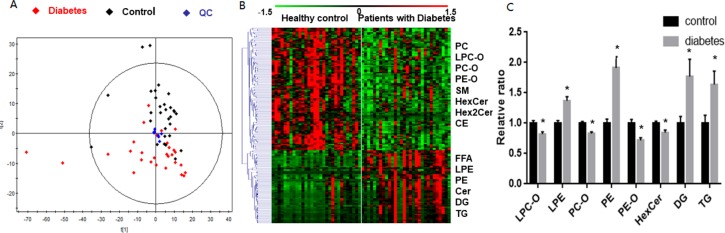
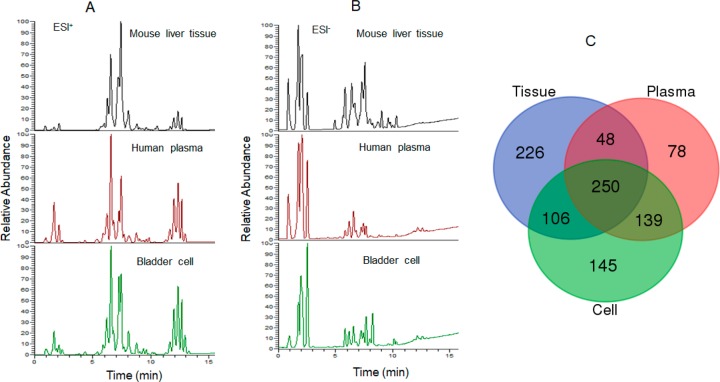
Lipid coverage is crucial in comprehensive lipidomics studies challenged by high diversity in lipid structures and wide dynamic range in lipid levels. Current state-of-the-art lipidomics technologies are mostly based on mass spectrometry (MS), including direct-infusion MS, chromatography-MS, and matrix-assisted laser desorption ionization (MALDI) imaging MS, each with its pros and cons. Due to the need or favorability for measurement of isomers and isobars, chromatography-MS is preferable for lipid profiling. The ultra-high performance liquid chromatography-high resolution mass spectrometry (UHPLC-HRMS)-based nontargeted lipidomics approach and UHPLC-tandem MS (UHPLC-MS/MS)-based targeted approach are two representative methodological platforms for chromatography-MS. In the present study, we developed a high coverage pseudotargeted lipidomics method combining the advantages of nontargeted and targeted lipidomics approaches. The high coverage of lipids was achieved by integration of the detected lipids derived from nontargeted UHPLC-HRMS lipidomics analysis of multiple matrices (e.g., plasma, cell, and tissue) and the predicted lipids speculated on the basis of the structure and chromatographic retention behavior of the known lipids. A total of 3377 targeted lipid ion pairs with over 7000 lipid molecular structures were defined. The pseudotargeted lipidomics method was well validated with satisfactory analytical characteristics in terms of linearity, precision, reproducibility, and recovery for lipidomics profiling. Importantly, it showed better repeatability and higher coverage of lipids than the nontargeted lipidomics method. The applicability of the developed pseudotargeted lipidomics method was testified in defining differential lipids related to diabetes. We believe that comprehensive lipidomics studies will benefit from the developed high coverage pseudotargeted lipidomics approach.
脂质覆盖是全面脂质组学研究的关键,脂质结构的多样性和脂质水平的广泛动态范围带来了挑战。目前最先进的脂质组学技术大多基于质谱(MS),包括直接进样 MS、色谱-MS 和基质辅助激光解吸电离(MALDI)成像 MS,每种技术都有其优缺点。由于需要或偏好测量异构体和同位素,色谱-MS 更适合脂质分析。基于超高效液相色谱-高分辨质谱(UHPLC-HRMS)的非靶向脂质组学方法和基于 UHPLC-串联质谱(UHPLC-MS/MS)的靶向方法是色谱-MS 的两种代表性方法学平台。在本研究中,我们开发了一种高覆盖度的伪靶向脂质组学方法,结合了非靶向和靶向脂质组学方法的优势。通过整合来自多种基质(如血浆、细胞和组织)的非靶向 UHPLC-HRMS 脂质组学分析中检测到的脂质和基于已知脂质的结构和色谱保留行为推测的预测脂质,实现了脂质的高覆盖度。共定义了 3377 个靶向脂质离子对和超过 7000 个脂质分子结构。该伪靶向脂质组学方法具有令人满意的分析特性,如线性、精密度、重现性和脂质组学分析的回收率,得到了很好的验证。重要的是,与非靶向脂质组学方法相比,它显示出更好的重复性和更高的脂质覆盖率。该方法在定义与糖尿病相关的差异脂质方面的适用性得到了验证。我们相信,开发的高覆盖度伪靶向脂质组学方法将有益于全面的脂质组学研究。