Department of General Surgery, Renhe Hospital of China, Three Gorges University, Yichang, Hubei, China (mainland).
Department of Oncology, Renhe Hospital of China, Three Gorges University, Yichang, Hubei, China (mainland).
Med Sci Monit. 2018 May 29;24:3571-3577. doi: 10.12659/MSM.907038.
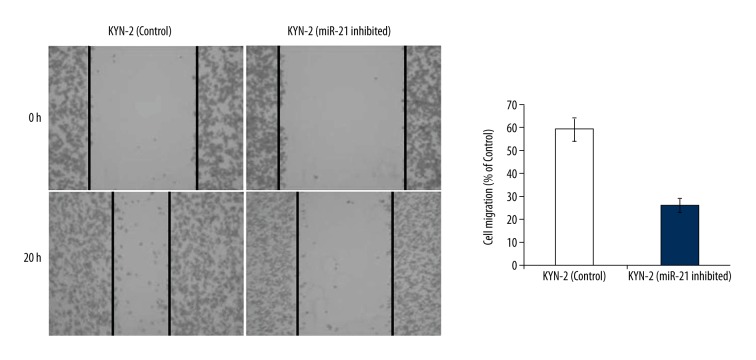
BACKGROUND Liver cancer is considered one of the main causes of cancer related deaths across the globe. Moreover, the incidence of liver cancer in developed countries is likely to increase in future. The increase in the incidence of liver cancer, the limited availability of standard treatments, and the side effects of the existing drugs demands exploration and identification of new targets and treatment strategies for liver cancer. In this context, the present study investigated the potential of miR-21 as the therapeutic target for the management of liver cancer. MATERIAL AND METHODS Total RNA was extracted by RNA isolation kit (RNeasy) as per the manufacturer's instructions. The cDNA synthesis was carried out with the help of RevertAid cDNA synthesis kit (Fermentas). Expression analysis was performed by quantitative RT-PCR. Cell proliferation was examined by CellTiter 96 aqueous one cell proliferation assay kit (Promega) as per manufacturer's guidelines. Apoptosis was detected by DAPI and Annexin V/PI staining. Cell migration was assessed by wound healing assay. MicroRNA-383 target was delimited by TargetScan software. Protein expression analysis was evaluated by western blotting. RESULTS Our results revealed that miR-21 was significantly upregulated in liver cancer cells. However, downregulation of miR-21 inhibited cancer cell proliferation, promoted apoptosis, inhibited cell migration, and triggered cell cycle arrest in KYN-2 liver cancer cells. Additionally, in silico analysis revealed PTEN to be the downstream target of miR-21, which was further confirmed by expression analysis through western blotting. CONCLUSIONS Our results reveal that miR-21 might prove to be an important target for the management of liver cancer.
肝癌被认为是全球癌症相关死亡的主要原因之一。此外,发达国家的肝癌发病率在未来可能会增加。肝癌发病率的增加、标准治疗方法的有限可用性以及现有药物的副作用,要求我们探索和确定肝癌的新靶点和治疗策略。在这种情况下,本研究探讨了 miR-21 作为肝癌治疗靶点的潜力。
按照制造商的说明,使用 RNA 分离试剂盒(RNeasy)提取总 RNA。在 RevertAid cDNA 合成试剂盒(Fermentas)的帮助下进行 cDNA 合成。通过定量 RT-PCR 进行表达分析。根据制造商的指南,使用 CellTiter 96 水性单细胞增殖测定试剂盒(Promega)检查细胞增殖。通过 DAPI 和 Annexin V/PI 染色检测细胞凋亡。通过划痕愈合试验评估细胞迁移。使用 TargetScan 软件划定 microRNA-383 的靶位。通过 Western 印迹评估蛋白质表达分析。
我们的结果表明,miR-21 在肝癌细胞中显著上调。然而,miR-21 的下调抑制了癌细胞增殖,促进了细胞凋亡,抑制了细胞迁移,并在 KYN-2 肝癌细胞中引发了细胞周期停滞。此外,通过 Western 印迹进行的表达分析进一步证实了 PTEN 是 miR-21 的下游靶标。
我们的结果表明,miR-21 可能成为肝癌治疗的一个重要靶点。