Chen Xingyuan, Khalid Khan, Chen Dandan, Qiu Chen
Department of Respiratory and Critical Care Medicine, Shenzhen People's Hospital (The Second Clinical Medical College of Jinan University), Shenzhen Institute of Respiratory Diseases, Shenzhen 518003, China.
Ann Transl Med. 2020 Apr;8(7):494. doi: 10.21037/atm.2020.03.213.
Neutrophils are a key component of inflammation in asthma. Olfactomedin 4 (OLFM4) is produced by neutrophils and has been reported to be associated with asthma inflammation. We hypothesized that serum OLFM4 may be increased in asthmatic individuals and can assist with predicting asthma control state.
A total of 79 individuals were enrolled from Shenzhen People's Hospital, China and divided into 3 groups: uncontrolled asthmatics (n=35), controlled asthmatics (n=14), and healthy controls (n=30). The serum OLFM4 level was measured by enzyme-linked immunosorbent assay (ELISA). Clinical characteristics (such as age, gender, allergy history, body mass index (BIM), and smoking history), clinical indicators (such as whole blood count, sputum neutrophil, sputum eosinophil, forced expiratory volume in one second as percentage of predicted volume (FEV1% pred), IgE level, high sensitivity C-reactive protein (hs-CRP), and fractional expiratory nitric oxide (FeNO) were measured and the three groups were compared. The correlation between OLFM4 and the clinical characteristics and indicators was then evaluated. Finally, stepwise multiple regression analysis was performed to determine the contribution of clinical characteristics and clinical indicators influencing serum OLFM4 level.
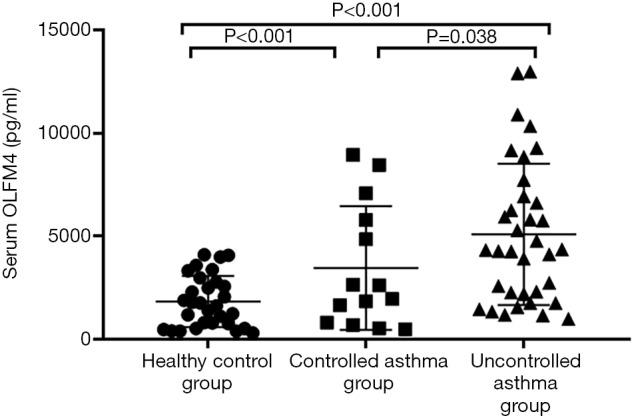
Our results showed that the serum OLFM4 level was increased two-fold in the controlled asthma group (3,450.38±3,000.35 pg/mL) and three-fold in the uncontrolled asthma group (5,084.57±3,425.76 pg/mL), compared to the healthy control group (1,830.11±1,239.70 ng/mL) (P<0.001). We found a positive correlation between serum OLFM4 level and sputum neutrophils (P<0.001). OLFM4 was also found to be related to both hs-CRP level (P=0.007*) and blood neutrophil count (P<0.001). There were no significant associations identified between OLFM4 and age, gender, BMI, allergy, blood eosinophils, blood neutrophils, IgE, FeNO, or FEV1% pred.
Serum OLFM4 levels were increased in patients with asthma (the controlled asthma and uncontrolled asthma groups). There was a significant correlation between serum OLFM4 and levels of sputum neutrophil and hs-CRP, and OLFM4 was also related to both Hs-CRP level and blood neutrophil count. Serum OLFM4 level may serve as a useful biomarker for assessing asthma control state in asthmatic adults.
中性粒细胞是哮喘炎症的关键组成部分。嗅觉介质4(OLFM4)由中性粒细胞产生,据报道与哮喘炎症相关。我们推测哮喘患者血清OLFM4可能升高,并有助于预测哮喘控制状态。
从中国深圳市人民医院招募了79名个体,分为3组:未控制的哮喘患者(n = 35)、已控制的哮喘患者(n = 14)和健康对照者(n = 30)。采用酶联免疫吸附测定(ELISA)法检测血清OLFM4水平。测量临床特征(如年龄、性别、过敏史、体重指数(BIM)和吸烟史)、临床指标(如全血细胞计数、痰液中性粒细胞、痰液嗜酸性粒细胞、一秒用力呼气容积占预计值百分比(FEV1%pred)、IgE水平、高敏C反应蛋白(hs-CRP)和呼出一氧化氮分数(FeNO)),并对三组进行比较。然后评估OLFM4与临床特征和指标之间的相关性。最后,进行逐步多元回归分析,以确定影响血清OLFM4水平的临床特征和临床指标的作用。
我们的结果显示,与健康对照组(1,830.11±1,239.70 ng/mL)相比,已控制哮喘组血清OLFM4水平升高了两倍(3,450.38±3,000.35 pg/mL),未控制哮喘组升高了三倍(5,084.57±3,425.76 pg/mL)(P<0.001)。我们发现血清OLFM4水平与痰液中性粒细胞之间呈正相关(P<0.001)。还发现OLFM4与hs-CRP水平(P = 0.007*)和血液中性粒细胞计数均相关(P<0.001)。未发现OLFM4与年龄、性别、BMI、过敏、血液嗜酸性粒细胞、血液中性粒细胞、IgE、FeNO或FEV1%pred之间存在显著关联。
哮喘患者(已控制哮喘组和未控制哮喘组)血清OLFM4水平升高。血清OLFM4与痰液中性粒细胞水平和hs-CRP之间存在显著相关性,且OLFM4也与Hs-CRP水平和血液中性粒细胞计数相关。血清OLFM4水平可能是评估成年哮喘患者哮喘控制状态的有用生物标志物。