1 Clem Jones Centre for Neurobiology and Stem Cell Research, Griffith Institute for Drug Discovery, Griffith University, Nathan, Queensland, Australia.
2 Menzies Health Institute Queensland, Griffith University, Southport, Queensland, Australia.
Cell Transplant. 2018 Jun;27(6):867-878. doi: 10.1177/0963689718759472. Epub 2018 May 31.
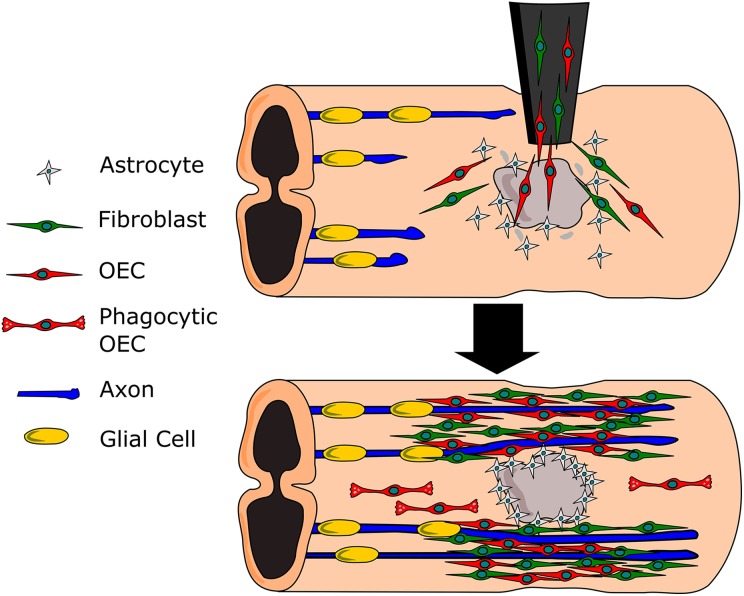
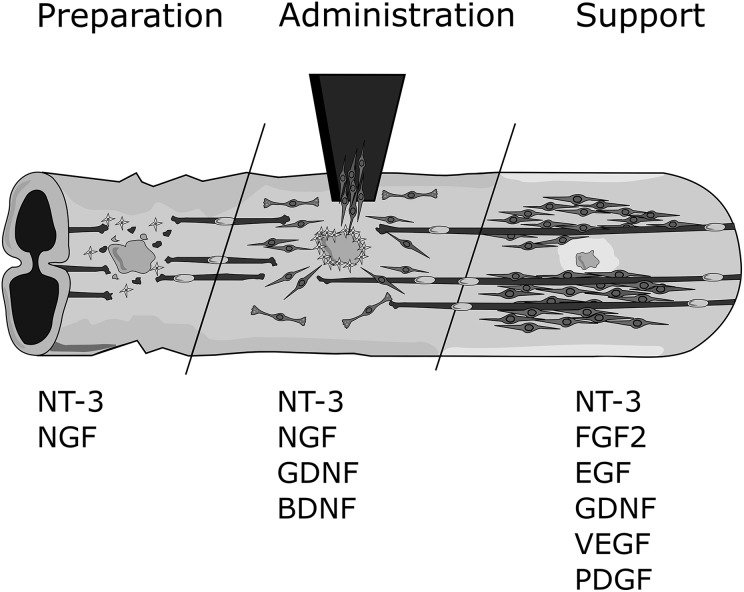
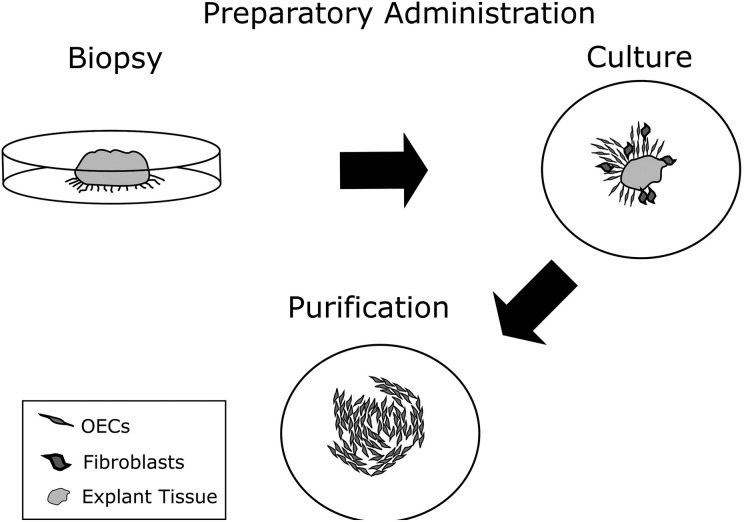
Autologous olfactory ensheathing cell (OEC) transplantation is a promising therapy for spinal cord injury; however, the efficacy varies between trials in both animals and humans. The main reason for this variability is that the purity and phenotype of the transplanted cells differs between studies. OECs are susceptible to modulation with neurotrophic factors, and thus, neurotrophins can be used to manipulate the transplanted cells into an optimal, consistent phenotype. OEC transplantation can be divided into 3 phases: (1) cell preparation, (2) cell administration, and (3) continuous support to the transplanted cells in situ. The ideal behaviour of OECs differs between these 3 phases; in the cell preparation phase, rapid cell expansion is desirable to decrease the time between damage and transplantation. In the cell administration phase, OEC survival and integration at the injury site, in particular migration into the glial scar, are the most critical factors, along with OEC-mediated phagocytosis of cellular debris. Finally, continuous support needs to be provided to the transplantation site to promote survival of both transplanted cells and endogenous cells within injury site and to promote long-term integration of the transplanted cells and angiogenesis. In this review, we define the 3 phases of OEC transplantation into the injured spinal cord and the optimal cell behaviors required for each phase. Optimising functional outcomes of OEC transplantation can be achieved by modulation of cell behaviours with neurotrophins. We identify the key growth factors that exhibit the strongest potential for optimizing the OEC phenotype required for each phase.
自体嗅鞘细胞(OEC)移植是治疗脊髓损伤的一种很有前途的方法;然而,动物和人类试验的疗效存在差异。造成这种变异性的主要原因是移植细胞的纯度和表型在研究之间存在差异。OEC 容易受到神经营养因子的调节,因此,神经营养因子可用于将移植细胞操纵成最佳、一致的表型。OEC 移植可分为 3 个阶段:(1)细胞准备,(2)细胞给药,和(3)原位对移植细胞的持续支持。OEC 的理想行为在这 3 个阶段有所不同;在细胞准备阶段,需要快速细胞扩增以减少损伤和移植之间的时间。在细胞给药阶段,OEC 在损伤部位的存活和整合,特别是迁移到神经胶质瘢痕中,以及 OEC 介导的细胞碎片吞噬作用,是最重要的因素。最后,需要向移植部位提供持续的支持,以促进移植细胞和损伤部位内的内源性细胞的存活,并促进移植细胞和血管生成的长期整合。在这篇综述中,我们将 OEC 移植到损伤的脊髓中的 3 个阶段定义为,并为每个阶段定义了所需的最佳细胞行为。通过神经营养因子调节细胞行为,可以实现 OEC 移植功能结果的优化。我们确定了关键的生长因子,这些因子表现出最强的潜力,可以优化每个阶段所需的 OEC 表型。