Graduate Institute of Clinical Medicine, Taipei Medical University, Taipei, Taiwan.
Department of Internal Medicine, School of Medicine, College of Medicine, Taipei Medical University, Taipei, Taiwan.
Oxid Med Cell Longev. 2018 Apr 30;2018:7861518. doi: 10.1155/2018/7861518. eCollection 2018.
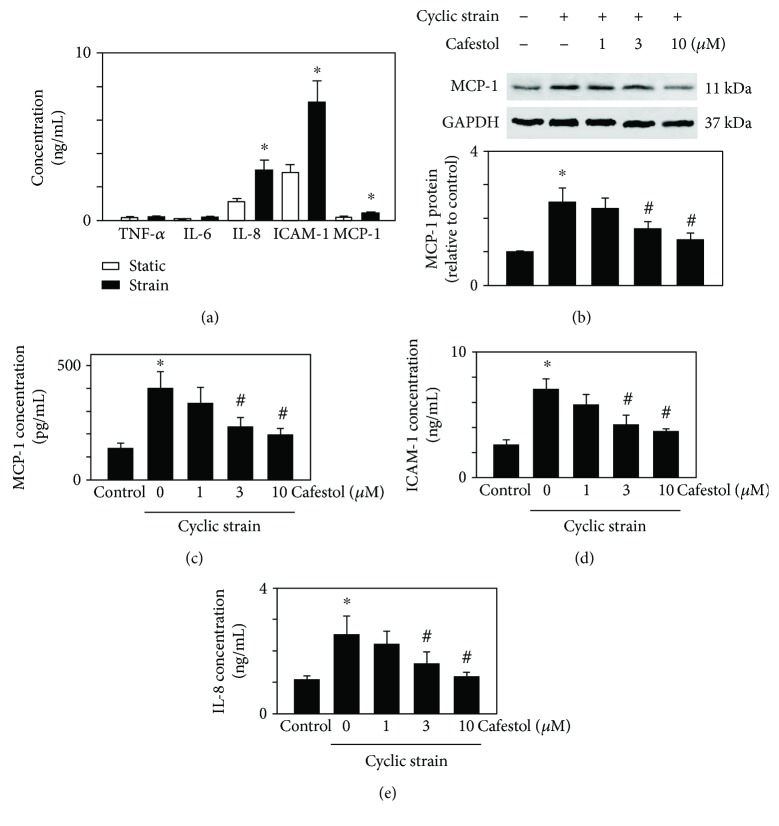
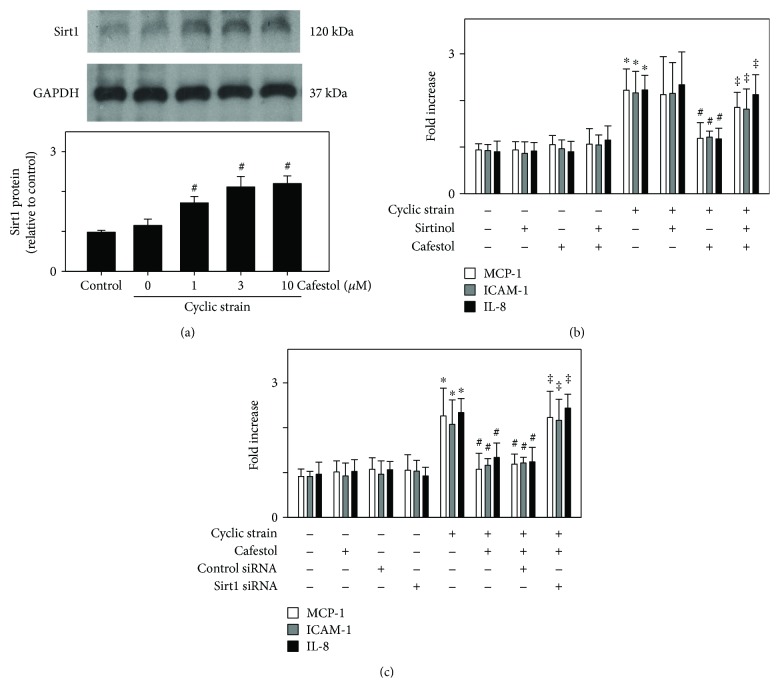
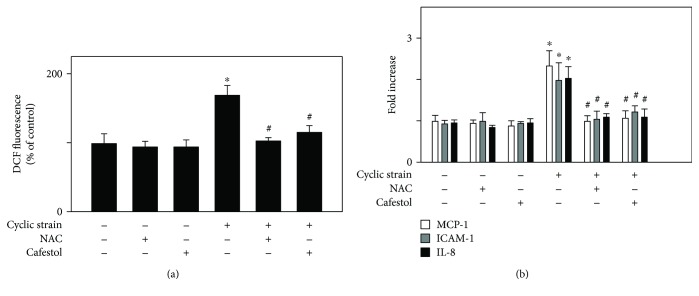
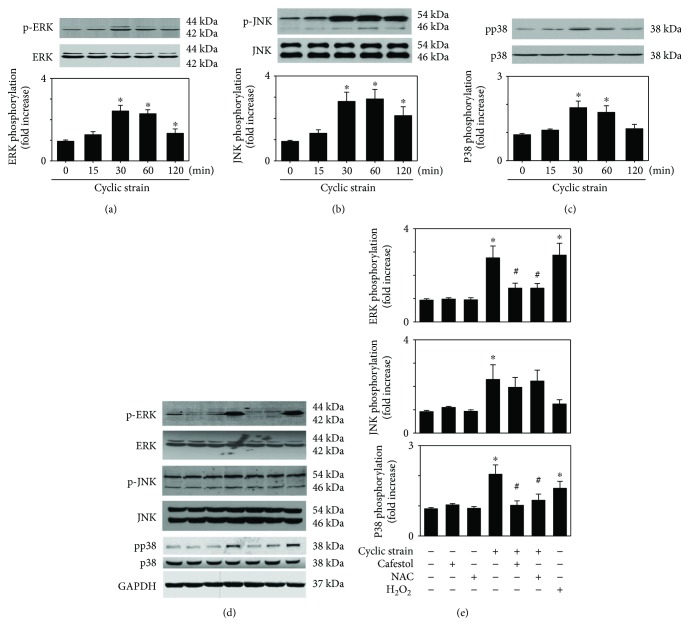
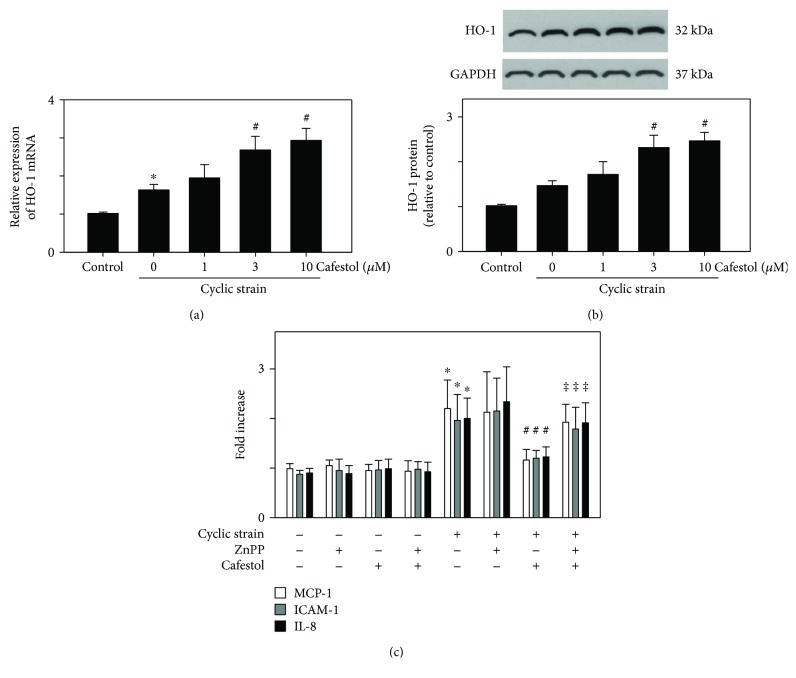
Moderate coffee consumption is inversely associated with cardiovascular disease mortality; however, mechanisms underlying this causal effect remain unclear. Cafestol, a diterpene found in coffee, has various properties, including an anti-inflammatory property. This study investigated the effect of cafestol on cyclic-strain-induced inflammatory molecule secretion in vascular endothelial cells. Cells were cultured under static or cyclic strain conditions, and the secretion of inflammatory molecules was determined using enzyme-linked immunosorbent assay. The effects of cafestol on mitogen-activated protein kinases (MAPK), heme oxygenase-1 (HO-1), and sirtuin 1 (Sirt1) signaling pathways were examined using Western blotting and specific inhibitors. Cafestol attenuated cyclic-strain-stimulated intercellular adhesion molecule-1 (ICAM-1), monocyte chemoattractant protein- (MCP-) 1, and interleukin- (IL-) 8 secretion. Cafestol inhibited the cyclic-strain-induced phosphorylation of extracellular signal-regulated kinase and p38 MAPK. By contrast, cafestol upregulated cyclic-strain-induced HO-1 and Sirt1 expression. The addition of zinc protoporphyrin IX, sirtinol, or Sirt1 silencing (transfected with Sirt1 siRNA) significantly attenuated cafestol-mediated modulatory effects on cyclic-strain-stimulated ICAM-1, MCP-1, and IL-8 secretion. This is the first study to report that cafestol inhibited cyclic-strain-induced inflammatory molecule secretion, possibly through the activation of HO-1 and Sirt1 in endothelial cells. The results provide valuable insights into molecular pathways that may contribute to the effects of cafestol.
适量饮用咖啡与心血管疾病死亡率呈负相关;然而,这种因果关系的机制仍不清楚。咖啡醇是一种在咖啡中发现的二萜,具有多种特性,包括抗炎特性。本研究旨在探讨咖啡醇对血管内皮细胞周期性应变诱导的炎症分子分泌的影响。细胞在静态或周期性应变条件下培养,并使用酶联免疫吸附测定法测定炎症分子的分泌。使用 Western blot 和特定抑制剂研究咖啡醇对丝裂原激活蛋白激酶(MAPK)、血红素加氧酶-1(HO-1)和沉默调节蛋白 1(Sirt1)信号通路的影响。咖啡醇减弱了周期性应变刺激的细胞间黏附分子-1(ICAM-1)、单核细胞趋化蛋白-1(MCP-1)和白细胞介素-8(IL-8)的分泌。咖啡醇抑制了周期性应变诱导的细胞外信号调节激酶和 p38 MAPK 的磷酸化。相比之下,咖啡醇上调了周期性应变诱导的 HO-1 和 Sirt1 的表达。锌原卟啉 IX、sirtinol 或 Sirt1 沉默(转染 Sirt1 siRNA)的添加显著减弱了咖啡醇对周期性应变刺激的 ICAM-1、MCP-1 和 IL-8 分泌的调节作用。这是第一项报道咖啡醇抑制周期性应变诱导的炎症分子分泌的研究,可能是通过内皮细胞中 HO-1 和 Sirt1 的激活。研究结果为可能导致咖啡醇作用的分子途径提供了有价值的见解。