Division of Viral Hepatitis, Centers for Disease Control and Prevention, 1600 Clifton Rd, Atlanta 30333, GA, USA.
Division of Viral Hepatitis, Centers for Disease Control and Prevention, 1600 Clifton Rd, Atlanta 30333, GA, USA.
Infect Genet Evol. 2018 Sep;63:204-215. doi: 10.1016/j.meegid.2018.05.028. Epub 2018 May 31.
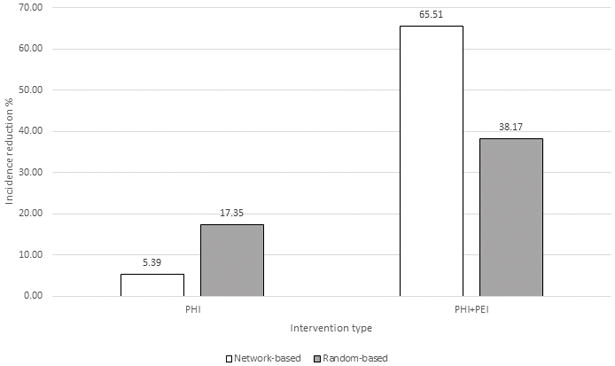
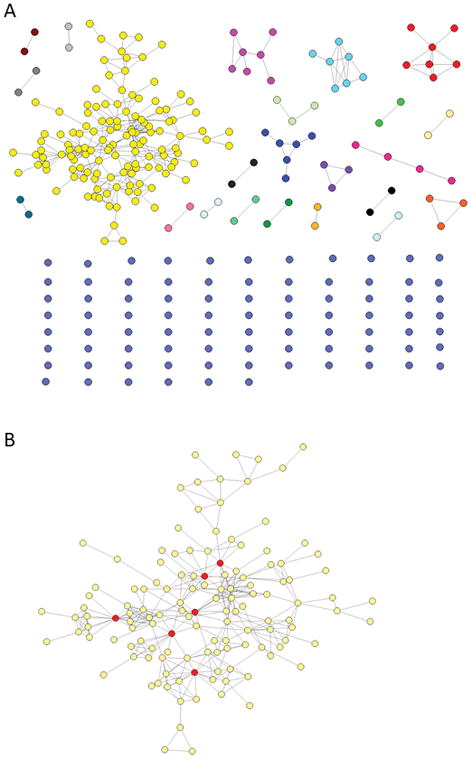
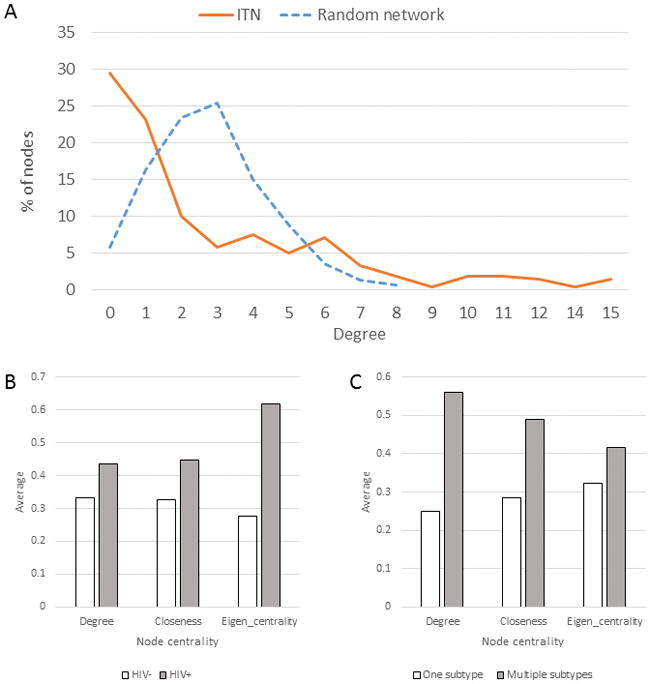
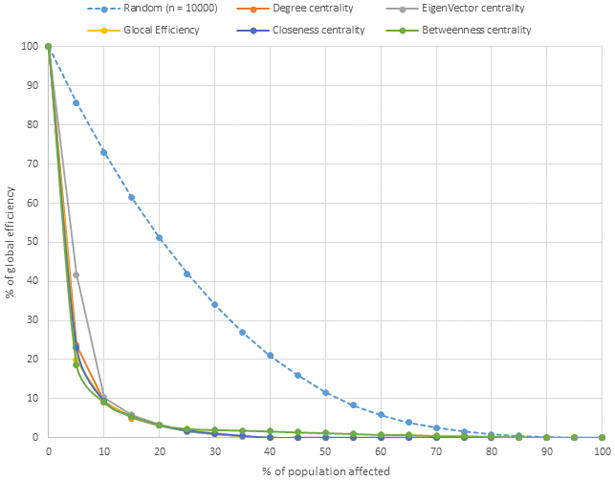
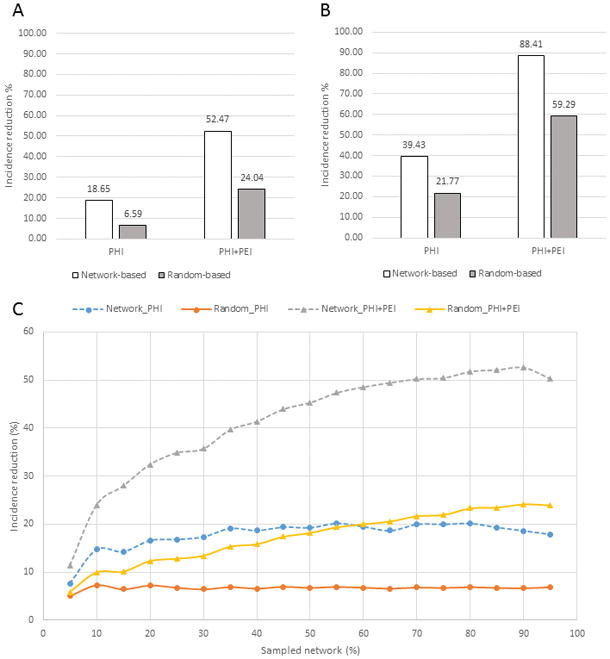
Hepatitis C virus (HCV) infection is a global public health problem. The implementation of public health interventions (PHI) to control HCV infection could effectively interrupt HCV transmission. PHI targeting high-risk populations, e.g., people who inject drugs (PWID), are most efficient but there is a lack of tools for prioritizing individuals within a high-risk community. Here, we present Intelligent Network DisRuption Analysis (INDRA), a targeted strategy for efficient interruption of hepatitis C transmissions.Using a large HCV transmission network among PWID in Indiana as an example, we compare effectiveness of random and targeted strategies in reducing the rate of HCV transmission in two settings: (1) long-established and (2) rapidly spreading infections (outbreak). Identification of high centrality for the network nodes co-infected with HIV or > 1 HCV subtype indicates that the network structure properly represents the underlying contacts among PWID relevant to the transmission of these infections. Changes in the network's global efficiency (GE) were used as a measure of the PHI effects. In setting 1, simulation experiments showed that a 50% GE reduction can be achieved by removing 11.2 times less nodes using targeted vs random strategies. A greater effect of targeted strategies on GE was consistently observed when networks were simulated: (1) with a varying degree of errors in node sampling and link assignment, and (2) at different levels of transmission reduction at affected nodes. In simulations considering a 10% removal of infected nodes, targeted strategies were ~2.8 times more effective than random in reducing incidence. Peer-education intervention (PEI) was modeled as a probabilistic distribution of actionable knowledge of safe injection practices from the affected node to adjacent nodes in the network. Addition of PEI to the models resulted in a 2-3 times greater reduction in incidence than from direct PHI alone. In setting 2, however, random direct PHI were ~3.2 times more effective in reducing incidence at the simulated conditions. Nevertheless, addition of PEI resulted in a ~1.7-fold greater efficiency of targeted PHI. In conclusion, targeted PHI facilitated by INDRA outperforms random strategies in decreasing circulation of long-established infections. Network-based PEI may amplify effects of PHI on incidence reduction in both settings.
丙型肝炎病毒(HCV)感染是一个全球性的公共卫生问题。实施公共卫生干预措施(PHI)来控制 HCV 感染,可以有效地阻断 HCV 的传播。针对高危人群(例如,注射毒品者)的 PHI 最为有效,但在高危人群中确定个体优先级方面缺乏工具。在这里,我们提出了智能网络中断分析(INDRA),这是一种高效阻断丙型肝炎传播的靶向策略。
我们以印第安纳州注射毒品者中的 HCV 传播网络为例,比较了随机和靶向策略在两种情况下降低 HCV 传播率的效果:(1)长期存在的感染和(2)迅速传播的感染(爆发)。识别出同时感染 HIV 或超过 1 种 HCV 亚型的网络节点的高中心度表明,该网络结构恰当地代表了与这些感染传播相关的注射毒品者之间的潜在接触。网络全局效率(GE)的变化被用作 PHI 效果的衡量标准。在设置 1 中,模拟实验表明,使用靶向策略可以减少 11.2 倍的节点,即可实现 50%的 GE 降低,而使用随机策略则需要减少 11.2 倍的节点。当网络模拟时,始终观察到靶向策略对 GE 的影响更大:(1)在节点采样和链路分配的误差程度不同时,(2)在受影响节点的传播减少程度不同时。在考虑去除 10%的感染节点的模拟中,靶向策略在降低发病率方面比随机策略有效约 2.8 倍。同伴教育干预(PEI)被建模为受影响节点向网络中相邻节点传播安全注射实践的可操作知识的概率分布。将 PEI 添加到模型中,可使发病率降低 2-3 倍,而仅直接进行 PHI 则降低 2-3 倍。然而,在设置 2 中,随机直接 PHI 在模拟条件下降低发病率的效果约为 3.2 倍。尽管如此,PEI 的添加使靶向 PHI 的效率提高了约 1.7 倍。
总之,INDRA 支持的靶向 PHI 在降低长期存在的感染传播方面优于随机策略。基于网络的 PEI 可以放大 PHI 对两种情况下发病率降低的影响。