From the Department of Anesthesia, Critical Care, and Pain Medicine, Massachusetts General Hospital, Boston, Massachusetts.
Department of Emergency Medicine, Beth Israel Deaconess Medical Center, Boston, Massachusetts.
Anesth Analg. 2019 May;128(5):1005-1012. doi: 10.1213/ANE.0000000000003517.
Although racial/ethnic and sex disparities have been examined in health care generally and pain management more specifically, the combined influence of these sociodemographic factors together has not been well documented. The aim of this study was to examine the association between administration of opioid analgesics in the emergency department (ED) and interaction of race/ethnicity and sex.
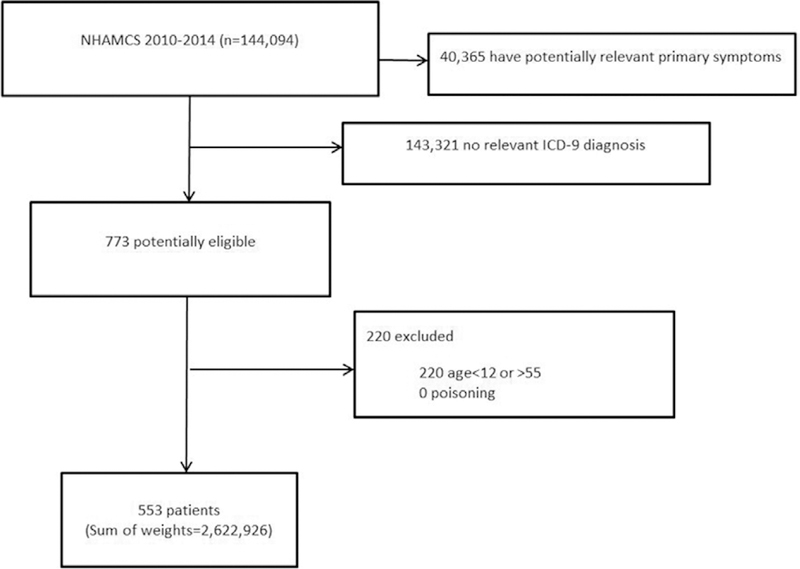
We conducted a retrospective cohort study using 2010-2014 Center for Disease Control-National Hospital Ambulatory Medical Care Survey data for patients 12-55 years of age presenting to EDs with a primary diagnosis of appendicitis or gallbladder disease as defined by International Classification of Diseases, Ninth Revision codes. The primary outcome was the receipt of opioid analgesic medications. Secondary outcomes included: receipt of nonopioids, receipt of antiemetic medications, wait time to see a provider, and length of visit in the ED. The association between sex and analgesic receipt within Caucasian non-Hispanic and non-Caucasian groups was evaluated adjusting for pain score on presentation, patient age, emergent status, number of comorbidities, time of visit (month, day of the week, standard versus nonstandard working hours, year), and US region.
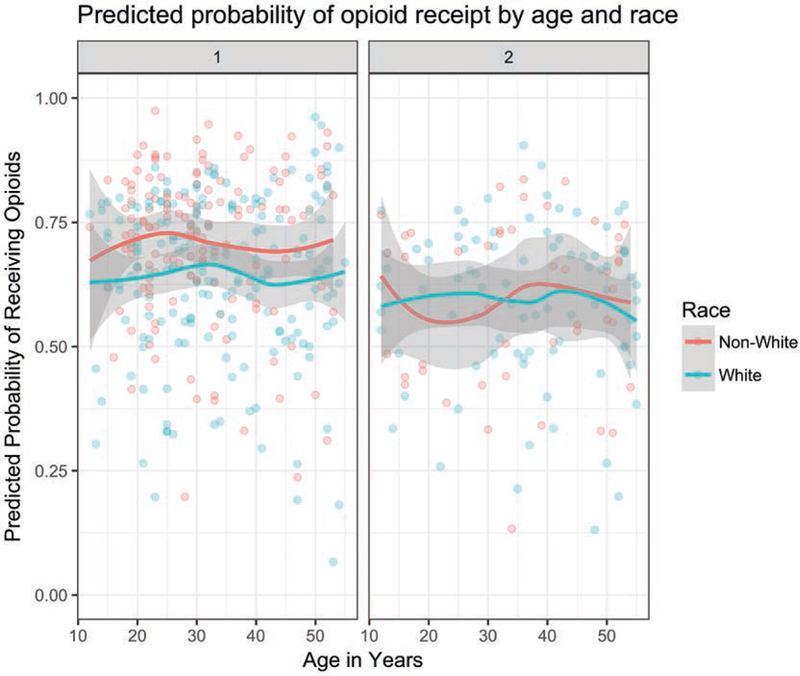
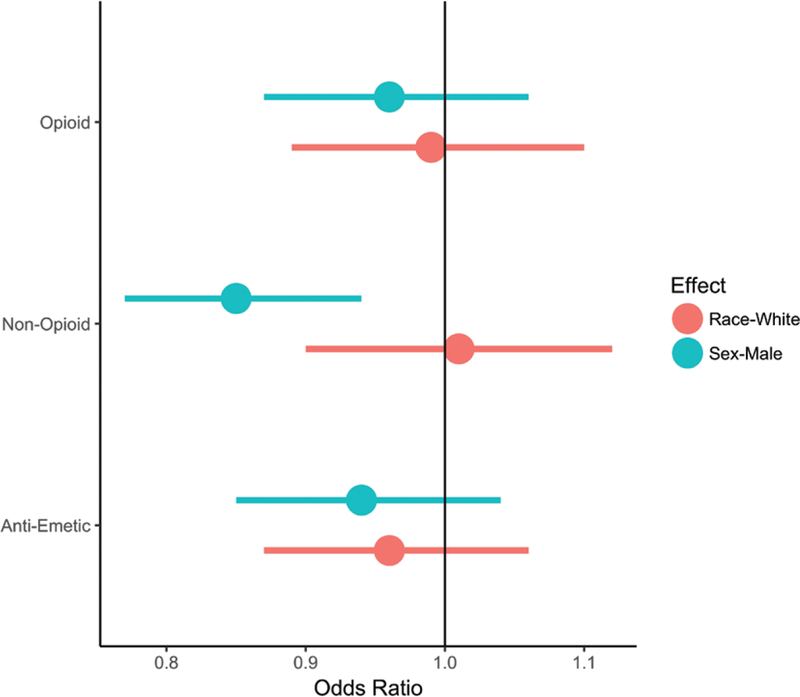
After exclusions, a weighted sample of 553 ED visits was identified, representing 2,622,926 unique visits. The sample population was comprised of 1,858,035 (70.8%) females and 1,535,794 (58.6%) Caucasian non-Hispanics. No interaction was found in adjusted sampling-weighted model between sex and race/ethnicity on the odds of receiving opioids (P = .74). There was no difference in opioid administration to males as compared to females (odds ratio [OR] = 0.96, 95% CI, 0.87-1.06; P = .42) or to non-Caucasians as compared to Caucasians (OR = 0.99, 95% CI, 0.89-1.10; P = .84). In adjusted weighted models, non-Caucasian males, 123,121/239,457 (51.4%) did not differ from Caucasian non-Hispanic males, 317,427/525,434 (60.4%), on odds of receiving opioids, aOR = 0.88, 95% CI, 0.39-1.99; P = .75. Non-Caucasian females, 547,709/847,675 (64.6%) also did not differ from Caucasian females, 621,638/1,010,360 (61.5%), on odds of receiving opioids, aOR = 1.01, 95% CI, 0.53-1.90; P = .98. Across both sexes, non-Caucasians did not differ from Caucasians on receipt of nonopioid analgesics or antiemetics. Neither wait time to see a provider nor the length of the hospital visit was significantly different between sexes or race/ethnicities.
Based on National Hospital Ambulatory Medical Care Survey data from 2010 to 2014, there is no statistically significant interaction between race/ethnicity and sex for administration of opioid analgesia to people presenting to the ED with appendicitis or gallbladder disease. These results suggest that the joint effect of patient race/ethnicity and sex may not manifest in disparities in opioid management.
尽管在医疗保健和疼痛管理方面已经研究了种族/民族和性别的差异,但这些社会人口因素的综合影响尚未得到很好的记录。本研究的目的是检查在急诊科(ED)使用阿片类镇痛药与种族/民族和性别的相互作用之间的关联。
我们使用 2010-2014 年疾病控制与国家医院门诊医疗调查数据进行了回顾性队列研究,该数据针对的是年龄在 12-55 岁之间、以阑尾炎或胆囊疾病为主要诊断的患者,这些疾病的定义为国际疾病分类第九版代码。主要结果是接受阿片类镇痛药。次要结果包括:接受非阿片类药物、接受止吐药物、等待看医生的时间和 ED 就诊时间。在调整了就诊时的疼痛评分、患者年龄、紧急状态、合并症数量、就诊时间(月份、星期几、标准工作时间与非标准工作时间、年份)和美国地区后,评估了白种非西班牙裔和非白种人群中性别与镇痛药物接受率之间的关系。
排除后,确定了 553 例 ED 就诊的加权样本,代表 2622926 例独特就诊。样本人群由 1858035 名(70.8%)女性和 1535794 名(58.6%)白种非西班牙裔组成。在调整后的抽样加权模型中,性别和种族/民族之间没有发现接受阿片类药物的几率存在交互作用(P =.74)。与女性相比,男性(比值比[OR] = 0.96,95%置信区间,0.87-1.06;P =.42)或与非白种人相比,白种人(OR = 0.99,95%置信区间,0.89-1.10;P =.84)接受阿片类药物的差异无统计学意义。在调整后的加权模型中,非白种男性,123121/239457(51.4%)与白种非西班牙裔男性,317427/525434(60.4%)在接受阿片类药物的几率上没有差异,比值比(aOR)= 0.88,95%置信区间,0.39-1.99;P =.75。非白种女性,547709/847675(64.6%)与白种女性,621638/1010360(61.5%)在接受阿片类药物的几率上也没有差异,比值比(aOR)= 1.01,95%置信区间,0.53-1.90;P =.98。在两性中,非白种人与白种人在接受非阿片类镇痛药或止吐药物方面没有差异。无论是等待看医生的时间还是住院时间都没有因性别或种族/民族而显著不同。
根据 2010 年至 2014 年国家医院门诊医疗调查数据,在 ED 就诊的阑尾炎或胆囊疾病患者中,种族/民族和性别的阿片类镇痛药使用之间没有统计学上显著的相互作用。这些结果表明,患者种族/民族和性别的联合效应可能不会导致阿片类药物管理方面的差异。