Department of Public Administration, Seowon University, Musimseoro, Cheongju 28674, Chungbuk 361-742, Korea.
Department of Public Administration, Ajou University, Worldcup-ro, Suwon 16499, Korea.
Int J Environ Res Public Health. 2018 Jun 4;15(6):1168. doi: 10.3390/ijerph15061168.
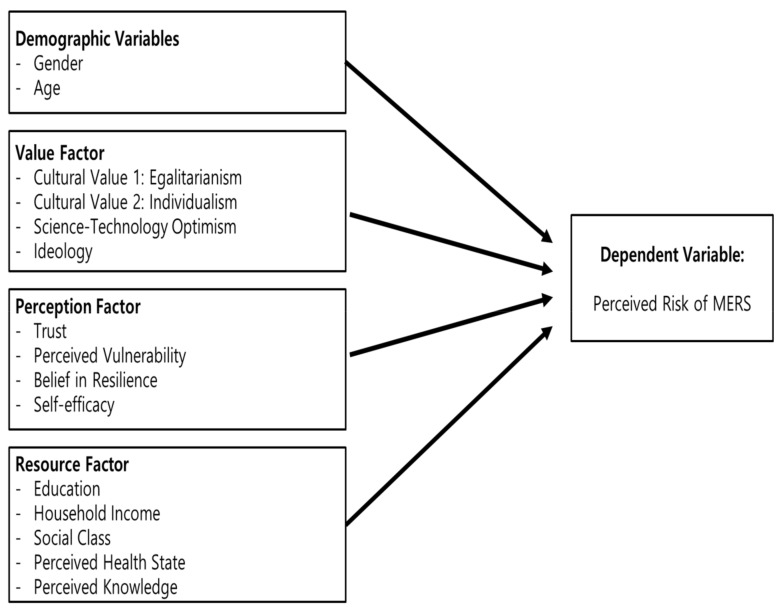
The world is turning into a risky society. Although modernization based on the developments in science and technology has increased individuals' well-being and wealth, the perceived risk toward the complex technological system has increased. In a risky society, social accidents amplify the existing fear among individuals. It is generally assumed that each value, perception, and resource influences the fear of risk. However, very few studies have tested these three factors together within an integrated causal model. Therefore, the present study aimed to examine the determinants that influence the perceived risk in cases of Middle East Respiratory Syndrome (MERS), a deadly epidemic disease, in Korea. Based on the theoretical model, we analyzed the survey data collected from respondents ( = 814) in Korea. After controlling for variables such as sociodemographic characteristics, we examined how three competing factors, i.e., value, perception, and resource, influence the perceived risk of MERS. The analysis showed that trust and vulnerability variables in the perception factor, health state, and perceived knowledge in the resource factor had a significant impact on the perceived risk of MERS.
世界正在变成一个充满风险的社会。虽然以科技发展为基础的现代化提高了个人的福祉和财富,但人们对复杂技术系统的感知风险也在增加。在一个充满风险的社会中,社会事故加剧了个人原本的恐惧。人们普遍认为,每种价值观、观念和资源都会影响对风险的恐惧。然而,很少有研究在一个综合因果模型中同时检验这三个因素。因此,本研究旨在检验影响中东呼吸综合征(MERS)在韩国被感知风险的决定因素。基于理论模型,我们分析了从韩国受访者(=814)收集的调查数据。在控制了社会人口统计学特征等变量后,我们检验了三种竞争因素,即价值观、观念和资源,如何影响 MERS 的被感知风险。分析结果表明,感知因素中的信任和脆弱性变量、资源因素中的健康状况和感知知识对 MERS 的被感知风险有显著影响。