Health Review and Assessment Committee, Health Insurance Review and Assessment Service, Wonju, South Korea.
Division of Suicide Prevention Policy, Ministry of Health and Welfare, Sejong, South Korea.
BMJ Open. 2020 Mar 4;10(3):e033026. doi: 10.1136/bmjopen-2019-033026.
This study aimed to assess the affective and cognitive risk perceptions in the general population of Middle East respiratory syndrome (MERS) during the 2015 MERS coronavirus (MERS-CoV) outbreak in South Korea and the influencing factors.
Serial cross-sectional design with four consecutive surveys.
Nationwide general population in South Korea.
Overall 4010 respondents (aged 19 years and over) from the general population during the MERS-CoV epidemic were included.
The main outcome measures were (1) affective risk perception, (2) cognitive risk perception, and (3) trust in the government. Multivariate logistic regression models were used to identify factors (demographic, socioeconomic, area and political orientation) associated with risk perceptions.
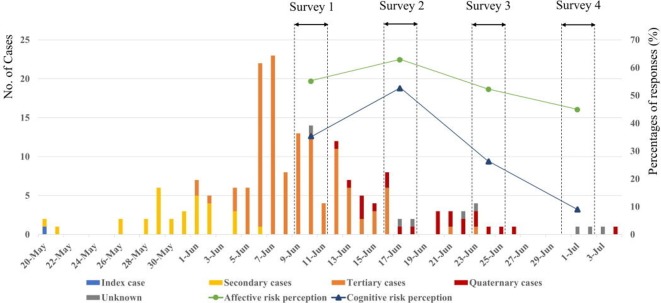
Both affective and cognitive risk perceptions decreased as the MERS-CoV epidemic progressed. Proportions of affective risk perception were higher in all surveys and slowly decreased compared with cognitive risk perception over time. Females (adjusted OR (aOR) 1.72-2.00; 95% CI 1.14 to 2.86) and lower self-reported household economic status respondents were more likely to perceive the affective risk. The older the adults, the higher the affective risk perception, but the lower the cognitive risk perception compared with younger adults. The respondents who had low trust in the government had higher affective (aOR 2.19-3.11; 95 CI 1.44 to 4.67) and cognitive (aOR 3.55-5.41; 95 CI 1.44 to 9.01) risk perceptions.
This study suggests that even if cognitive risk perception is dissolved, affective risk perception can continue during MERS-CoV epidemic. Risk perception associating factors (ie, gender, age and self-reported household economic status) appear to be noticeably different between affective and cognitive dimensions. It also indicates that trust in the government influences affective risk perception and cognitive risk perception. There is a need for further efforts to understand the mechanism regarding the general public's risk perception for effective risk communication.
本研究旨在评估中东呼吸综合征(MERS)期间韩国 2015 年中东呼吸综合征冠状病毒(MERS-CoV)爆发期间普通人群的情感和认知风险感知,以及影响因素。
连续四次调查的横断面研究。
韩国全国普通人群。
在 MERS-CoV 流行期间,共纳入来自普通人群的 4010 名年龄在 19 岁及以上的受访者。
主要结局指标为(1)情感风险感知,(2)认知风险感知,(3)对政府的信任。使用多变量逻辑回归模型确定与风险感知相关的因素(人口统计学、社会经济、地区和政治倾向)。
随着 MERS-CoV 疫情的发展,情感和认知风险感知均降低。在所有调查中,情感风险感知的比例均较高,且随着时间的推移,与认知风险感知相比,其比例缓慢下降。女性(调整后的比值比(aOR)1.72-2.00;95%置信区间 1.14 至 2.86)和报告家庭经济状况较低的受访者更有可能感知到情感风险。成年人年龄越大,情感风险感知越高,但与年轻成年人相比,认知风险感知越低。对政府信任度低的受访者对情感(aOR 2.19-3.11;95%置信区间 1.44 至 4.67)和认知(aOR 3.55-5.41;95%置信区间 1.44 至 9.01)风险感知更高。
本研究表明,即使认知风险感知消失,MERS-CoV 疫情期间仍可能继续出现情感风险感知。风险感知关联因素(即性别、年龄和自我报告的家庭经济状况)在情感和认知维度之间似乎明显不同。这也表明对政府的信任会影响情感风险感知和认知风险感知。需要进一步努力,以了解公众对有效风险沟通的风险感知机制。