Kim Miri, Kim Seoyong, Jeon Sehyeok
Social Science Research Institute, Ajou University, Suwon, 16499, Republic of Korea.
Department of Public Administration, Ajou University, Suwon, 16499, Republic of Korea.
Heliyon. 2024 Oct 19;10(21):e39337. doi: 10.1016/j.heliyon.2024.e39337. eCollection 2024 Nov 15.
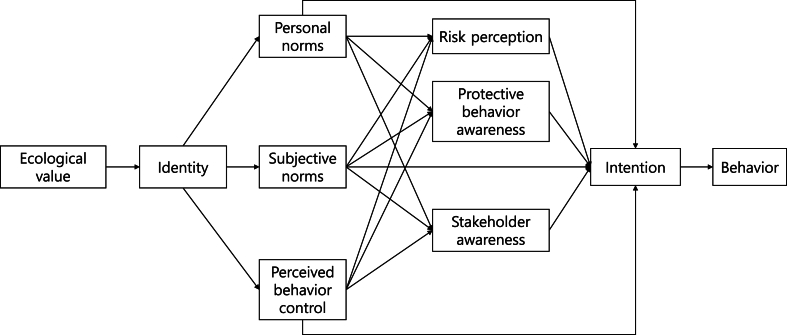
This study examines multidimensional factors affecting climate change response behavior. It constructs an integrated model based on the theory of planned behavior, value-identity-personal norms model, and protective action decision model, as a single theory cannot capture the complex nature of human behavior. Recent studies have shown that integrating theories include various influencing factors and indicate higher explanatory power. Therefore, this study uses an integrated model to identify multidimensional influencing factors. The fit of the integrated model was confirmed to be excellent (Chi-square = 1271.866, p = .000, GFI = 0.930, NFI = 0.940, RMSEA = 0.060, TLI = 0.937, SRMR = 0.059), and identity exhibited the greatest effect on personal norms, followed by intention on behavior. The integrated model suggests the following path: ecological value → identity → personal norms → stakeholder awareness → intention → behavior and then ecological value → identity → perceived behavioral control → risk awareness → intention → behavior. The results of the integrated model suggest that a multifaceted approach is necessary to promote climate change response behavior. Various factors, such as ecological value, identity, personal norms, stakeholder awareness, perceived behavioral control, and risk awareness, interact and influence behavior. Policies and programs that comprehensively consider these factors should be established.
本研究考察了影响气候变化应对行为的多维度因素。由于单一理论无法涵盖人类行为的复杂性,因此基于计划行为理论、价值认同 - 个人规范模型和保护行动决策模型构建了一个综合模型。近期研究表明,整合多种理论能纳入各种影响因素,并具有更高的解释力。因此,本研究使用综合模型来识别多维度影响因素。经确认,该综合模型的拟合度极佳(卡方 = 1271.866,p = 0.000,GFI = 0.930,NFI = 0.940,RMSEA = 0.060,TLI = 0.937,SRMR = 0.059),其中认同对个人规范的影响最大,其次是意图对行为的影响。综合模型表明了以下路径:生态价值→认同→个人规范→利益相关者意识→意图→行为,以及生态价值→认同→感知行为控制→风险意识→意图→行为。综合模型的结果表明,促进气候变化应对行为需要采取多方面的方法。生态价值、认同、个人规范、利益相关者意识、感知行为控制和风险意识等各种因素相互作用并影响行为。应制定全面考虑这些因素的政策和计划。