Manouchehrinia Ali, Hedström Anna Karin, Alfredsson Lars, Olsson Tomas, Hillert Jan, Ramanujam Ryan
Department of Clinical Neuroscience, Karolinska Institutet, Karolinska University Hospital Solna, Stockholm, Sweden.
Unit of Cardiovascular Epidemiology, Institute of Environmental Medicine, Karolinska Institutet, Stockholm, Sweden.
Front Neurol. 2018 May 11;9:232. doi: 10.3389/fneur.2018.00232. eCollection 2018.
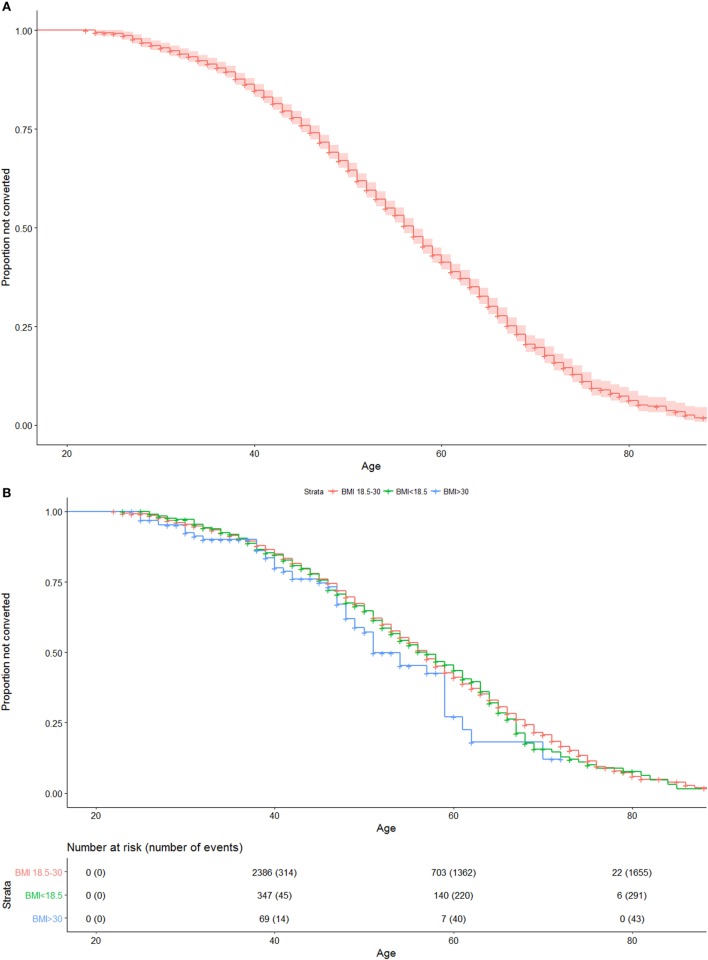
Both high body mass index (BMI) and smoking tobacco are known risk factors for developing multiple sclerosis (MS). However, it is unclear whether BMI, like smoking, is a risk factor for the secondary progressive (SP) course. We, therefore, sought to determine if high/low BMI at age 20 is associated to risk of SP development, in the context of smoking status. Using data from MS patients with BMI and smoking information available, we examined relapsing onset patients with MS onset after 20 years of age. Cox regressions were conducted on smokers and non-smokers, with BMI as the main exposure. In total, 5,598 relapsing onset MS patients were included. The models demonstrated that BMI > 30 was associated to increased risk of SPMS in smokers (hazard ratio 1.50, = 0.036). This association of obesity at age 20 with increased risk of SP was not observed in non-smokers (hazard rate 0.97, = 0.900). Since the risk is confined to smokers, the interaction observed may give insight to disease driving mechanisms.
高体重指数(BMI)和吸烟均为已知的多发性硬化症(MS)发病风险因素。然而,BMI是否像吸烟一样,是继发进展型(SP)病程的风险因素尚不清楚。因此,我们试图确定20岁时高/低BMI是否与吸烟状况相关的SP发病风险有关。利用有BMI和吸烟信息的MS患者数据,我们研究了20岁以后发病的复发型MS患者。以BMI作为主要暴露因素,对吸烟者和非吸烟者进行Cox回归分析。共纳入5598例复发型MS患者。模型显示,BMI>30与吸烟者发生继发进展型多发性硬化症(SPMS)的风险增加相关(风险比1.50,P = 0.036)。在非吸烟者中未观察到20岁时肥胖与SP风险增加的这种关联(风险率0.97,P = 0.900)。由于该风险仅限于吸烟者,观察到的相互作用可能有助于深入了解疾病驱动机制。