Lezama-Núñez Paulina R, Santos-Fita Dídac, Vallejo José R
Red Conbiand Mexico, Mexico City, Mexico.
Asociación Etnobiológica Mexicana A.C., San Cristóbal de las Casas, Mexico.
Front Plant Sci. 2018 May 17;9:649. doi: 10.3389/fpls.2018.00649. eCollection 2018.
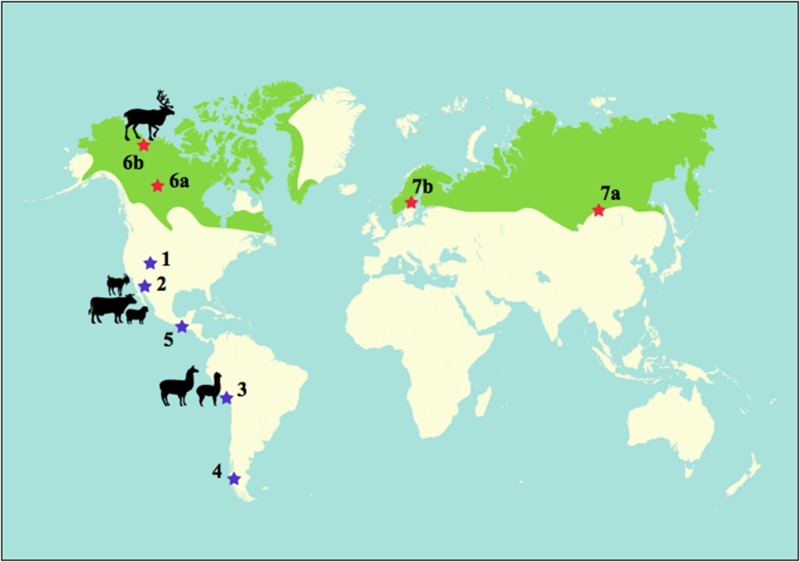
Understanding both domestication processes and agricultural practices is an interdisciplinary endeavor. Ethnographic research is potentially helpful for reconstructing past events. Such knowledge is also crucial for documenting the links between biological and cultural diversity, as well as for future purposes such as innovation in food production and sustainability. Here, we review six ethnographic case studies in different pastoral socioecological systems of the American continent. The livestock species involved include the native South American camelids and Arctic reindeer, as well as some Old World species (mainly goats, sheep, and cattle). Starting with the Columbian exchange (15th-16th centuries) and continuing up to the present, Old World herbivores launched novel uses of the local flora which resulted in entirely new livelihoods and cultures, i.e., pastoralism with its variants. Three of these case studies approach specifically how herding ecologies (human-animal-plant relationships) stirred specific management practices (human-plant relationships) that in some instances have moved toward conscious human selection of plant phenotypes. The other examples correspond to three potential instances of similar ongoing processes that we propose on the basis of ethnobotanical and ethnozoological data that were produced separately by other authors. Based on the studies we have reviewed, along with additional information from other parts of the world, we are able to conclude that: (a) New World pastoralist societies are/have been continuously adding species to the humanity's portfolio of useful plants; (b) animals have been aiding in this processes in different ways; and, (c) how human-animal-plant relationships unfold in the present could have been similar in the past, thus analogies may be proposed for explaining prehistoric multispecies interactions and their outcomes. With our review, we intend to bring more attention to contemporary pastoralists as plant managers, animals as agents in human-plant interactions, and domestication as a behavioral complex and multispecies process that is as important in the present or future as it was in the past. Our understanding of food production practices is not only fundamental for improving our current frameworks of governance, conservation, and restoration of useful species populations, but also of biocultural diversity altogether.
了解驯化过程和农业实践是一项跨学科的工作。民族志研究可能有助于重构过去的事件。这类知识对于记录生物多样性与文化多样性之间的联系,以及对于诸如粮食生产创新和可持续发展等未来目标而言也至关重要。在此,我们回顾了美洲大陆不同游牧社会生态系统中的六个民族志案例研究。涉及的牲畜物种包括南美洲本土的骆驼科动物和北极驯鹿,以及一些旧大陆物种(主要是山羊、绵羊和牛)。从15至16世纪的哥伦布大交换开始直至现在,旧大陆的食草动物开启了对当地植物群的新利用方式,这带来了全新的生计和文化,即各种形式的游牧生活方式。其中三个案例研究专门探讨了放牧生态(人 - 动物 - 植物关系)如何引发特定的管理实践(人 - 植物关系),在某些情况下,这些管理实践已朝着人类有意识地选择植物表型发展。其他案例则对应于我们根据其他作者分别收集的民族植物学和民族动物学数据所提出的三个类似的正在进行的过程的潜在实例。基于我们所回顾的研究,以及来自世界其他地区的额外信息,我们能够得出以下结论:(a)新大陆的游牧社会一直在/已经持续为人类有用植物的种类库增添物种;(b)动物一直在以不同方式助力这一过程;以及(c)人 - 动物 - 植物关系在当下的展开方式在过去可能也类似,因此可以提出类比来解释史前的多物种相互作用及其结果。通过我们的回顾,我们旨在让更多人关注当代游牧民作为植物管理者、动物作为人 - 植物相互作用中的媒介,以及驯化作为一种行为复合体和多物种过程,它在当下或未来与过去一样重要。我们对粮食生产实践的理解不仅对于完善我们当前对有用物种种群的治理、保护和恢复框架至关重要,而且对于整体生物文化多样性而言也是如此。