Department of Architecture and Computer Technology, Universidad de Sevilla, ETSII, Avenida Reina Mercedes S/N, 41012, Seville, Spain.
Department of Health Promotion, School for Public Health and Primary Care (Caphri), Maastricht University, P. Debyeplein 1, 6229, HA, Maastricht, The Netherlands.
BMC Public Health. 2018 Jun 5;18(1):698. doi: 10.1186/s12889-018-5612-5.
Smoking is one of the most avoidable health risk factors, and yet the quitting success rates are low. The usage of tailored health messages to support quitting has been proved to increase quitting success rates. Technology can provide convenient means to deliver tailored health messages. Health recommender systems are information-filtering algorithms that can choose the most relevant health-related items-for instance, motivational messages aimed at smoking cessation-for each user based on his or her profile. The goals of this study are to analyze the perceived quality of an mHealth recommender system aimed at smoking cessation, and to assess the level of engagement with the messages delivered to users via this medium.
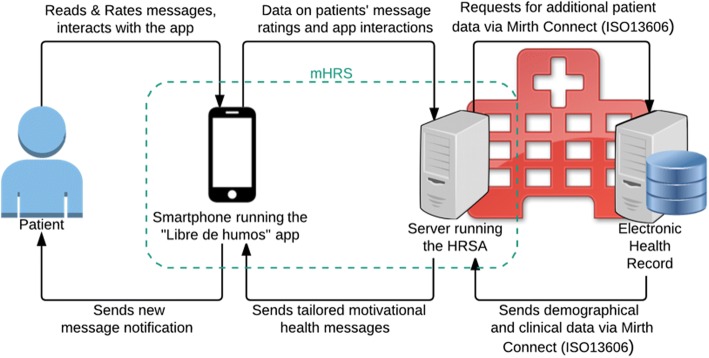
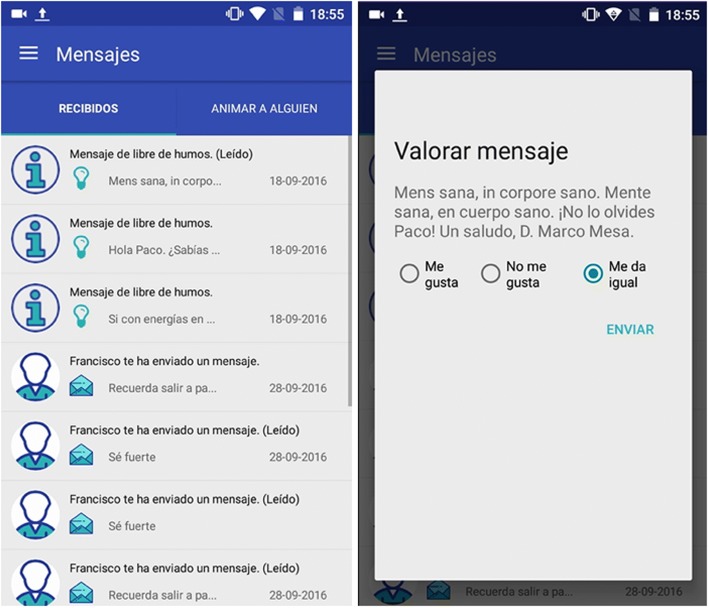
Patients participating in a smoking cessation program will be provided with a mobile app to receive tailored motivational health messages selected by a health recommender system, based on their profile retrieved from an electronic health record as the initial knowledge source. Patients' feedback on the messages and their interactions with the app will be analyzed and evaluated following an observational prospective methodology to a) assess the perceived quality of the mobile-based health recommender system and the messages, using the precision and time-to-read metrics and an 18-item questionnaire delivered to all patients who complete the program, and b) measure patient engagement with the mobile-based health recommender system using aggregated data analytic metrics like session frequency and, to determine the individual-level engagement, the rate of read messages for each user. This paper details the implementation and evaluation protocol that will be followed.
This study will explore whether a health recommender system algorithm integrated with an electronic health record can predict which tailored motivational health messages patients would prefer and consider to be of a good quality, encouraging them to engage with the system. The outcomes of this study will help future researchers design better tailored motivational message-sending recommender systems for smoking cessation to increase patient engagement, reduce attrition, and, as a result, increase the rates of smoking cessation.
The trial was registered at clinicaltrials.org under the ClinicalTrials.gov identifier NCT03206619 on July 2nd 2017. Retrospectively registered.
吸烟是最可避免的健康风险因素之一,但戒烟成功率却很低。事实证明,使用定制化健康信息来支持戒烟可以提高戒烟成功率。技术可以为提供定制化健康信息提供便捷的手段。健康推荐系统是一种信息过滤算法,可以根据每个用户的个人资料,为其选择最相关的健康相关项目,例如,旨在戒烟的激励信息。本研究的目的是分析旨在戒烟的移动健康推荐系统的感知质量,并评估通过该媒介向用户传递信息的参与程度。
参与戒烟计划的患者将获得一个移动应用程序,该应用程序将根据从电子健康记录中检索到的个人资料,通过健康推荐系统接收个性化的激励健康消息。将使用精度和阅读时间指标以及发送给所有完成该计划的患者的 18 项问卷,对患者对消息的反馈以及他们与应用程序的交互进行分析和评估,以评估基于移动的健康推荐系统和消息的感知质量。使用汇总数据分析指标,如会话频率来衡量患者对基于移动的健康推荐系统的参与度,并通过确定每个用户的阅读消息率来确定个人层面的参与度。本文详细介绍了将遵循的实施和评估方案。
本研究将探讨电子健康记录中集成的健康推荐系统算法是否可以预测患者更喜欢和认为质量好的个性化激励健康消息,从而鼓励他们与系统互动。该研究的结果将帮助未来的研究人员设计更好的针对戒烟的个性化激励消息发送推荐系统,以提高患者的参与度,降低流失率,并因此提高戒烟率。
该试验于 2017 年 7 月 2 日在 clinicaltrials.org 上以 ClinicalTrials.gov 标识符 NCT03206619 进行了注册。回顾性注册。