Department of Chemistry, Purdue University, West Lafayette, IN, 47907, USA.
Department of Chemistry, University of Chicago, Chicago, IL, 60637, USA.
Nat Commun. 2018 Jun 6;9(1):2196. doi: 10.1038/s41467-018-04652-4.
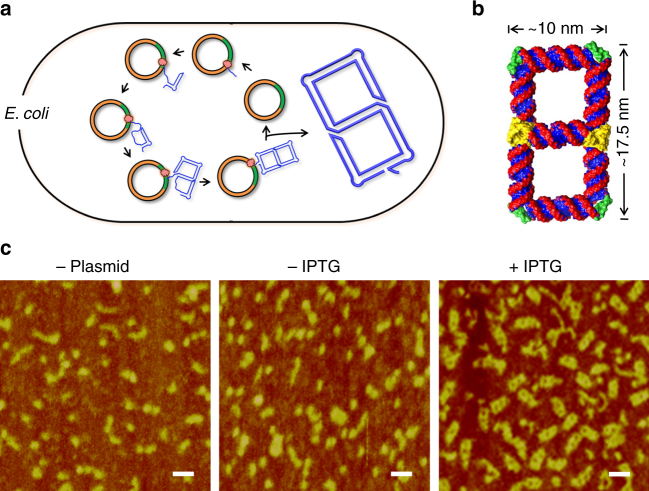
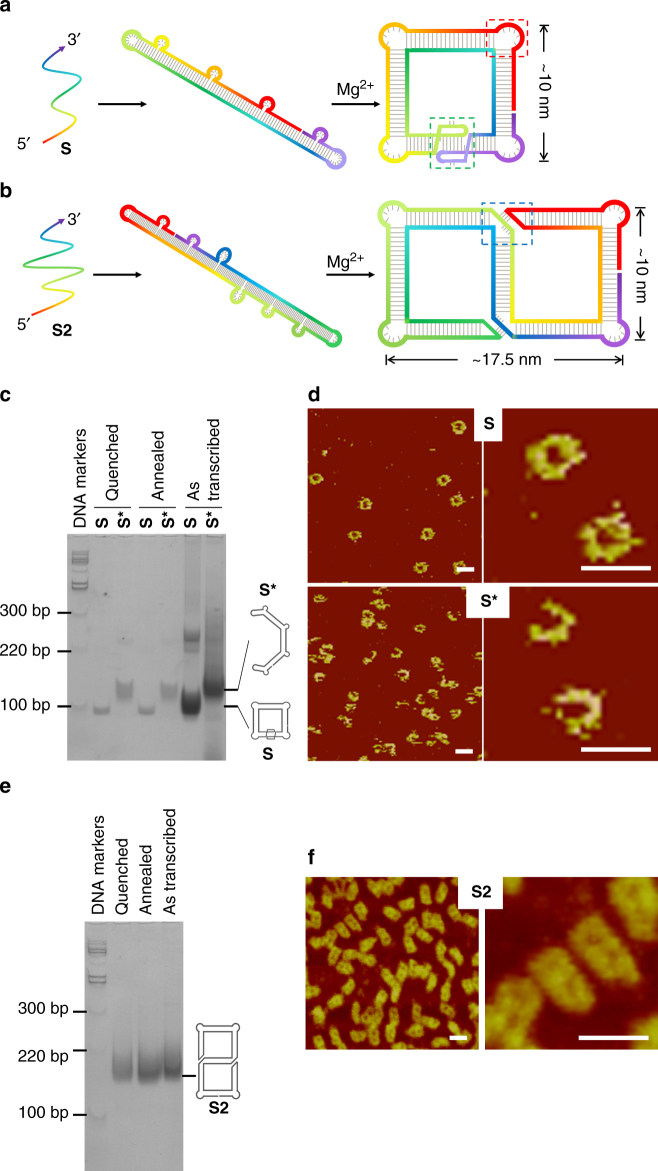
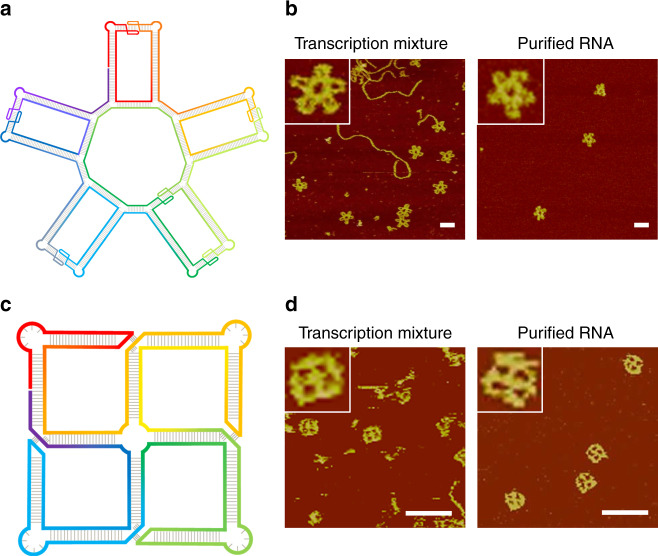
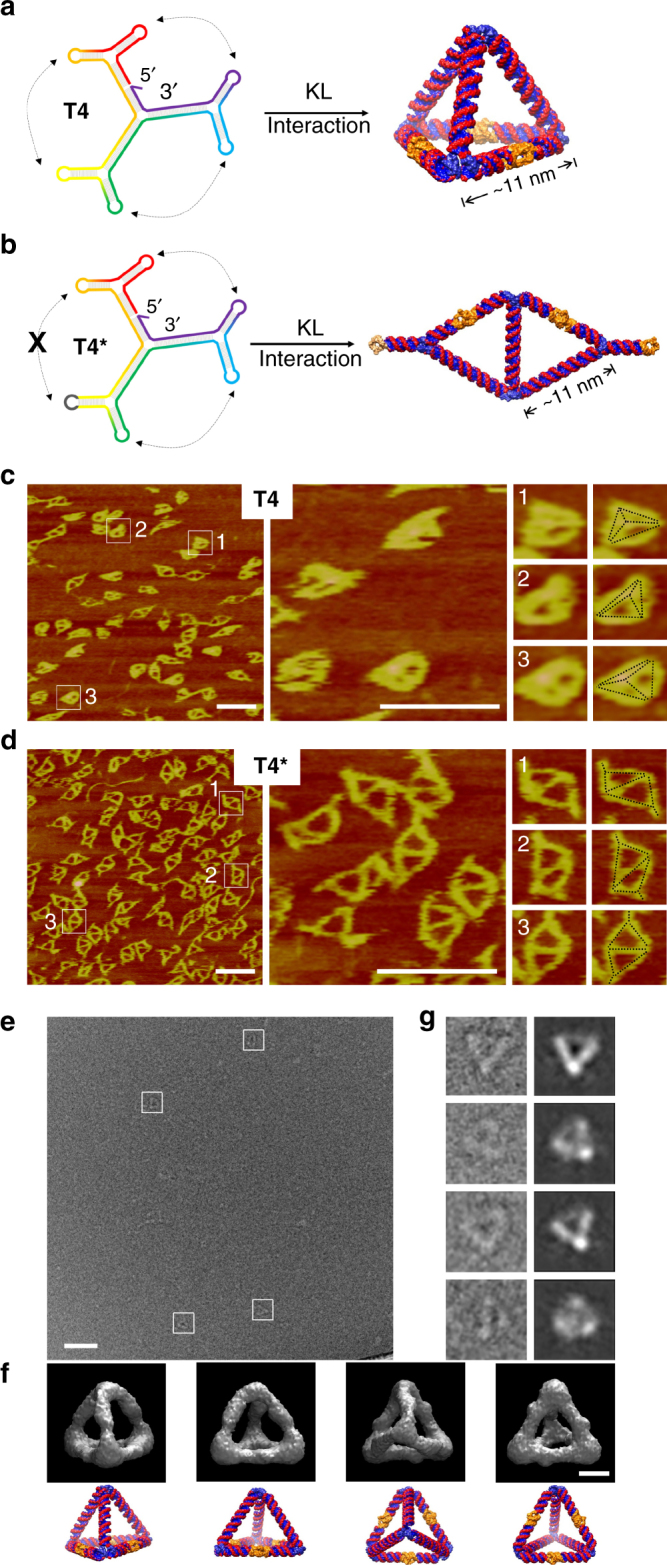
Programmed self-assembly of nucleic acids is a powerful approach for nano-constructions. The assembled nanostructures have been explored for various applications. However, nucleic acid assembly often requires chemical or in vitro enzymatical synthesis of DNA or RNA, which is not a cost-effective production method on a large scale. In addition, the difficulty of cellular delivery limits the in vivo applications. Herein we report a strategy that mimics protein production. Gene-encoded DNA duplexes are transcribed into single-stranded RNAs, which self-fold into well-defined RNA nanostructures in the same way as polypeptide chains fold into proteins. The resulting nanostructure contains only one component RNA molecule. This approach allows both in vitro and in vivo production of RNA nanostructures. In vivo synthesized RNA strands can fold into designed nanostructures inside cells. This work not only suggests a way to synthesize RNA nanostructures on a large scale and at a low cost but also facilitates the in vivo applications.
核酸的程序化自组装是一种用于纳米结构构建的强大方法。已探索了组装的纳米结构在各种应用中的用途。然而,核酸组装通常需要化学或体外酶促合成 DNA 或 RNA,这在大规模上不是一种具有成本效益的生产方法。此外,细胞递送的困难限制了其在体内的应用。在此,我们报告了一种模仿蛋白质生产的策略。基因编码的 DNA 双链体被转录成单链 RNA,这些 RNA 以与多肽链折叠成蛋白质相同的方式自折叠成具有明确定义的 RNA 纳米结构。所得的纳米结构仅包含一个 RNA 分子。这种方法允许体外和体内生产 RNA 纳米结构。体内合成的 RNA 链可以在细胞内折叠成设计的纳米结构。这项工作不仅为大规模、低成本地合成 RNA 纳米结构提供了一种方法,还促进了其在体内的应用。