Elbaz Johann, Yin Peng, Voigt Christopher A
Synthetic Biology Center, Department of Biological Engineering, Massachusetts Institute of Technology, 500 Technology Square NE47-140, Cambridge, Massachusetts 02139, USA.
Wyss Institute for Biologically Inspired Engineering, Harvard University, Boston, Massachusetts 02115, USA.
Nat Commun. 2016 Apr 19;7:11179. doi: 10.1038/ncomms11179.
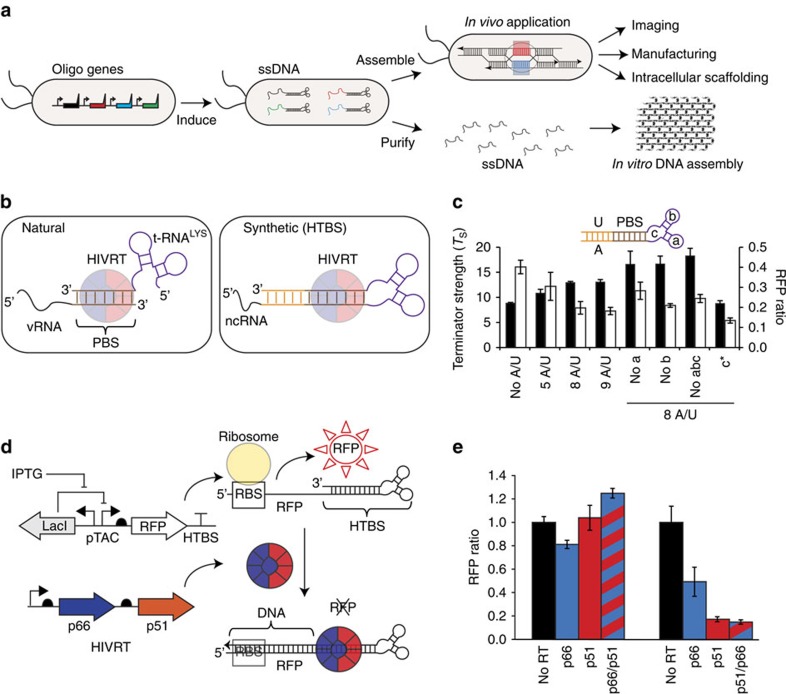
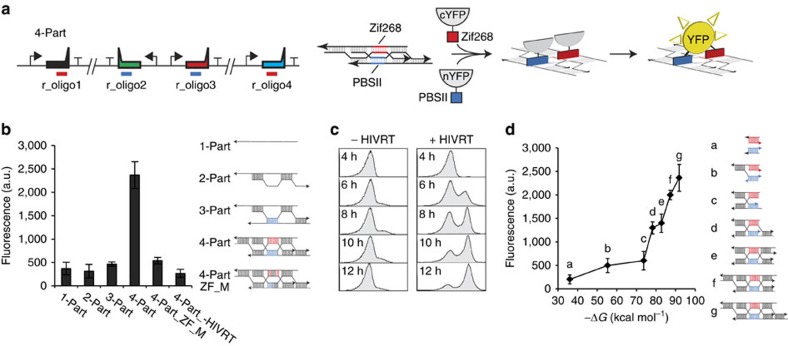
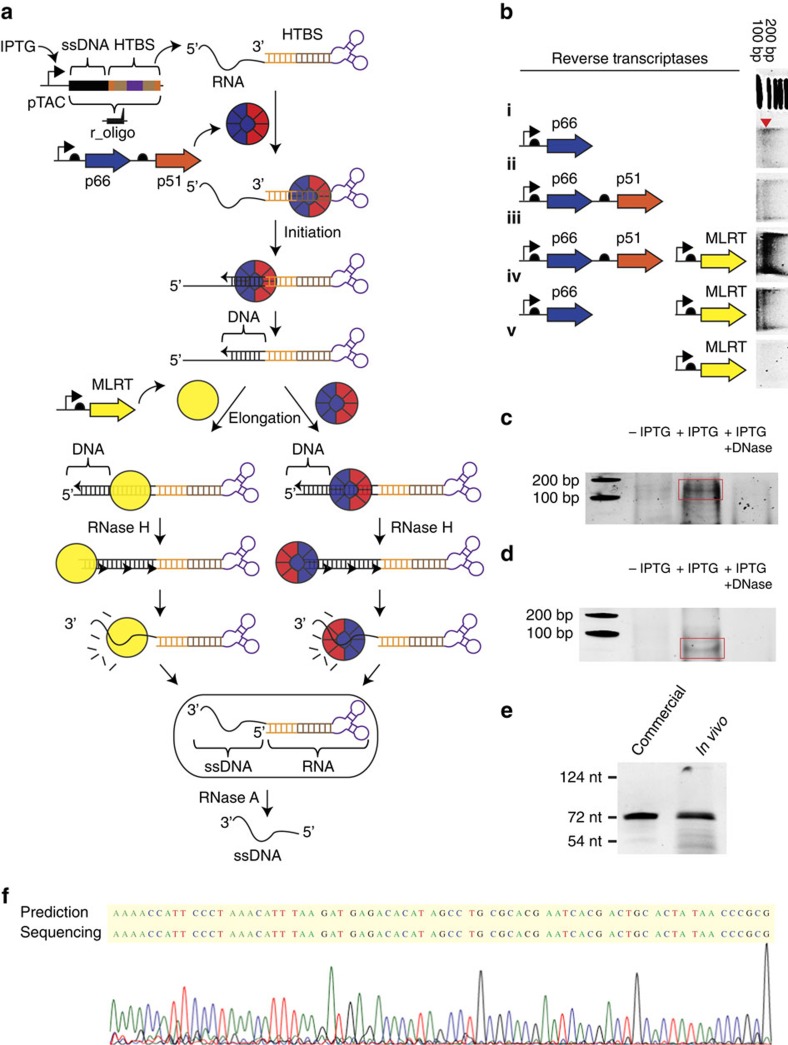
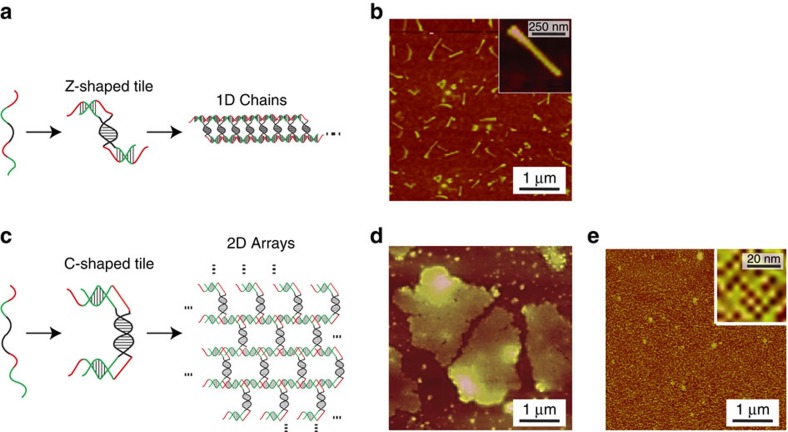
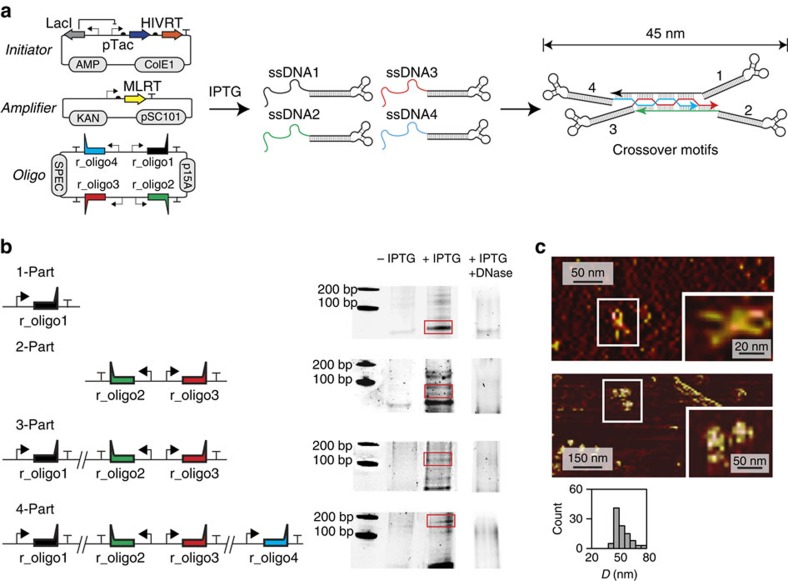
The field of DNA nanotechnology has harnessed the programmability of DNA base pairing to direct single-stranded DNAs (ssDNAs) to assemble into desired 3D structures. Here, we show the ability to express ssDNAs in Escherichia coli (32-205 nt), which can form structures in vivo or be purified for in vitro assembly. Each ssDNA is encoded by a gene that is transcribed into non-coding RNA containing a 3'-hairpin (HTBS). HTBS recruits HIV reverse transcriptase, which nucleates DNA synthesis and is aided in elongation by murine leukemia reverse transcriptase. Purified ssDNA that is produced in vivo is used to assemble large 1D wires (300 nm) and 2D sheets (5.8 μm(2)) in vitro. Intracellular assembly is demonstrated using a four-ssDNA crossover nanostructure that recruits split YFP when properly assembled. Genetically encoding DNA nanostructures provides a route for their production as well as applications in living cells.
DNA纳米技术领域利用DNA碱基配对的可编程性,引导单链DNA(ssDNA)组装成所需的三维结构。在此,我们展示了在大肠杆菌中表达ssDNA(32 - 205个核苷酸)的能力,这些ssDNA可在体内形成结构,或被纯化用于体外组装。每个ssDNA由一个基因编码,该基因转录成含有3' - 发夹结构(HTBS)的非编码RNA。HTBS招募HIV逆转录酶,该酶启动DNA合成,并在鼠白血病逆转录酶的辅助下进行延伸。体内产生的纯化ssDNA用于在体外组装大型一维线(300纳米)和二维片(5.8平方微米)。使用一种四ssDNA交叉纳米结构证明了细胞内组装,该结构在正确组装时会招募分裂型黄色荧光蛋白。对DNA纳米结构进行基因编码为其生产以及在活细胞中的应用提供了一条途径。