Centre for Infectious Diseases and Microbiology-Public Health, Westmead Hospital, cnr Hawkesbury and Darcy Roads, Westmead, NSW, 2145, Australia.
NSW Mycobacterium Reference Laboratory, Centre for Infectious Diseases and Microbiology Laboratory Services, NSW Health Pathology, Westmead, NSW, 2145, Australia.
BMC Infect Dis. 2018 Jun 7;18(1):265. doi: 10.1186/s12879-018-3164-z.
The recurrence of tuberculosis (TB) disease in treated patients can serve as a marker of the efficacy of TB control programs. Recurrent disease represents either endogenous reactivation with the same strain of Mycobacterium tuberculosis due to non-compliance or inadequate therapy or exogenous reinfection with a new strain. Genotyping or whole genome sequencing (WGS) of M. tuberculosis isolates from initial and recurrent cases can differentiate between reinfection and reactivation. This study examined cases of recurrent TB in New South Wales, Australia, using genotyping and WGS.
Culture-confirmed TB cases diagnosed at least 12 months apart between January 2011 and December 2016 were included. Isolates of M. tuberculosis from patients were compared using 24-locus Mycobacterial Interspersed Repetitive Unit Variable Number Tandem Repeat (MIRU-24) typing and WGS.
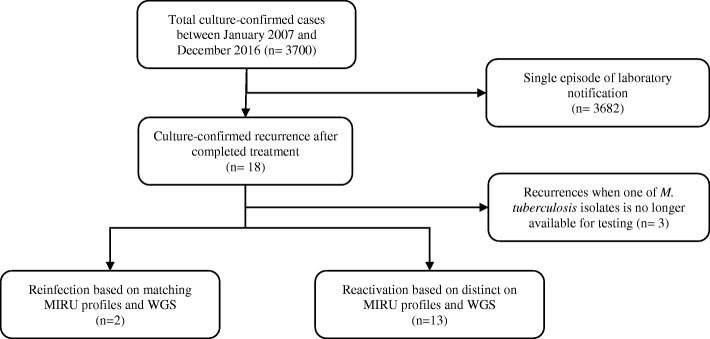
Eighteen cases of recurrent disease were identified but isolates from only 15 (83%) were available for study. MIRU-24 findings classified 13 (13/15; 87%) as reactivation and two (13%), as reinfection. Sequencing 13 cultivable paired isolates demonstrated 11 reactivations and two reinfections. There was genomic similarity in 10 out of 13 pairs while one case (1/13; 8%) had 12 SNPS differences. Two other cases (2/13;15%) had > 200 SNPs differences and were classified as reinfection. No phenotypic or genomic evidence of drug resistance was observed.
TB control programs can achieve consistently low rates of recurrent disease in low incidence settings. WGS of implicated isolates augments the differentiation between reactivation and reinfection and indicates that the majority of recurrences are due to reactivation rather than reinfection. Predominance of reactivation over reinfection indicates high-quality public health practices and a low risk of local transmission.
This study was approved by the Western Sydney Local Health District (WSLHD) Human Research Ethics Committee (HREC Ref: AU RED LNR/17/WMEAD/190; SSA Ref: LNR SSA/17/WMEAD/191).
治疗后的结核病(TB)患者的疾病复发可作为结核病控制项目疗效的标志。复发疾病代表由于不遵守或治疗不足而导致同一结核分枝杆菌菌株的内源性再激活,或者代表新菌株的外源性再感染。对初始和复发性病例的结核分枝杆菌分离株进行基因分型或全基因组测序(WGS)可以区分再感染和再激活。本研究使用基因分型和 WGS 检查了澳大利亚新南威尔士州的复发性 TB 病例。
纳入了 2011 年 1 月至 2016 年 12 月期间至少相隔 12 个月诊断的培养确诊的 TB 病例。对患者的结核分枝杆菌分离株使用 24 个基因座分枝杆菌散布重复单位可变数量串联重复(MIRU-24)分型和 WGS 进行比较。
确定了 18 例复发性疾病病例,但只有 15 例(83%)的分离株可用于研究。MIRU-24 发现将 13 例(13/15;87%)归类为再激活,2 例(13%)归类为再感染。对 13 个可培养的配对分离株进行测序表明,11 例为再激活,2 例为再感染。10 对中有 10 对具有基因组相似性,而 1 例(1/13;8%)有 12 个单核苷酸多态性差异。另外两例(2/13;15%)有>200 个 SNP 差异,被归类为再感染。未观察到表型或基因组耐药证据。
在低发病率环境中,结核病控制项目可以实现持续低复发率。受感染分离株的 WGS 增强了再激活和再感染之间的区分,并表明大多数复发是由于再激活而不是再感染。再激活的优势超过再感染表明公共卫生实践质量高,本地传播风险低。
本研究得到了西悉尼地方卫生区(WSLHD)人类研究伦理委员会(AU RED LNR/17/WMEAD/190;SSA Ref:LNR SSA/17/WMEAD/191)的批准。