Institute of Molecular Virology, Ulm University Medical Center, 89081, Ulm, Germany.
Institute of Virology, Ulm University Medical Center, 89081, Ulm, Germany.
Nat Commun. 2018 Jun 7;9(1):2207. doi: 10.1038/s41467-018-04442-y.
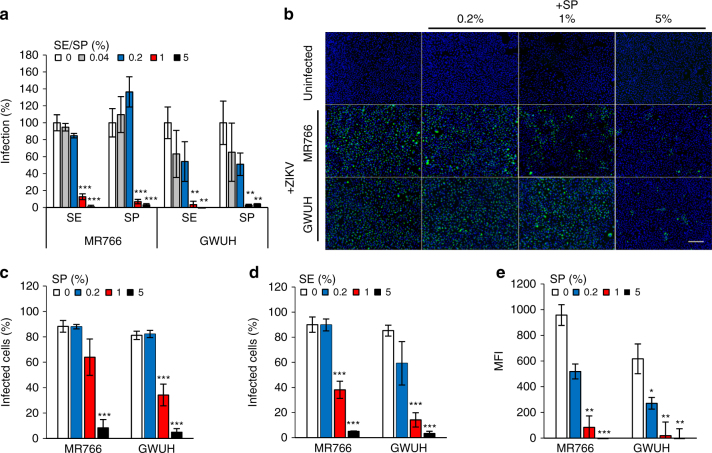
Zika virus (ZIKV) causes severe birth defects and can be transmitted via sexual intercourse. Semen from ZIKV-infected individuals contains high viral loads and may therefore serve as an important vector for virus transmission. Here we analyze the effect of semen on ZIKV infection of cells and tissues derived from the anogenital region. ZIKV replicates in all analyzed cell lines, primary cells, and endometrial or vaginal tissues. However, in the presence of semen, infection by ZIKV and other flaviviruses is potently inhibited. We show that semen prevents ZIKV attachment to target cells, and that an extracellular vesicle preparation from semen is responsible for this anti-ZIKV activity. Our findings suggest that ZIKV transmission is limited by semen. As such, semen appears to serve as a protector against sexual ZIKV transmission, despite the availability of highly susceptible cells in the anogenital tract and high viral loads in this bodily fluid.
寨卡病毒(ZIKV)可导致严重的出生缺陷,并可通过性行为传播。来自 ZIKV 感染个体的精液中含有高病毒载量,因此可能是病毒传播的重要载体。在这里,我们分析了精液对来自肛门生殖器区域的细胞和组织中 ZIKV 感染的影响。ZIKV 在所有分析的细胞系、原代细胞和子宫内膜或阴道组织中均复制。然而,在精液存在的情况下,ZIKV 和其他黄病毒的感染被强烈抑制。我们表明,精液可阻止 ZIKV 附着于靶细胞,并且精液中的细胞外囊泡制剂负责这种抗 ZIKV 活性。我们的研究结果表明,精液限制了 ZIKV 的传播。因此,尽管在肛门生殖器道中存在高度易感细胞和这种体液中的高病毒载量,但精液似乎可作为防止性传播 ZIKV 的保护物。