GRK 1624 'Frequency Effects in Language', University of Freiburg, Freiburg, Germany.
Department of German Linguistics, University of Freiburg, Freiburg, Germany.
Sci Rep. 2018 Jun 11;8(1):8898. doi: 10.1038/s41598-018-26801-x.
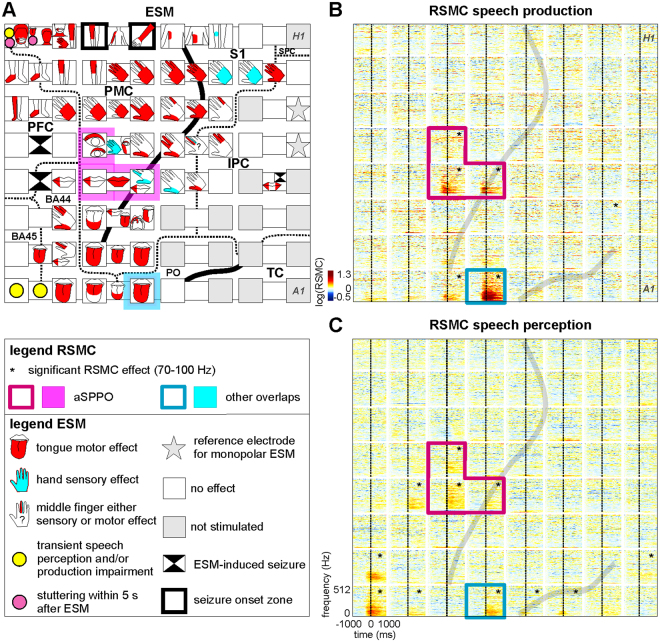
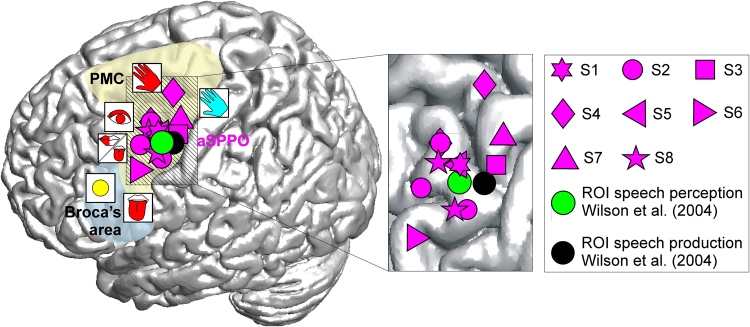
Motor-cognitive accounts assume that the articulatory cortex is involved in language comprehension, but previous studies may have observed such an involvement as an artefact of experimental procedures. Here, we employed electrocorticography (ECoG) during natural, non-experimental behavior combined with electrocortical stimulation mapping to study the neural basis of real-life human verbal communication. We took advantage of ECoG's ability to capture high-gamma activity (70-350 Hz) as a spatially and temporally precise index of cortical activation during unconstrained, naturalistic speech production and perception conditions. Our findings show that an electrostimulation-defined mouth motor region located in the superior ventral premotor cortex is consistently activated during both conditions. This region became active early relative to the onset of speech production and was recruited during speech perception regardless of acoustic background noise. Our study thus pinpoints a shared ventral premotor substrate for real-life speech production and perception with its basic properties.
运动认知理论假设,发音皮层参与语言理解,但之前的研究可能将这种参与观察为实验程序的一种人为产物。在这里,我们在自然的非实验行为期间利用脑皮层电图(ECoG)并结合皮层电刺激映射来研究现实人类言语交流的神经基础。我们利用 ECoG 捕捉高伽马活动(70-350Hz)的能力,作为在不受限制的自然言语产生和感知条件下皮质激活的空间和时间精确指标。我们的研究结果表明,在两种条件下,位于上腹侧前运动皮层的电刺激定义的嘴运动区都一致被激活。该区域相对于言语产生的开始更早激活,并在无论声学背景噪声如何都在言语感知过程中被招募。因此,我们的研究确定了现实生活中言语产生和感知的共同腹侧前运动基础及其基本特性。