Weetman Catherine, Anker Mathew D, Arrowsmith Merle, Hill Michael S, Kociok-Köhn Gabriele, Liptrot David J, Mahon Mary F
Department of Chemistry , University of Bath , Claverton Down , Bath , BA2 7AY , UK . Email:
Chem Sci. 2016 Jan 1;7(1):628-641. doi: 10.1039/c5sc03114a. Epub 2015 Oct 20.
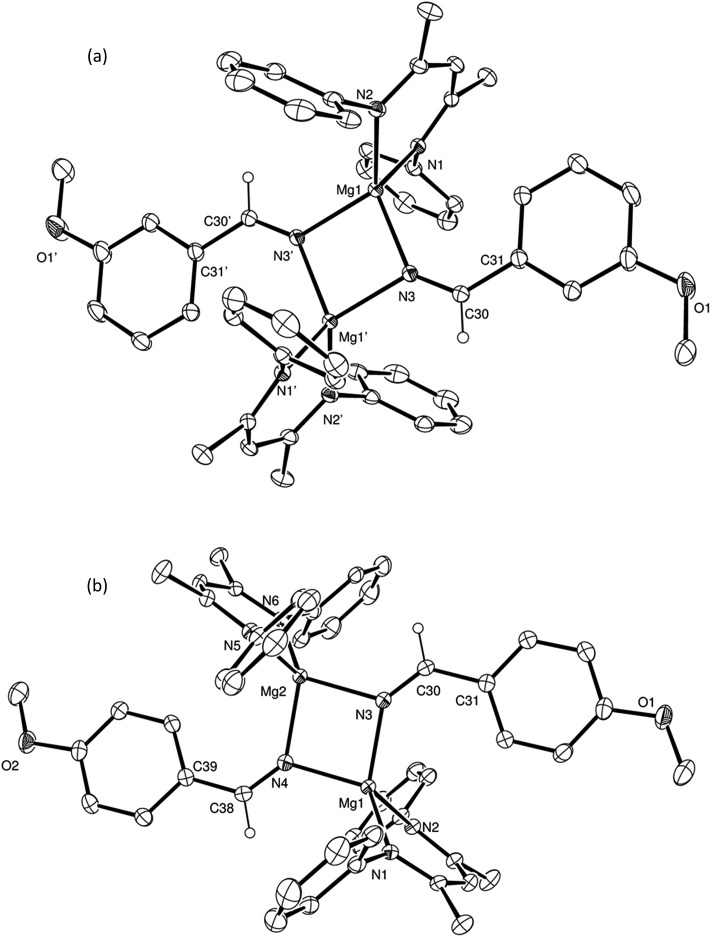
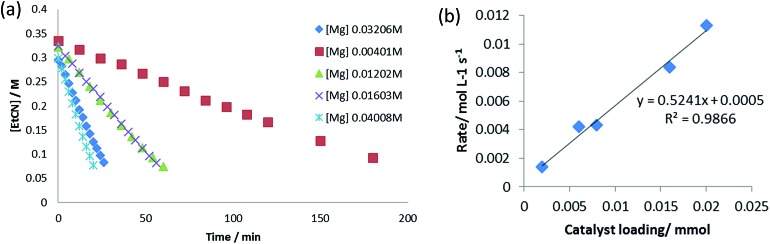
A β-diketiminato -butylmagnesium complex is presented as a selective precatalyst for the reductive hydroboration of organic nitriles with pinacolborane (HBpin). Stoichiometric reactivity studies indicate that catalytic turnover ensues through the generation of magnesium aldimido, aldimidoborate and borylamido intermediates, which are formed in a sequence of intramolecular nitrile insertion and inter- and intramolecular B-H metathesis events. Kinetic studies highlight variations in mechanism for the catalytic dihydroboration of alkyl nitriles, aryl nitriles bearing electron withdrawing (Ar(EWG)CN) and aryl nitriles bearing electron donating (Ar(EDG)CN) substitution patterns. Kinetic isotope effects (KIEs) for catalysis performed with DBpin indicate that B-H bond breaking and C-H bond forming reactions are involved in the rate determining processes during the dihydroboration of alkyl nitriles and Ar(EDG)CN substrates, which display divergent first and second order rate dependences on [HBpin] respectively. In contrast, the hydroboration of Ar(EWG)CN substrates provides no KIE and HBpin is not implicated in the rate determining process during catalysis. Irrespective of these differences, a common mechanism is proposed in which the rate determining steps are deduced to vary through the establishment of several pre-equilibria, the relative positions of which are determined by the respective stabilities of the dimeric and monomeric magnesium aldimide and magnesium aldimidoborate intermediates as a result of adjustments to the basicity of the nitrile substrate. More generally, these observations indicate that homogeneous processes performed under heavier alkaline earth catalysis are likely to demonstrate previously unappreciated mechanistic diversity.
一种β-二酮亚胺基-丁基镁配合物被提出作为一种选择性预催化剂,用于用频哪醇硼烷(HBpin)对有机腈进行还原硼氢化反应。化学计量反应性研究表明,催化周转通过生成镁醛亚胺、醛亚胺硼酸酯和硼胺基中间体而发生,这些中间体是在分子内腈插入以及分子间和分子内B-H复分解反应序列中形成的。动力学研究突出了烷基腈、带有吸电子取代基的芳基腈(Ar(EWG)CN)和带有供电子取代基的芳基腈(Ar(EDG)CN)的催化二硼氢化反应机制的差异。用DBpin进行催化的动力学同位素效应(KIEs)表明,在烷基腈和Ar(EDG)CN底物的二硼氢化反应过程中,B-H键断裂和C-H键形成反应参与了速率决定过程,它们分别对[HBpin]表现出不同的一级和二级速率依赖性。相比之下,Ar(EWG)CN底物的硼氢化反应没有提供KIE,并且HBpin在催化过程中不涉及速率决定过程。尽管存在这些差异,但提出了一种共同的机制,其中速率决定步骤被推断通过建立几个预平衡而变化,这些预平衡的相对位置由二聚体和单体镁醛亚胺以及镁醛亚胺硼酸酯中间体的各自稳定性决定,这是由于对腈底物碱性的调整所致。更一般地说,这些观察结果表明,在较重的碱土催化下进行的均相过程可能表现出以前未被认识到的机制多样性。