Occupational and Environmental Medicine, Department of Public Health and Clinical Medicine, Umeå University, Umeå, Sweden.
Swedish Meteorological and Hydrological Institute, Norrköping, Sweden.
PLoS One. 2018 Jun 13;13(6):e0198283. doi: 10.1371/journal.pone.0198283. eCollection 2018.
There is highly suggestive evidence for an effect of air pollution exposure on dementia-related outcomes, but evidence is not yet present to clearly pinpoint which pollutants are the probable causal agents. The aims of this study was to assess the longitudinal association between exposures of fine ambient particulate matter (PM2.5) from residential wood burning, and vehicle exhaust, with dementia.
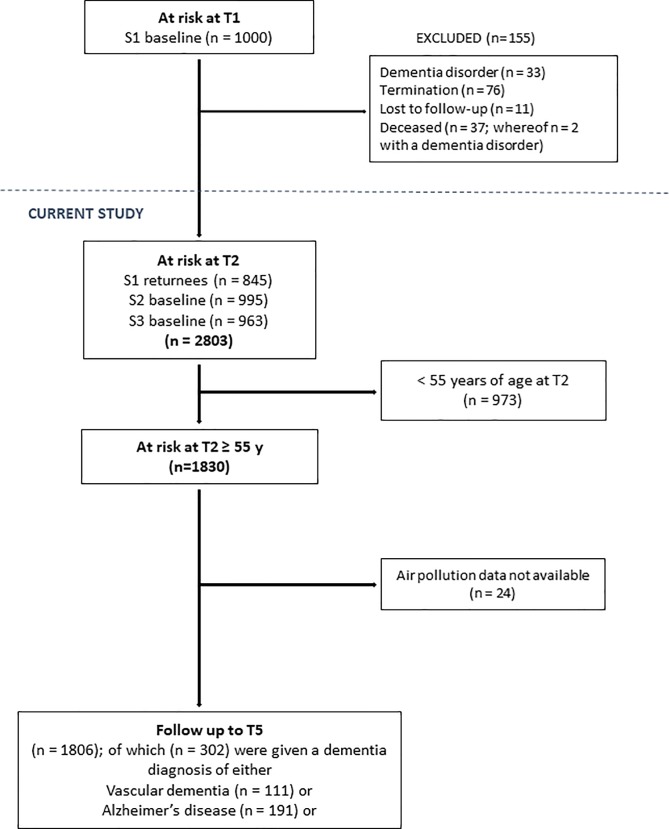
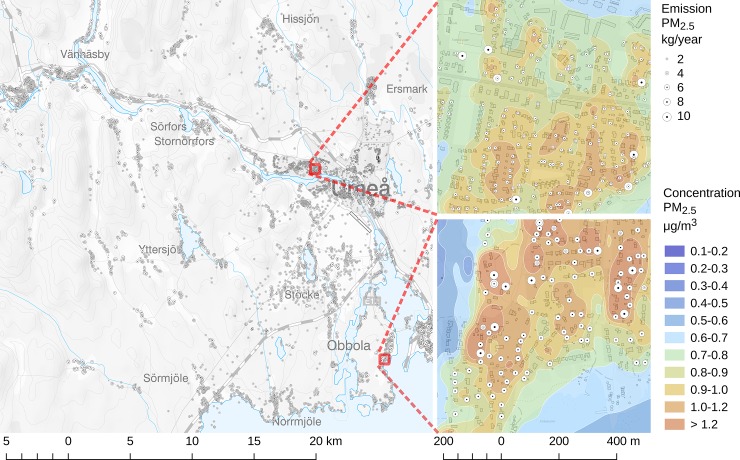
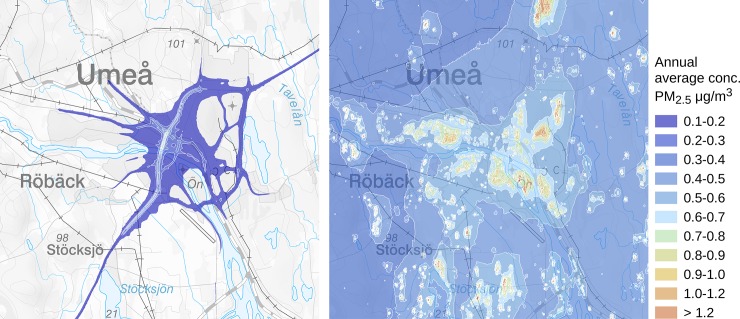
We used data from the Betula study, a longitudinal study of dementia in Umeå, Northern Sweden. The study size was 1 806 and the participants were followed from study entry (1993-1995) to 2010. Modelled levels of source-specific fine particulate matter at the residential address were combined with information on wood stoves or wood boilers, and with validated data on dementia diagnosis and individual-level characteristics from the Betula study. Cox proportional hazards models were used to estimate Hazard Ratios (HRs) and their 95% CIs for dementia incidence (vascular dementia and Alzheimer's disease), adjusted for individual-level characteristics.
The emission of PM2.5 from local residential wood burning was associated with dementia incidence with a hazard ratio of 1.55 for a 1 μg/m3 increase in PM2.5 (95% Confidence Interval (CI): 1.00-2.41, p-value 0.05). Study participants with an address in an area with the highest quartile of PM2.5 from residential wood burning and who also had a wood-burning stove were more likely to develop dementia than those in the lower three quartiles without a wood-burning stove with hazard ratios of 1.74 (CI: 1.10-2.75, p-value 0.018). Particulate matter from traffic exhaust seemed to be associated with dementia incidence with hazard ratios of 1.66, (CI: 1.16-2.39), p-value 0.006, and 1.41 (CI: 0.97-2.23), p-value 0.07, in the third and fourth quartiles, respectively.
If the associations we observed are causal, then air pollution from residential wood burning, and air pollution from traffic, might be independent important risk factors for dementia.
有高度提示性证据表明,空气污染暴露与痴呆相关结局之间存在关联,但目前尚无证据能够明确指出哪些污染物是可能的致病因子。本研究旨在评估居住性木材燃烧和机动车尾气细颗粒物质(PM2.5)暴露与痴呆之间的纵向关联。
我们使用了来自瑞典于默奥的贝图拉(Betula)研究的纵向痴呆研究数据。该研究共有 1806 名参与者,从研究开始(1993-1995 年)到 2010 年进行了随访。将住宅地址的特定源细颗粒物的模型水平与柴炉或木炉的信息相结合,并结合贝图拉研究中的痴呆诊断和个体特征的验证数据。使用 Cox 比例风险模型来估计痴呆发病率(血管性痴呆和阿尔茨海默病)的风险比(HR)及其 95%置信区间(CI),并对个体特征进行了调整。
当地居民燃烧木材产生的 PM2.5 排放与痴呆发病率相关,PM2.5 每增加 1μg/m3,风险比为 1.55(95%CI:1.00-2.41,p 值为 0.05)。住址处于 PM2.5 来自居民燃烧木材的最高四分位数区域且有柴炉的研究参与者比处于较低三分位数且没有柴炉的参与者更有可能患上痴呆,风险比为 1.74(CI:1.10-2.75,p 值为 0.018)。交通尾气产生的颗粒物与痴呆发病率相关,第三和第四四分位数的风险比分别为 1.66(CI:1.16-2.39),p 值为 0.006,和 1.41(CI:0.97-2.23),p 值为 0.07。
如果我们观察到的关联是因果关系,那么来自居民燃烧木材和交通的空气污染可能是痴呆的独立重要危险因素。