Department of Nutrition Science, Purdue University, West Lafayette, IN.
Department of Nutrition and Metabolism, University of Texas Medical Branch, Galveston, TX.
Am J Clin Nutr. 2018 Jul 1;108(1):33-40. doi: 10.1093/ajcn/nqy075.
A Mediterranean-style eating pattern (Mediterranean Pattern) is often described as being low in red meat. Research shows that lean, unprocessed red meat can be incorporated into healthy eating patterns to improve cardiometabolic disease (CMD) risk factors.
We assessed the effects of consuming different amounts of lean, unprocessed red meat in a Mediterranean Pattern on CMD risk factors. We hypothesized that consuming a Mediterranean Pattern would improve CMD risk factors and that red meat intake would not influence these improvements.
In an investigator-blinded, randomized, crossover, controlled feeding trial, 41 subjects [mean ± SD age: 46 ± 2 y; mean ± SD body mass index (kg/m2): 30.5 ± 0.6] were provided with a Mediterranean Pattern for two 5-wk interventions separated by 4 wk of self-selected eating. The Mediterranean Patterns contained ∼500 g [typical US intake (Med-Red)] and ∼200 g [commonly recommended intake in heart-healthy eating patterns (Med-Control)] of lean, unprocessed beef or pork per week. Red meat intake was compensated by poultry and other protein-rich foods. Baseline and postintervention outcomes included fasting blood pressure, serum lipids, lipoproteins, glucose, insulin, and ambulatory blood pressure. The presented results were adjusted for age, sex, and body mass at each time point (P < 0.05).
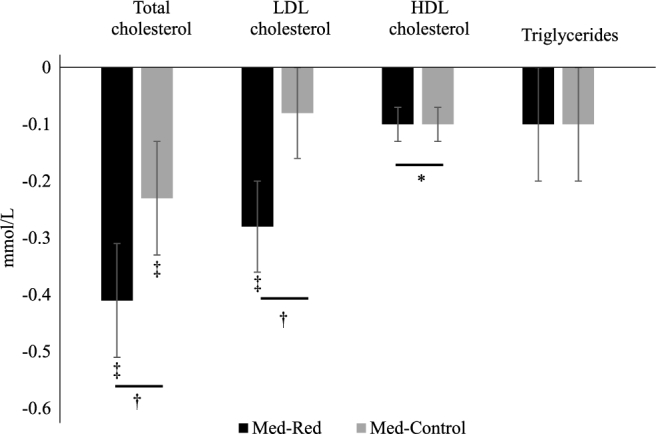
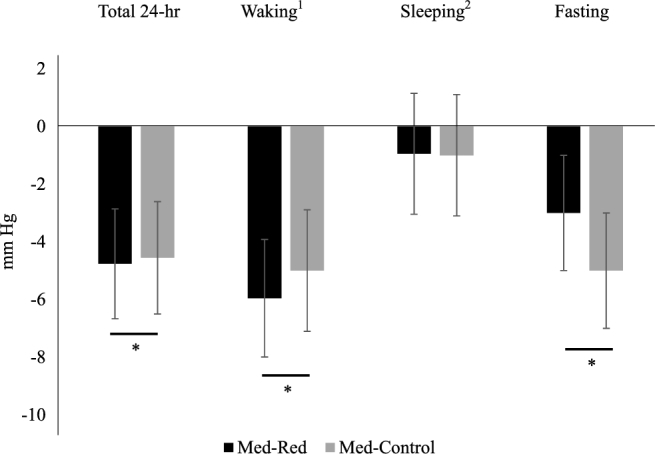
Total cholesterol decreased, but greater reductions occurred with Med-Red than with Med-Control (-0.4 ± 0.1 and -0.2 ±0.1 mmol/L, respectively, intervention × time = 0.045]. Low-density lipoprotein decreased with Med-Red but was unchanged with Med-Control [-0.3 ± 0.1 and -0.1 ± 0.1 mmol/L, respectively, intervention × time = 0.038], whereas high-density lipoprotein (HDL) concentrations decreased nondifferentially [-0.1 ± 0.0 mmol/L]. Triglycerides, total cholesterol:HDL, glucose, and insulin did not change with either Med-Red or Med-Control. All blood pressure parameters improved, except during sleep, independent of the red meat intake amount.
Adults who are overweight or moderately obese may improve multiple cardiometabolic disease risk factors by adopting a Mediterranean-style eating pattern with or without reductions in red meat intake when red meats are lean and unprocessed. This trial was registered at clinicaltrials.gov as NCT02573129.
地中海饮食模式(Mediterranean Pattern)通常被描述为低红肉摄入。研究表明,摄入瘦肉、未加工的红肉可以纳入健康饮食模式,以改善心血管代谢疾病(CMD)的风险因素。
我们评估了地中海饮食模式中摄入不同量的瘦肉、未加工红肉对 CMD 风险因素的影响。我们假设摄入地中海饮食模式将改善 CMD 风险因素,而红肉摄入不会影响这些改善。
在一项研究者设盲、随机、交叉、对照喂养试验中,41 名受试者[平均年龄 ± 标准差(SD):46 ± 2 岁;平均 BMI ± SD(kg/m2):30.5 ± 0.6]接受了为期 5 周的地中海饮食模式干预,两种饮食模式之间间隔 4 周的自我选择饮食。地中海饮食模式每周含有约 500 g [典型的美国摄入量(Med-Red)]和 200 g [在心脏健康饮食模式中通常推荐的摄入量(Med-Control)]的瘦肉、未加工的牛肉或猪肉。红肉摄入量通过禽肉和其他富含蛋白质的食物来补充。基线和干预后评估的结果包括空腹血压、血清脂质、脂蛋白、血糖、胰岛素和动态血压。呈现的结果是在每个时间点调整年龄、性别和体重后的结果(P<0.05)。
总胆固醇降低,但 Med-Red 组的降低幅度大于 Med-Control 组(分别为-0.4 ± 0.1 和-0.2 ± 0.1 mmol/L,干预×时间=0.045)。低密度脂蛋白胆固醇(LDL)在 Med-Red 组降低,但在 Med-Control 组不变(分别为-0.3 ± 0.1 和-0.1 ± 0.1 mmol/L,干预×时间=0.038),而高密度脂蛋白胆固醇(HDL)浓度非差异降低[-0.1 ± 0.0 mmol/L]。甘油三酯、总胆固醇:HDL、血糖和胰岛素在 Med-Red 或 Med-Control 组均未发生变化。除睡眠期间外,所有血压参数均改善,而与红肉摄入量无关。
超重或中度肥胖的成年人通过采用地中海饮食模式,无论是否减少红肉摄入(当红肉为瘦肉和未加工时),都可以改善多种心血管代谢疾病的风险因素。本试验在 clinicaltrials.gov 注册为 NCT02573129。