Seow Pohchoo, Wong Jeannie Hsiu Ding, Ahmad-Annuar Azlina, Mahajan Abhishek, Abdullah Nor Aniza, Ramli Norlisah
1 Department of Biomedical Imaging, University of Malaya , Kuala Lumpur , Malaysia.
2 Department of Biomedical Imaging, University of Malaya Research Imaging Centre, University of Malaya , Kuala Lumpur , Malaysia.
Br J Radiol. 2018 Dec;91(1092):20170930. doi: 10.1259/bjr.20170930. Epub 2018 Jun 29.
: The diversity of tumour characteristics among glioma patients, even within same tumour grade, is a big challenge for disease outcome prediction. A possible approach for improved radiological imaging could come from combining information obtained at the molecular level. This review assembles recent evidence highlighting the value of using radiogenomic biomarkers to infer the underlying biology of gliomas and its correlation with imaging features.
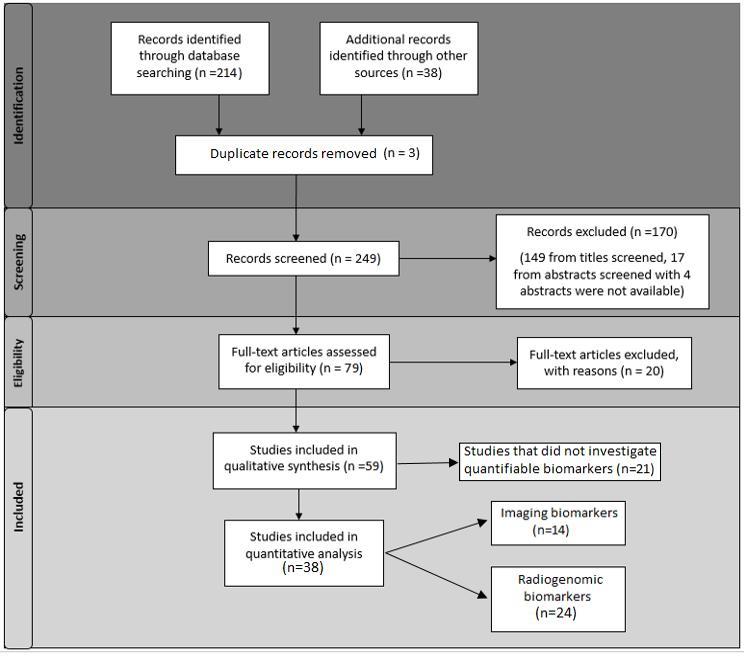
: A literature search was done for articles published between 2002 and 2017 on Medline electronic databases. Of 249 titles identified, 38 fulfilled the inclusion criteria, with 14 articles related to quantifiable imaging parameters (heterogeneity, vascularity, diffusion, cell density, infiltrations, perfusion, and metabolite changes) and 24 articles relevant to molecular biomarkers linked to imaging.
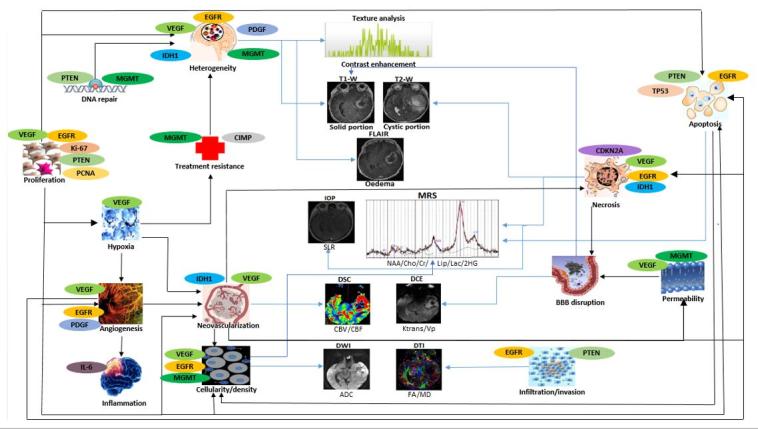
: Genes found to correlate with various imaging phenotypes were EGFR, MGMT, IDH1, VEGF, PDGF, TP53, and Ki-67. EGFR is the most studied gene related to imaging characteristics in the studies reviewed (41.7%), followed by MGMT (20.8%) and IDH1 (16.7%). A summary of the relationship amongst glioma morphology, gene expressions, imaging characteristics, prognosis and therapeutic response are presented.
: The use of radiogenomics can provide insights to understanding tumour biology and the underlying molecular pathways. Certain MRI characteristics that show strong correlations with EGFR, MGMT and IDH1 could be used as imaging biomarkers. Knowing the pathways involved in tumour progression and their associated imaging patterns may assist in diagnosis, prognosis and treatment management, while facilitating personalised medicine.
: Radiogenomics can offer clinicians better insight into diagnosis, prognosis, and prediction of therapeutic responses of glioma.
胶质瘤患者肿瘤特征的多样性,即使在同一肿瘤分级内,也是疾病预后预测的一大挑战。改进放射影像学的一种可能方法是整合从分子水平获得的信息。本综述收集了近期证据,强调了使用放射基因组生物标志物推断胶质瘤潜在生物学特性及其与影像特征相关性的价值。
在Medline电子数据库中检索2002年至2017年发表的文章。在识别出的249篇标题中,38篇符合纳入标准,其中14篇文章涉及可量化的影像参数(异质性、血管生成、扩散、细胞密度、浸润、灌注和代谢物变化),24篇文章涉及与影像相关的分子生物标志物。
发现与各种影像表型相关的基因有表皮生长因子受体(EGFR)、O6-甲基鸟嘌呤-DNA甲基转移酶(MGMT)、异柠檬酸脱氢酶1(IDH1)、血管内皮生长因子(VEGF)、血小板衍生生长因子(PDGF)、肿瘤蛋白p53(TP53)和Ki-67。在本综述的研究中,EGFR是与影像特征相关研究最多的基因(41.7%),其次是MGMT(20.8%)和IDH1(16.7%)。总结了胶质瘤形态、基因表达、影像特征、预后和治疗反应之间的关系。
放射基因组学的应用有助于深入了解肿瘤生物学和潜在的分子途径。某些与EGFR、MGMT和IDH1显示出强相关性的磁共振成像(MRI)特征可作为影像生物标志物。了解肿瘤进展所涉及的途径及其相关的影像模式可能有助于诊断、预后和治疗管理,同时促进个性化医疗。
放射基因组学可为临床医生提供关于胶质瘤诊断、预后和治疗反应预测的更好见解。