Haque Farzin, Wang Shaoying, Stites Chris, Chen Li, Wang Chi, Guo Peixuan
Nanobiotechnology Center, University of Kentucky, Lexington, KY 40536, USA; Markey Cancer Center, University of Kentucky, Lexington, KY 40536, USA; Department of Pharmaceutical Sciences, University of Kentucky, Lexington, KY 40536, USA.
Nanobiotechnology Center, University of Kentucky, Lexington, KY 40536, USA; Markey Cancer Center, University of Kentucky, Lexington, KY 40536, USA; Department of Pharmaceutical Sciences, University of Kentucky, Lexington, KY 40536, USA.
Biomaterials. 2015;53:744-52. doi: 10.1016/j.biomaterials.2015.02.104. Epub 2015 Mar 27.
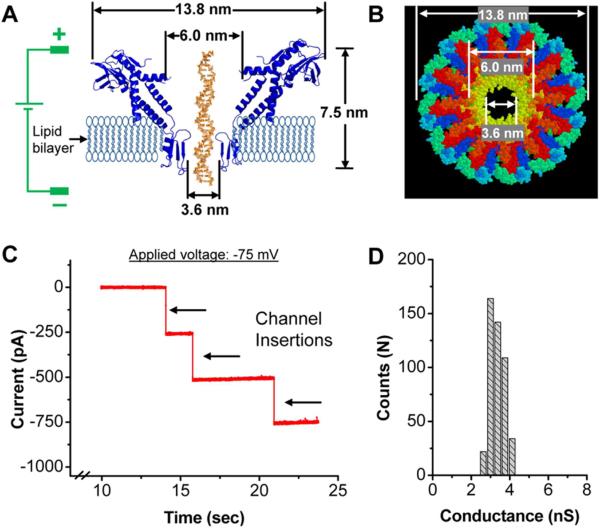
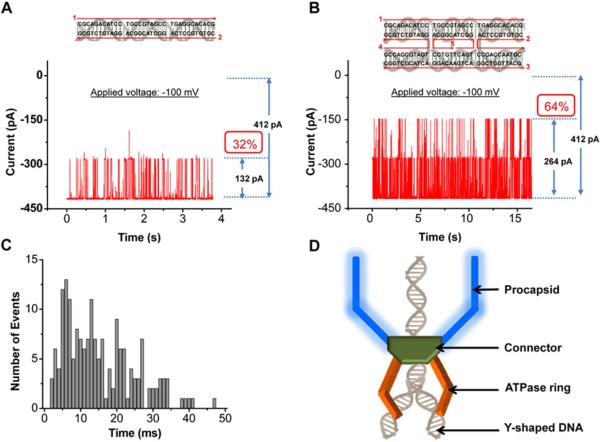
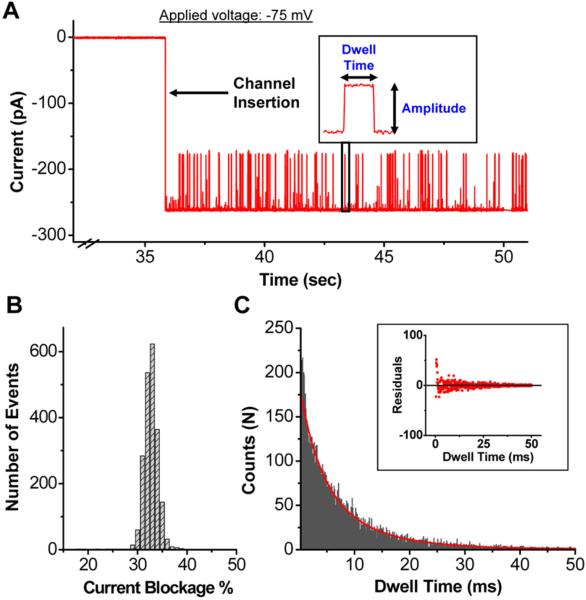
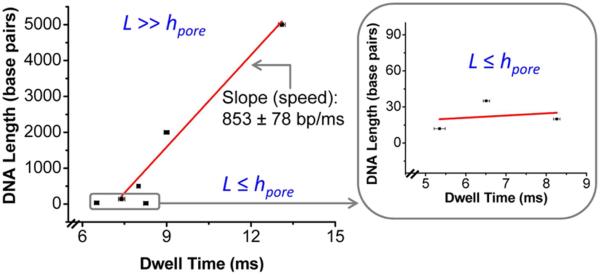
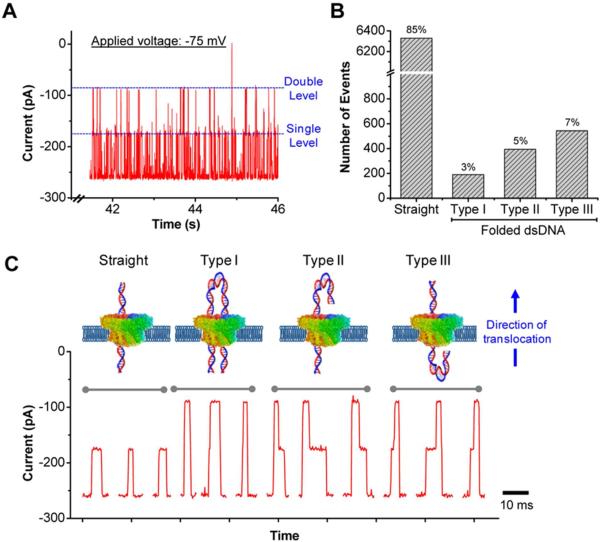
The elegant architecture of the channel of bacteriophage phi29 DNA packaging motor has inspired the development of biomimetics for biophysical and nanobiomedical applications. The reengineered channel inserted into a lipid membrane exhibits robust electrophysiological properties ideal for precise sensing and fingerprinting of dsDNA at the single-molecule level. Herein, we used single channel conduction assays to quantitatively evaluate the translocation dynamics of dsDNA as a function of the length and conformation of dsDNA. We extracted the speed of dsDNA translocation from the dwell time distribution and estimated the various forces involved in the translocation process. A ∼35-fold slower speed of translocation per base-pair was observed for long dsDNA, a significant contrast to the speed of dsDNA crossing synthetic pores. It was found that the channel could translocate both dsDNA with ∼32% of channel current blockage and with ∼64% for tetra-stranded DNA (two parallel dsDNA). The calculation of both cross-sectional areas of the dsDNA and tetra-stranded DNA suggested that the blockage was purely proportional to the physical space of the channel lumen and the size of the DNA substrate. Folded dsDNA configuration was clearly reflected in their characteristic current signatures. The finding of translocation of tetra-stranded DNA with 64% blockage is in consent with the recently elucidated mechanism of viral DNA packaging via a revolution mode that requires a channel larger than the dsDNA diameter of 2 nm to provide room for viral DNA revolving without rotation. The understanding of the dynamics of dsDNA translocation in the phi29 system will enable us to design more sophisticated single pore DNA translocation devices for future applications in nanotechnology and personal medicine.
噬菌体 phi29 DNA 包装马达通道的精巧结构激发了用于生物物理和纳米生物医学应用的仿生学发展。插入脂质膜的重新设计通道展现出强大的电生理特性,非常适合在单分子水平上对双链 DNA 进行精确传感和指纹识别。在此,我们使用单通道传导分析来定量评估双链 DNA 的转位动力学,作为双链 DNA 长度和构象的函数。我们从驻留时间分布中提取双链 DNA 的转位速度,并估计转位过程中涉及的各种力。对于长双链 DNA,观察到每碱基对的转位速度慢约 35 倍,这与双链 DNA 通过合成孔的转位速度形成显著对比。发现该通道能够转位双链 DNA,通道电流阻断约为 32%,对于四链 DNA(两条平行双链 DNA)则约为 64%。双链 DNA 和四链 DNA 横截面积的计算表明,阻断纯粹与通道内腔的物理空间和 DNA 底物的大小成正比。折叠的双链 DNA 构象在其特征电流信号中清晰体现。四链 DNA 以 64%阻断转位的发现与最近阐明的病毒 DNA 通过旋转模式包装的机制一致,该模式需要一个大于双链 DNA 直径 2 纳米的通道,为病毒 DNA 旋转而不转动提供空间。对 phi29 系统中双链 DNA 转位动力学的理解将使我们能够设计更复杂的单孔 DNA 转位装置,用于未来的纳米技术和个人医学应用。