Sun Mingxia, Liu Chongdong, Zhao Na, Meng Kaikai, Zhang Zhenyu
Department of Obstetrics and Gynecology, Beijing Chaoyang Hospital, Beijing 100043, P.R. China.
Exp Ther Med. 2018 Jun;15(6):5215-5220. doi: 10.3892/etm.2018.6116. Epub 2018 May 2.
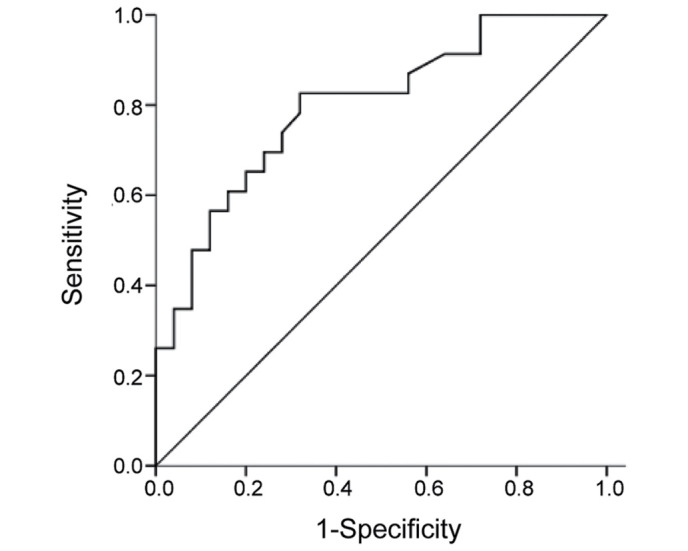
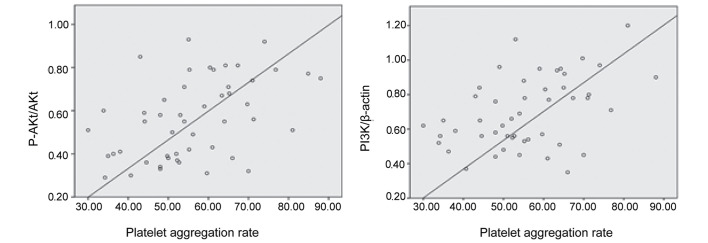
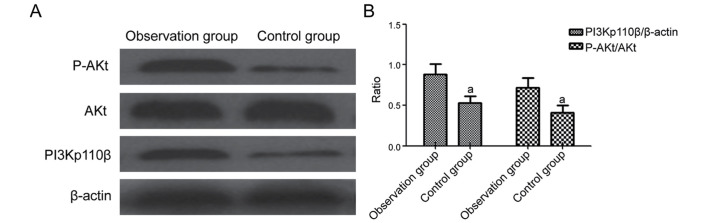
The present study investigated the predictive value of the platelet aggregation rate in postpartum deep venous thrombosis and its possible mechanism. From January 2014 to January 2016, 23 patients with postpartum deep vein thrombosis of lower extremity treated in the Department of Obstetrics of Beijing Chaoyang Hospital were as assigned as the observation group. At the same time, 25 cases with normal recovery were assigned as the control group. Blood samples were collected from all the subjects. The platelet aggregation rate was measured using a platelet aggregation apparatus. Plasma platelet activating factor (PAF) levels were measured by ELISA. The positive rate of platelet P-selectin (CD62p) and lysosomal membrane glycoprotein (CD63) was measured by flow cytometry. PI3K expression and AKt phosphorylation levels were measured by western blot analysis. The ROC curve was used to evaluate the value of the platelet aggregation rate in predicting postpartum deep vein thrombosis of lower extremity. The correlation between the platelet aggregation rate and PAF and PI3K/AKt expression was also analyzed. The cesarean section rate, platelet 5-min maximum aggregation rate, PAF level and the positive rate of CD62p and CD63 were significantly higher in the control than those in the observation group (P<0.05). Furthermore, the platelet aggregation rate was positively correlated with the expression of PAF, CD62p and CD63 (r=0.389, 0.451, and 0.452; all P<0.05). The platelet 5-min maximum aggregation rate for predicting postpartum deep vein thrombosis of lower extremity was reflected by the area under the ROC curve (AUC=0.797, P=0.000). The PI3Kp110β/β-actin and p-AKt/AKt ratio was significantly higher in the observation compared with the control group (P<0.05). In addition, the platelet aggregation rate was positively correlated with the expression of PI3K and phosphorylation level of AKt (r=0.441, 0.430; all P<0.05). The results suggested that platelet aggregation activity is elevated in postpartum deep vein thrombosis patients. It has a certain predictive value for the occurrence of postpartum deep vein thrombosis of lower extremity. Thuss, the PI3K/AKt signaling pathway may be one of the mechanisms of platelet aggregation.
本研究探讨血小板聚集率在产后下肢深静脉血栓形成中的预测价值及其可能机制。选取2014年1月至2016年1月在北京朝阳医院产科治疗的23例产后下肢深静脉血栓形成患者作为观察组。同时,选取25例恢复正常的患者作为对照组。采集所有受试者的血样。使用血小板聚集仪测量血小板聚集率。采用酶联免疫吸附测定法检测血浆血小板活化因子(PAF)水平。采用流式细胞术检测血小板P-选择素(CD62p)和溶酶体膜糖蛋白(CD63)的阳性率。采用蛋白质免疫印迹分析检测PI3K表达和AKt磷酸化水平。采用ROC曲线评估血小板聚集率对产后下肢深静脉血栓形成的预测价值。分析血小板聚集率与PAF及PI3K/AKt表达的相关性。对照组剖宫产率、血小板5分钟最大聚集率、PAF水平及CD62p和CD63阳性率均显著高于观察组(P<0.05)。此外,血小板聚集率与PAF、CD62p和CD63的表达呈正相关(r=0.389、0.451和0.452;均P<0.05)。ROC曲线下面积反映血小板5分钟最大聚集率对产后下肢深静脉血栓形成的预测价值(AUC=0.797,P=0.000)。观察组PI3Kp110β/β-肌动蛋白和p-AKt/AKt比值显著高于对照组(P<0.05)。此外,血小板聚集率与PI3K表达和AKt磷酸化水平呈正相关(r=0.441、0.43;均P<0.05)。结果提示,产后下肢深静脉血栓形成患者血小板聚集活性升高。其对产后下肢深静脉血栓形成的发生具有一定的预测价值。因此,PI3K/AKt信号通路可能是血小板聚集的机制之一。