Katz Ella, Nisani Sophia, Chamovitz Daniel A
School of Plant Sciences and Food Security, Tel Aviv University, Tel Aviv, Israel.
Department of Plant Sciences, University of California , Davis , USA.
F1000Res. 2018 Jun 1;7. doi: 10.12688/f1000research.14127.1. eCollection 2018.
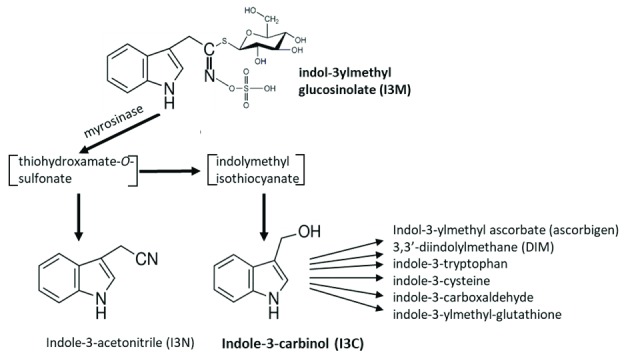
A diet rich in cruciferous vegetables such as cauliflower, broccoli, and cabbage has long been considered healthy, and various epidemiological studies suggest that the consumption of cruciferous vegetables contributes to a cancer-protecting diet. While these vegetables contain a vast array of phytochemicals, the mechanism by which these vegetables counteract cancer is still largely unresolved. Numerous studies have implicated indole-3-carbinol, a breakdown product of the glucosinolate indole-3-ylmethylglucosinolate, as one of the phytochemicals with anti-cancer properties. Indole-3-carbinol influences a range of cellular processes, but the mechanisms by which it acts on cancer cells are slowly being revealed. Recent studies on the role of indole-3-carbinol in Arabidopsis opens the door for cross-kingdom comparisons that can help in understanding the roles of this important phytohormone in both plant biology and combatting cancer.
长期以来,富含十字花科蔬菜(如菜花、西兰花和卷心菜)的饮食一直被认为是健康的,各种流行病学研究表明,食用十字花科蔬菜有助于形成防癌饮食。虽然这些蔬菜含有大量的植物化学物质,但这些蔬菜对抗癌症的机制在很大程度上仍未得到解决。许多研究表明,吲哚 - 3 - 甲醇是芥子油苷吲哚 - 3 - 基甲基芥子油苷的分解产物,是具有抗癌特性的植物化学物质之一。吲哚 - 3 - 甲醇影响一系列细胞过程,但其作用于癌细胞的机制正在慢慢被揭示。最近关于吲哚 - 3 - 甲醇在拟南芥中的作用的研究为跨领域比较打开了大门,这有助于理解这种重要植物激素在植物生物学和抗癌方面的作用。