GrassrootsHealth, Encinitas, California, United States of America.
Department of Family Medicine and Public Health, University of California San Diego, La Jolla, California, United States of America.
PLoS One. 2018 Jun 15;13(6):e0199265. doi: 10.1371/journal.pone.0199265. eCollection 2018.
While numerous epidemiologic studies have found an association between higher serum 25-hydroxyvitamin D [25(OH)D] concentrations and lower breast cancer risk, few have assessed this association for concentrations >40 ng/ml.
To investigate the relationship between 25(OH)D concentration and breast cancer risk across a broad range of 25(OH)D concentrations among women aged 55 years and older.
Analyses used pooled data from two randomized clinical trials (N = 1129, N = 2196) and a prospective cohort (N = 1713) to examine a broad range of 25(OH)D concentrations. The outcome was diagnosis of breast cancer during the observation periods (median: 4.0 years). Three analyses were conducted: 1) Incidence rates were compared according to 25(OH)D concentration from <20 to ≥60 ng/ml (<50 to ≥150 nmol/L), 2) Kaplan-Meier plots were developed and 3) multivariate Cox regression was used to examine the association between 25(OH)D and breast cancer risk using multiple 25(OH)D measurements.
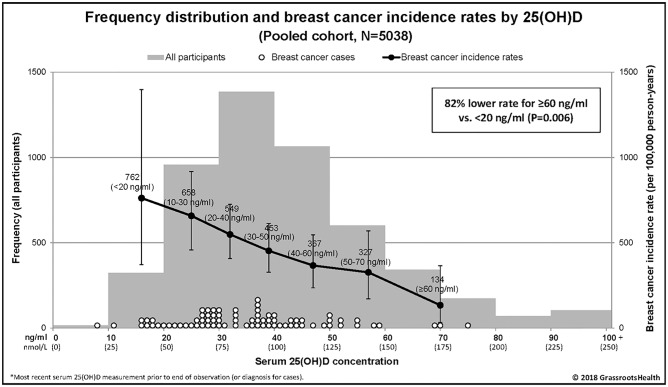
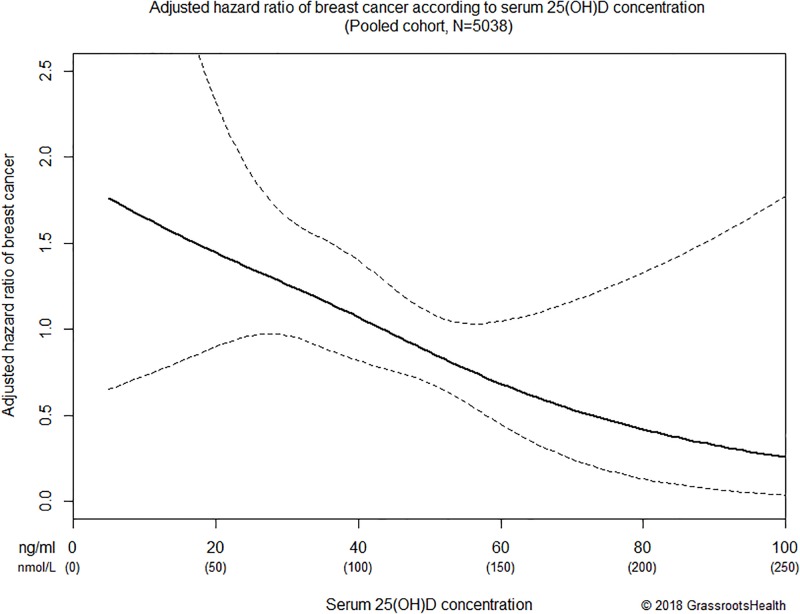
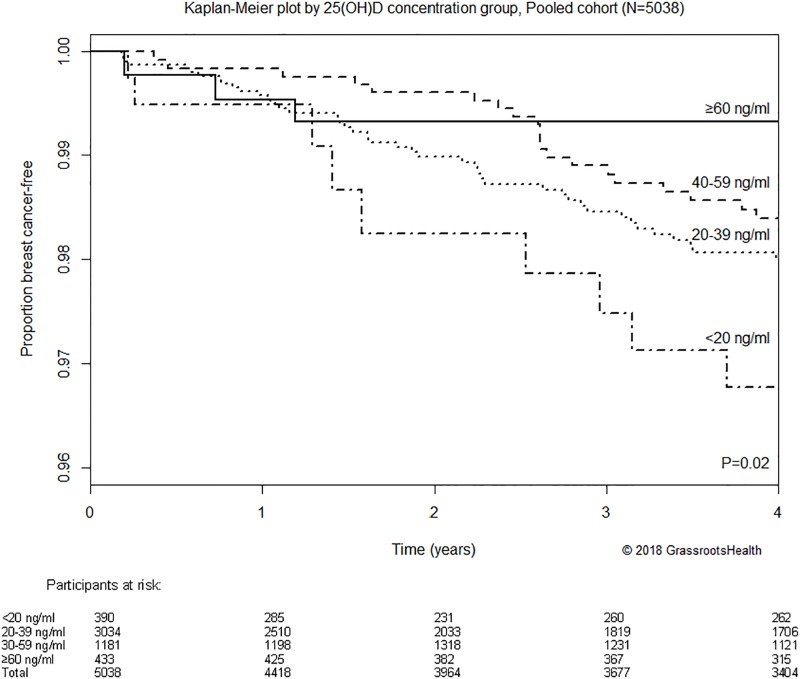
Within the pooled cohort (N = 5038), 77 women were diagnosed with breast cancer (age-adjusted incidence: 512 cases per 100,000 person-years). Results were similar for the three analyses. First, comparing incidence rates, there was an 82% lower incidence rate of breast cancer for women with 25(OH)D concentrations ≥60 vs <20 ng/ml (Rate Ratio = 0.18, P = 0.006). Second, Kaplan-Meier curves for concentrations of <20, 20-39, 40-59 and ≥60 ng/ml were significantly different (P = 0.02), with the highest proportion breast cancer-free in the ≥60 ng/ml group (99.3%) and the lowest proportion breast cancer-free in the <20 ng/ml group (96.8%). The proportion with breast cancer was 78% lower for ≥60 vs <20 ng/ml (P = 0.02). Third, multivariate Cox regression revealed that women with 25(OH)D concentrations ≥60 ng/ml had an 80% lower risk of breast cancer than women with concentrations <20 ng/ml (HR = 0.20, P = 0.03), adjusting for age, BMI, smoking status, calcium supplement intake, and study of origin.
Higher 25(OH)D concentrations were associated with a dose-response decrease in breast cancer risk with concentrations ≥60 ng/ml being most protective.
虽然许多流行病学研究发现血清 25-羟维生素 D [25(OH)D] 浓度较高与乳腺癌风险较低有关,但很少有研究评估浓度 >40ng/ml 时的这种关联。
在年龄在 55 岁及以上的女性中,在广泛的 25(OH)D 浓度范围内,研究 25(OH)D 浓度与乳腺癌风险之间的关系。
分析使用两项随机临床试验(N=1129,N=2196)和一项前瞻性队列研究(N=1713)的汇总数据来检查广泛的 25(OH)D 浓度范围内的关系。观察期间的结局为乳腺癌诊断(中位随访时间:4.0 年)。进行了三项分析:1)根据 25(OH)D 浓度<20-≥60ng/ml(<50-≥150nmol/L)比较发病率;2)绘制 Kaplan-Meier 图;3)使用多次 25(OH)D 测量,多变量 Cox 回归检查 25(OH)D 与乳腺癌风险之间的关联。
在汇总队列(N=5038)中,有 77 名女性被诊断患有乳腺癌(年龄调整后的发病率:每 100000 人年 512 例)。这三种分析的结果相似。首先,比较发病率,25(OH)D 浓度≥60ng/ml 与<20ng/ml 的女性乳腺癌发病率降低 82%(发生率比=0.18,P=0.006)。其次,<20ng/ml、20-39ng/ml、40-59ng/ml 和≥60ng/ml 浓度的 Kaplan-Meier 曲线差异有统计学意义(P=0.02),≥60ng/ml 组乳腺癌无病比例最高(99.3%),<20ng/ml 组乳腺癌无病比例最低(96.8%)。≥60ng/ml 组乳腺癌的比例比<20ng/ml 组低 78%(P=0.02)。第三,多变量 Cox 回归显示,25(OH)D 浓度≥60ng/ml 的女性乳腺癌风险比浓度<20ng/ml 的女性低 80%(风险比=0.20,P=0.03),调整了年龄、BMI、吸烟状况、钙补充剂摄入量和研究来源。
较高的 25(OH)D 浓度与乳腺癌风险呈剂量反应性降低相关,浓度≥60ng/ml 时的保护作用最强。