Department of Health Systems Management, Guilford Glazer Faculty of Business and Management and Faculty of Health Sciences, Ben-Gurion University of the Negev, PO Box 653, 84105, Beer-Sheva, Israel.
Institute for Health Policy, Management and Evaluation, University of Toronto, 4th Floor, 155 College St, Toronto, ON, M5T 3M6, Canada.
Health Res Policy Syst. 2018 Jun 15;16(1):48. doi: 10.1186/s12961-018-0325-x.
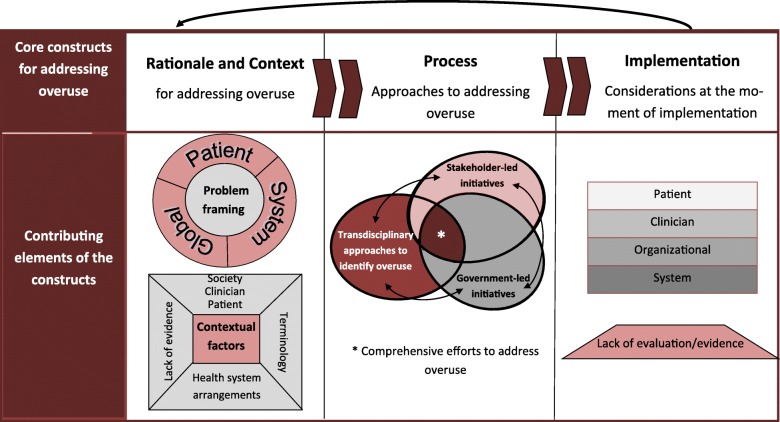
Health systems are increasingly focusing on the issue of 'overuse' of health services and how to address it. We developed a framework focused on (1) the rationale and context for health systems prioritising addressing overuse, (2) elements of a comprehensive process and approach to reduce overuse and (3) implementation considerations for addressing overuse.
We conducted a critical interpretive synthesis informed by a stakeholder-engagement process. The synthesis identified relevant empirical and non-empirical articles about system-level overuse. Two reviewers independently screened records, assessed for inclusion and conceptually mapped included articles. From these, we selected a purposive sample, created structured summaries of key findings and thematically synthesised the results.
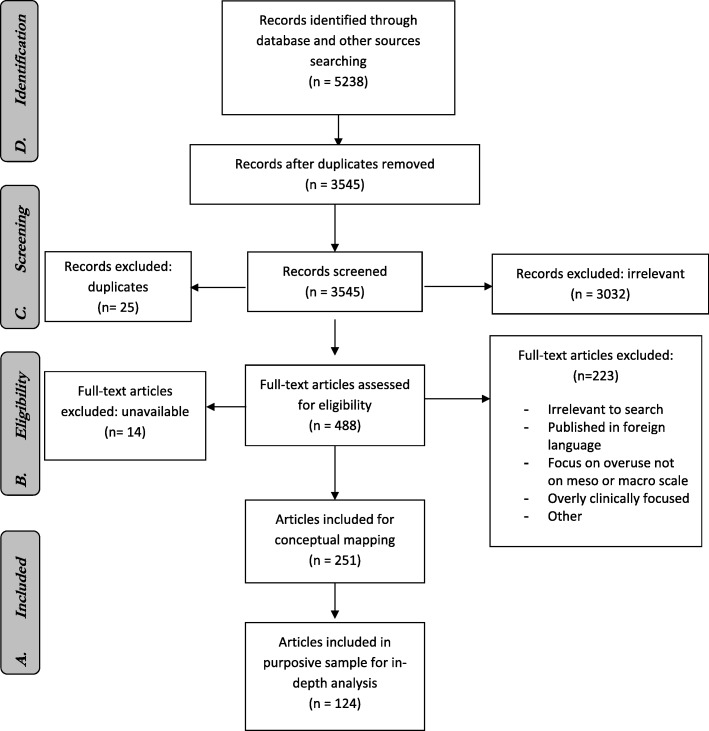
Our search identified 3545 references, from which we included 251. Most articles (76%; n = 192) were published within 5 years of conducting the review and addressed processes for addressing overuse (63%; n = 158) or political and health system context (60%; n = 151). Besides negative outcomes at the patient, system and global level, there were various contextual factors to addressing service overuse that seem to be key issue drivers. Processes for addressing overuse can be grouped into three elements comprising a comprehensive approach, including (1) approaches to identify overused health services, (2) stakeholder- or patient-led approaches and (3) government-led initiatives. Key implementation considerations include the need to develop 'buy in' from stakeholders and citizens.
Health systems want to ensure the use of high-value services to keep citizens healthy and avoid harm. Our synthesis can be used by policy-makers, stakeholders and researchers to understand how the issue has been prioritised, what approaches have been used to address it and implementation considerations.
PROSPERO CRD42014013204 .
医疗体系越来越关注医疗服务“过度使用”的问题及其应对方法。我们制定了一个框架,重点关注(1)医疗体系优先考虑解决过度使用问题的基本原理和背景,(2)减少过度使用的综合流程和方法的要素,以及(3)解决过度使用问题的实施注意事项。
我们开展了一项关键的解释性综合研究,并在此过程中征求了利益攸关方的意见。该综合研究确定了有关系统层面过度使用的相关实证和非实证文章。两名评审员独立筛选记录,评估纳入标准,并对纳入的文章进行概念性映射。在此基础上,我们选择了一个有针对性的样本,对关键发现进行了结构化总结,并对结果进行了主题综合。
我们的搜索共确定了 3545 篇参考文献,其中纳入了 251 篇。大多数文章(76%;n=192)是在进行综述后 5 年内发表的,内容涉及解决过度使用的流程(63%;n=158)或政治和医疗体系背景(60%;n=151)。除了在患者、体系和全球层面产生负面结果外,还有各种解决服务过度使用的背景因素,这些因素似乎是关键的问题驱动因素。解决过度使用的流程可分为三个要素,包括(1)识别过度使用的卫生服务的方法,(2)利益攸关方或患者主导的方法,以及(3)政府主导的举措。关键的实施注意事项包括需要获得利益攸关方和公民的“认同”。
医疗体系希望确保使用高价值的服务来保持公民健康并避免伤害。我们的综合研究可供政策制定者、利益攸关方和研究人员使用,以了解该问题是如何被优先考虑的,以及已经使用了哪些方法来解决该问题和实施的注意事项。
PROSPERO CRD42014013204。