Ellard Kristen K, Gosai Aishwarya G, Bernstein Emily E, Kaur Navneet, Sylvia Lousia G, Camprodon Joan A, Dougherty Darin D, Nierenberg Andrew A, Deckersbach Thilo
Dauten Family Center for Bipolar Treatment Innovation, Massachusetts General Hospital, 50 Staniford Street, Suite 580, Boston, MA 02114, United States.
Dauten Family Center for Bipolar Treatment Innovation, Massachusetts General Hospital, 50 Staniford Street, Suite 580, Boston, MA 02114, United States.
J Affect Disord. 2018 Oct 1;238:383-391. doi: 10.1016/j.jad.2018.06.002. Epub 2018 Jun 2.
Anxiety in bipolar disorder (BD) exacerbates emotion dysregulation and reduces treatment response. We recently conducted a pilot trial of transdiagnostic CBT to target anxiety and emotion dysregulation in BD adjunctive to pharmacotherapy. Reductions in depression and anxiety symptoms were significantly predicted by baseline levels of neuroticism and perceived affective control, as well as changes over time in emotion regulation skills. The present study investigates mechanism of treatment response by examining the relationship between baseline emotion regulation-related neural circuitry and trial outcomes.
Nineteen patients completed baseline resting state fMRI scans prior to treatment randomization. Functional connectivity between the anterior insula (AI) and regions in the salience network (SN), default mode network (DMN), and executive control network (ECN) were examined as predictors of baseline and treatment-related changes in emotion regulation.
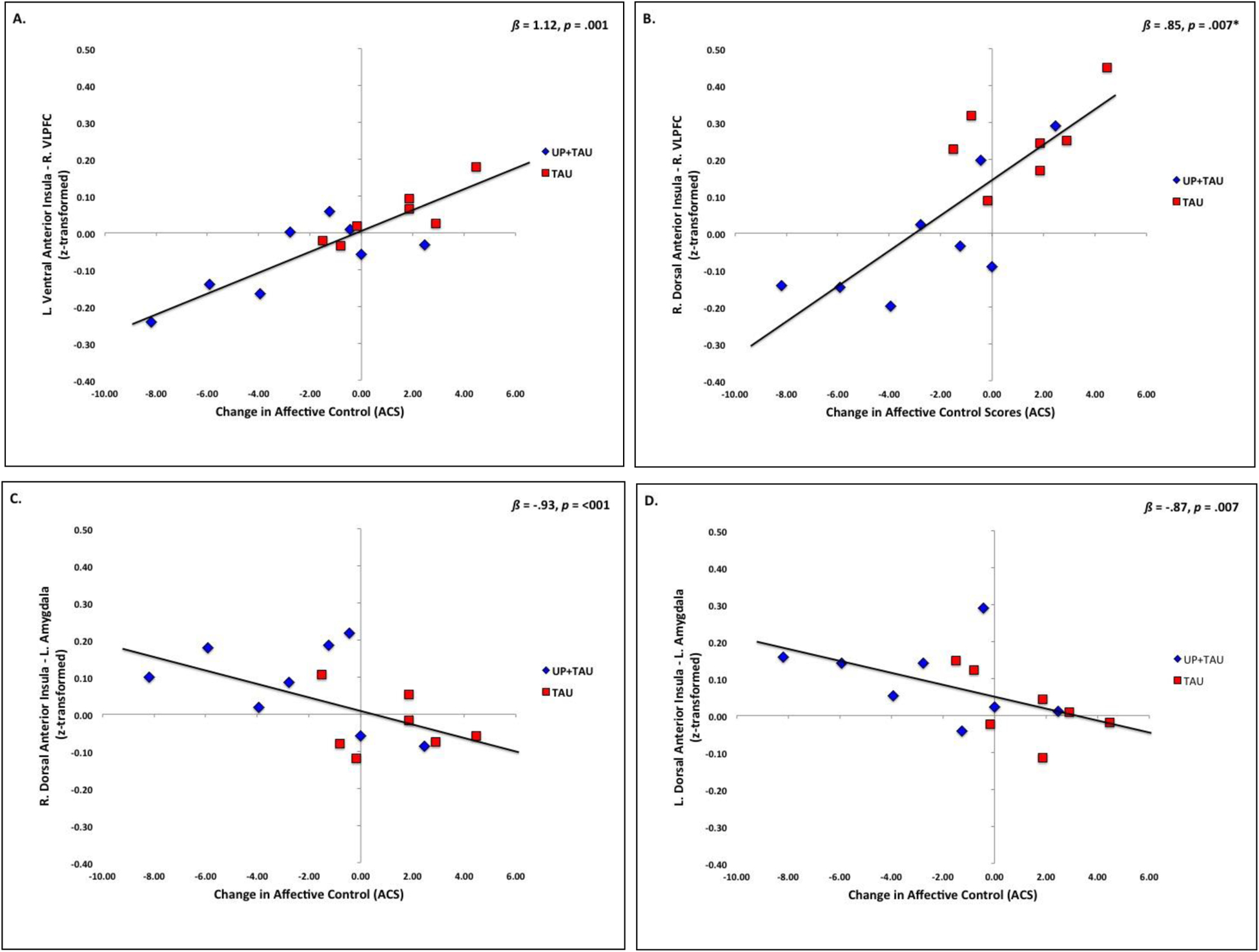
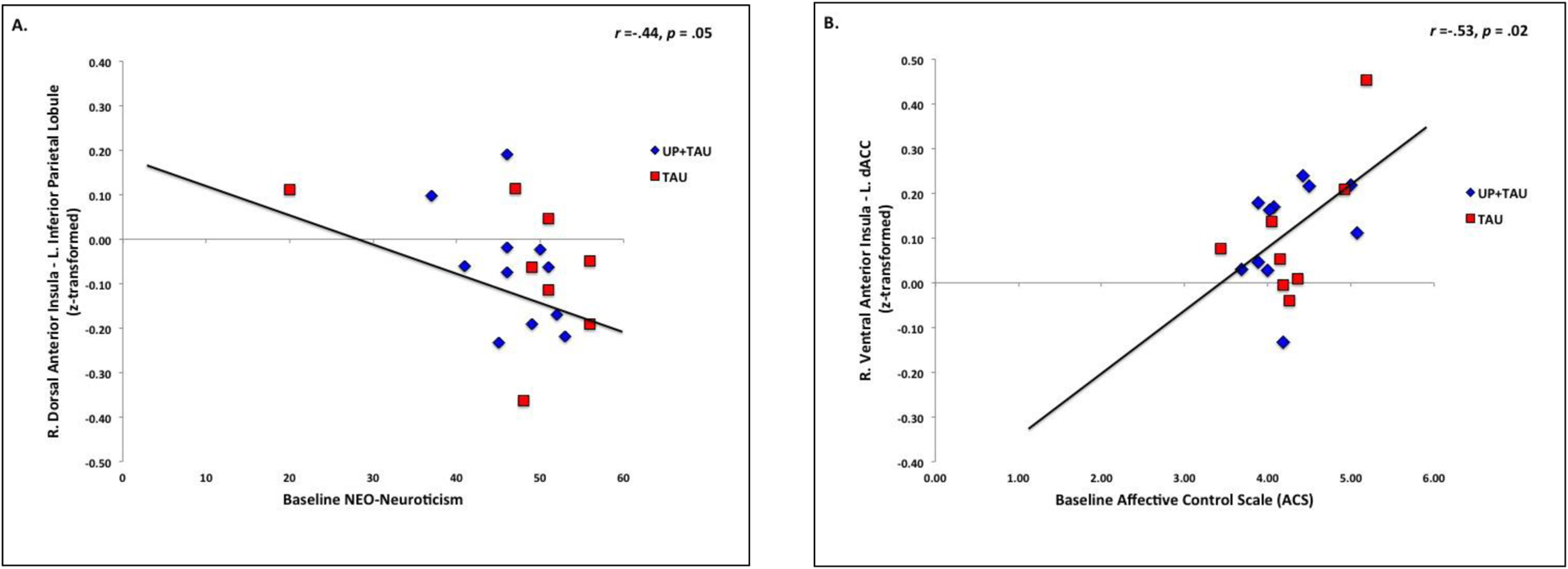
Greater improvements in emotion regulation were predicted by weaker right dorsal AI - right ventrolateral prefrontal cortex (VLPFC; SN) and stronger bilateral dorsal AI - bilateral amygdala functional connectivity. Baseline neuroticism was negatively correlated with right dorsal AI- inferior parietal lobule (ECN) functional connectivity, and baseline deficits in perceived affective control were positively associated with ventral AI - bilateral dACC (SN) connectivity.
Small sample limits interpretability of treatment-specific effects.
Baseline functional connectivity of emotion-regulation related neural circuitry significantly predicted change in emotion regulation-related dimensions associated with anxiety and depression symptom reduction. Future studies are needed to determine if employing methods such as neuromodulation to rehabilitate relevant neural circuitry may improve ultimate treatment outcomes of transdiagnostic CBT for BD and anxiety.
双相情感障碍(BD)中的焦虑会加剧情绪失调并降低治疗反应。我们最近进行了一项跨诊断认知行为疗法(CBT)的试点试验,以针对BD药物治疗辅助中的焦虑和情绪失调。抑郁和焦虑症状的减轻显著地由神经质的基线水平、感知到的情感控制以及情绪调节技能随时间的变化所预测。本研究通过检查基线情绪调节相关神经回路与试验结果之间的关系来探究治疗反应的机制。
19名患者在治疗随机分组前完成了基线静息态功能磁共振成像(fMRI)扫描。检查前脑岛(AI)与突显网络(SN)、默认模式网络(DMN)和执行控制网络(ECN)区域之间的功能连接,作为情绪调节基线和治疗相关变化的预测指标。
右侧背侧AI-右侧腹外侧前额叶皮层(VLPFC;SN)功能连接较弱以及双侧背侧AI-双侧杏仁核功能连接较强预示着情绪调节有更大改善。基线神经质与右侧背侧AI-顶下小叶(ECN)功能连接呈负相关,而感知情感控制的基线缺陷与腹侧AI-双侧背前扣带回(SN)连接呈正相关。
小样本限制了特定治疗效果的可解释性。
情绪调节相关神经回路的基线功能连接显著预测了与焦虑和抑郁症状减轻相关的情绪调节相关维度的变化。未来需要研究确定采用神经调节等方法来修复相关神经回路是否可以改善BD和焦虑跨诊断CBT的最终治疗结果。