School of Social and Community Medicine, University of Bristol, Bristol, UK.
School of Social and Community Medicine, University of Bristol, Bristol, UK.
Value Health. 2018 Jun;21(6):640-649. doi: 10.1016/j.jval.2017.06.011. Epub 2017 Sep 1.
Resource use measurement by patient recall is characterized by inconsistent methods and a lack of validation. A validated standardized resource use measure could increase data quality, improve comparability between studies, and reduce research burden.
To identify a minimum set of core resource use items that should be included in a standardized adult instrument for UK health economic evaluation from a provider perspective.
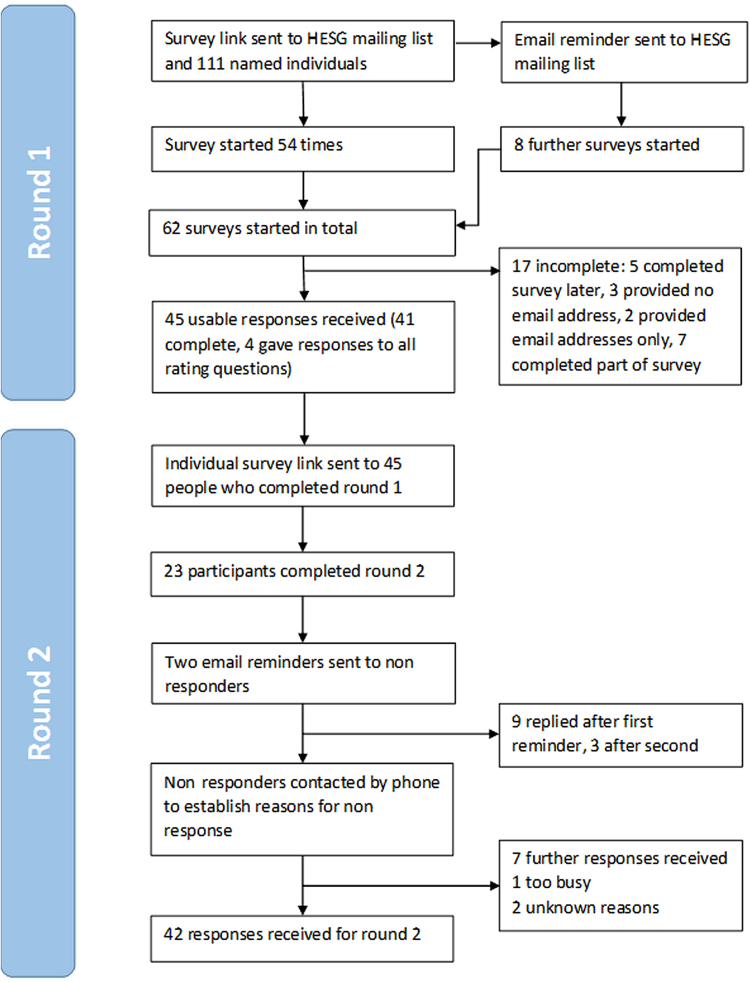
Health economists with experience of UK-based economic evaluations were recruited to participate in an electronic Delphi survey. Respondents were asked to rate 60 resource use items (e.g., medication names) on a scale of 1 to 9 according to the importance of the item in a generic context. Items considered less important according to predefined consensus criteria were dropped and a second survey was developed. In the second round, respondents received the median score and their own score from round 1 for each item alongside summarized comments and were asked to rerate items. A final project team meeting was held to determine the recommended core set.
Forty-five participants completed round 1. Twenty-six items were considered less important and were dropped, 34 items were retained for the second round, and no new items were added. Forty-two respondents (93.3%) completed round 2, and greater consensus was observed. After the final meeting, 10 core items were selected, with further items identified as suitable for "bolt-on" questionnaire modules.
The consensus on 10 items considered important in a generic context suggests that a standardized instrument for core resource use items is feasible.
患者回忆法测量资源利用具有方法不一致和缺乏验证的特点。经过验证的标准化资源利用测量方法可以提高数据质量,提高研究之间的可比性,并减少研究负担。
从提供者的角度确定一个最小的核心资源利用项目集,这些项目应包含在用于英国健康经济评估的标准化成人工具中。
招募具有英国经济评估经验的卫生经济学家参与电子德尔菲调查。受访者被要求根据项目在通用背景下的重要性,对 60 项资源利用项目(例如药物名称)进行 1 到 9 的评分。根据预设的共识标准,认为不重要的项目被删除,并制定了第二轮调查。在第二轮中,受访者收到了第一轮中每个项目的中位数得分和自己的得分,以及汇总的评论,并被要求重新评估项目。最后举行了一个项目团队会议,以确定推荐的核心集。
45 名参与者完成了第一轮。26 个项目被认为不太重要而被删除,34 个项目被保留用于第二轮,并且没有添加新的项目。42 名受访者(93.3%)完成了第二轮,并且观察到了更大的共识。经过最后一次会议,选择了 10 个核心项目,进一步确定了其他项目适合“附加”问卷模块。
在通用背景下认为重要的 10 个项目的共识表明,标准化的核心资源利用项目工具是可行的。